
Loc Dang 20 Aug 2026
Joint and Several Liability in Texas: How It Works
When multiple people or businesses contribute to an accident, figuring out who pays for your injuries can become complicated.
A crash may involve another driver, a trucking company, a vehicle owner, or another potentially responsible party. So if several parties share the blame, does each pay only their percentage—or can one defendant be responsible for the entire award?
Texas addresses these questions through Chapter 33 of the Texas Civil Practice and Remedies Code, which governs proportionate responsibility and, in certain circumstances, joint and several liability.
Quick answer
Texas generally holds each liable defendant responsible only for its own percentage of responsibility.
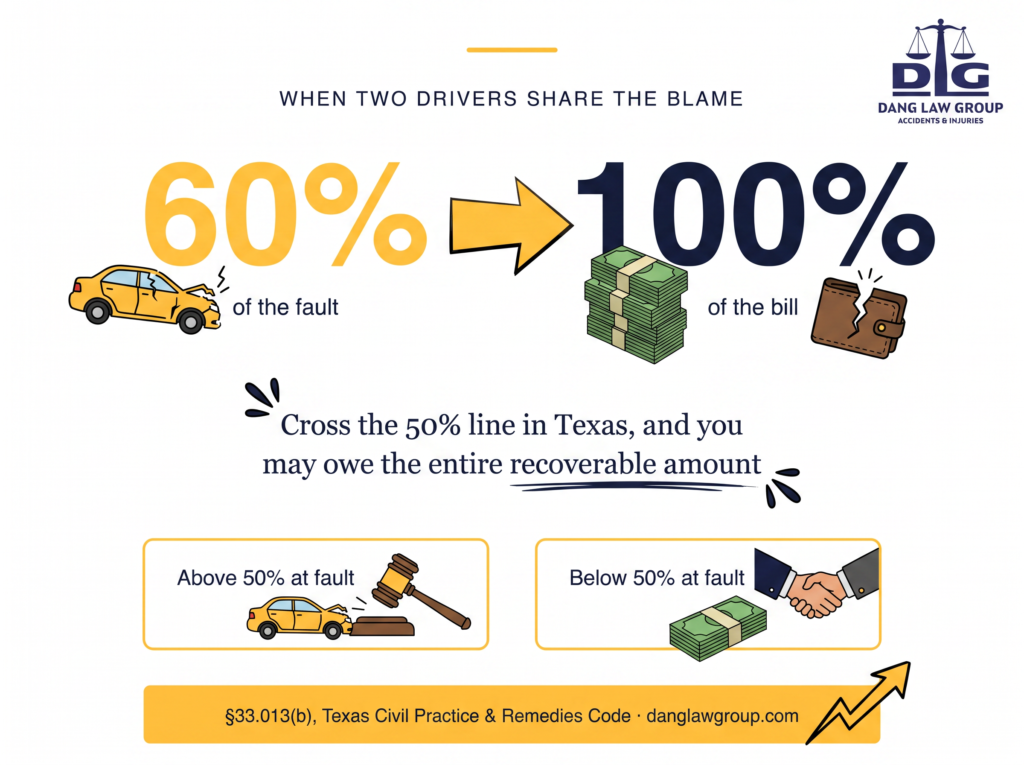
Under §33.013(b), however, a defendant found more than 50 percent responsible may be jointly and severally liable for the recoverable damages. A separate rule may apply to certain intentional conduct committed in concert with another person.
1. What Is Joint and Several Liability in Texas?
Joint and several liability means that, when the statutory requirements are met, one defendant may be responsible for the full damages recoverable by the injured person—not just that defendant’s percentage of fault.
This matters when multiple at-fault parties contributed to an injury.
For example, suppose a jury finds:
- Driver A: 60% responsible
- Driver B: 25% responsible
- Injured person: 15% responsible
If Driver A meets the requirements for joint and several liability under Texas law, Driver A may be responsible for the full recoverable damages rather than only 60%.
This differs from several liability, where a defendant is generally responsible for the percentage of damages corresponding to that defendant’s percentage of responsibility.
Joint and several vs. several liability
| Liability type | General rule |
|---|---|
| Several liability | A defendant is generally responsible only for its own assigned percentage of the damages. |
| Joint and several liability | A defendant meeting the statutory requirements may be responsible for the full recoverable damages. |
The distinction becomes especially important when another at-fault party has little insurance, few assets, or simply cannot pay its share. In that situation, whether a defendant is jointly and severally liable can decide whether you recover most of what you are owed or only a fraction of it.
How Does Proportionate Responsibility Work in Texas?
Texas uses proportionate responsibility to allocate fault among parties in cases covered by Chapter 33.
A jury or other trier of fact may assign percentages of responsibility to the claimant, defendants, settling persons, and properly designated responsible third parties.
For example:
- Defendant A: 40%
- Defendant B: 35%
- Defendant C: 15%
- Claimant: 10%
The claimant’s own percentage can reduce the damages recovered. The allocation can also affect whether a particular defendant meets the threshold for joint and several liability.
This can become especially important in a multi-vehicle accident
What Is the 51% Rule in Texas?
Texas is often described as having a 51% rule.
Under Texas Civil Practice and Remedies Code §33.001, a claimant cannot recover damages if the claimant’s percentage of responsibility is greater than 50%.
In simple terms:
- 50% or less responsible: You are not barred from recovery by §33.001, although your damages may be reduced according to your percentage of responsibility.
- More than 50% responsible: You are barred from recovering damages under §33.001.
For example, if you are found 30% responsible for an accident, your recovery may be reduced by that percentage.
If you are found 51% responsible, §33.001 bars recovery. Texas’s modified comparative fault rules also determine how your own percentage of responsibility affects the damages you may recover.
This rule makes fault allocation particularly important when an insurance company argues that the injured person contributed significantly to the accident.
When Does Joint and Several Liability Apply in Texas?
Under §33.013(a), the general rule is that a liable defendant is responsible for the percentage of damages corresponding to that defendant’s percentage of responsibility.
Section 33.013(b) provides an exception.

If you have suffered injuries, call Attorney Dang to give the insurance companies a Bang!

A defendant may be jointly and severally liable for the recoverable damages when:
- The defendant is more than 50% responsible for the cause of action; or
- The defendant falls within the statute’s separate provision concerning certain intentional conduct committed in concert with another person.
The greater-than-50% threshold is important.
For example:
- Defendant A: 50%
- Defendant B: 30%
- Claimant: 20%
Defendant A does not meet the >50% threshold based on percentage alone.
But if the allocation is:
- Defendant A: 55%
- Defendant B: 25%
- Claimant: 20%
Defendant A meets the percentage threshold described in §33.013(b)(1), subject to the applicable requirements of the claim and judgment.
What If One At-Fault Party Cannot Pay?
The difference between several and joint and several liability can become especially important when one responsible party cannot pay.
Under percentage-based liability, a defendant generally owes its assigned share. If that defendant has insufficient insurance or assets, collecting that portion can become difficult.
When joint and several liability applies, however, a qualifying defendant may be responsible for the full recoverable damages.
For example, suppose:
- Total recoverable damages: $500,000
- Defendant A: 60% responsible
- Defendant B: 40% responsible
If Defendant A is jointly and severally liable under §33.013(b), the claimant may have the ability to pursue the recoverable damages from Defendant A rather than being limited to Defendant A’s percentage alone.
Texas also provides rules governing contribution between defendants, including under §33.015.
In a multi-party case, identifying which defendant may be jointly and severally liable can affect not only the allocation of fault but also the practical ability to collect a judgment.
Common Misunderstandings
“One defendant always pays the entire judgment.”
No. Texas generally applies percentage-based liability. Joint and several liability is an exception that applies when the statutory requirements are met.
“If I am 50% at fault, I recover nothing.”
Not under §33.001 solely because of your percentage of responsibility. The statutory bar applies when your responsibility is greater than 50%. Your damages may still be reduced based on your percentage of responsibility.
“Only the defendants I sue can receive a percentage of fault.”
Not necessarily. Chapter 33 allows responsibility to be allocated to properly designated responsible third parties when the statutory requirements are satisfied.
“If another defendant cannot pay, I automatically have to absorb that loss.”
Not necessarily. Whether another party’s unpaid share affects your recovery depends on the type of liability that applies and the circumstances of the case.
Frequently Asked Questions
1. When is a defendant jointly and severally liable in Texas?
Under §33.013(b), a liable defendant may be jointly and severally liable when the defendant’s percentage of responsibility is greater than 50%. The statute also contains a separate provision addressing certain intentional conduct committed in concert with another person.
2. What is the 51% rule in Texas?
The 51% rule refers to §33.001. If a claimant is found to be more than 50% responsible, the claimant is barred from recovering damages in an action covered by that provision.
3. What is the difference between joint and several liability and several liability?
Under the general rule, a liable defendant is responsible for its percentage of the damages. When joint and several liability applies, a qualifying defendant may instead be responsible for the full recoverable damages.
4. What happens if an at-fault party cannot pay?
If a defendant is subject only to percentage-based liability, collecting that defendant’s unpaid share may be difficult. If another defendant is jointly and severally liable, the claimant may have a broader avenue for recovering the damages covered by that obligation.
Who Really Pays in a Multi-Party Texas Injury Case?
When several parties may have contributed to an accident, identifying who is at fault is only part of the analysis.
You also need to determine:
- how responsibility should be divided;
- whether your own fault affects your recovery;
- whether a responsible third party should be considered;
- whether any defendant exceeds the 50% threshold; and
- which parties may have sufficient insurance or assets to satisfy a judgment.
If you were injured in an Austin accident involving multiple potentially responsible parties, these issues can directly affect your potential recovery.
Learn more about your options with an experienced Austin car accident lawyer.
Information verified by lawyer Loc Dang
Loc Dang is a founder and member of our legal team. In this blog, Attorney Dang shares his expertise to guide accident victims.
CONTACT US
Where are we?
North Austin: 11442 N Interstate Hwy 35, Austin, TX 78753.South Austin: 2512 South IH 35, Suite 250, Austin TX 78704
You can contact us 24 hours a day if you have been in an accident and need legal help to fight for the maximum compensation you are legally entitled to. If you fill out this form , someone from our team will contact you.
 9 to 5pm
 512-973-8997