
Loc Dang 12 Sep 2026
What Happens If My Medical Bills Exceed the At-Fault Driver’s Insurance Limits in Texas?
When the other driver’s policy is too small to cover your losses, the policy limit may not be the end of the claim.
A serious car accident can create medical bills, lost income, future treatment costs, and other damages that quickly exceed the amount of liability insurance carried by the at-fault driver.
When that happens, many people assume the remaining loss becomes their responsibility.
That is not necessarily the case.
Quick answer
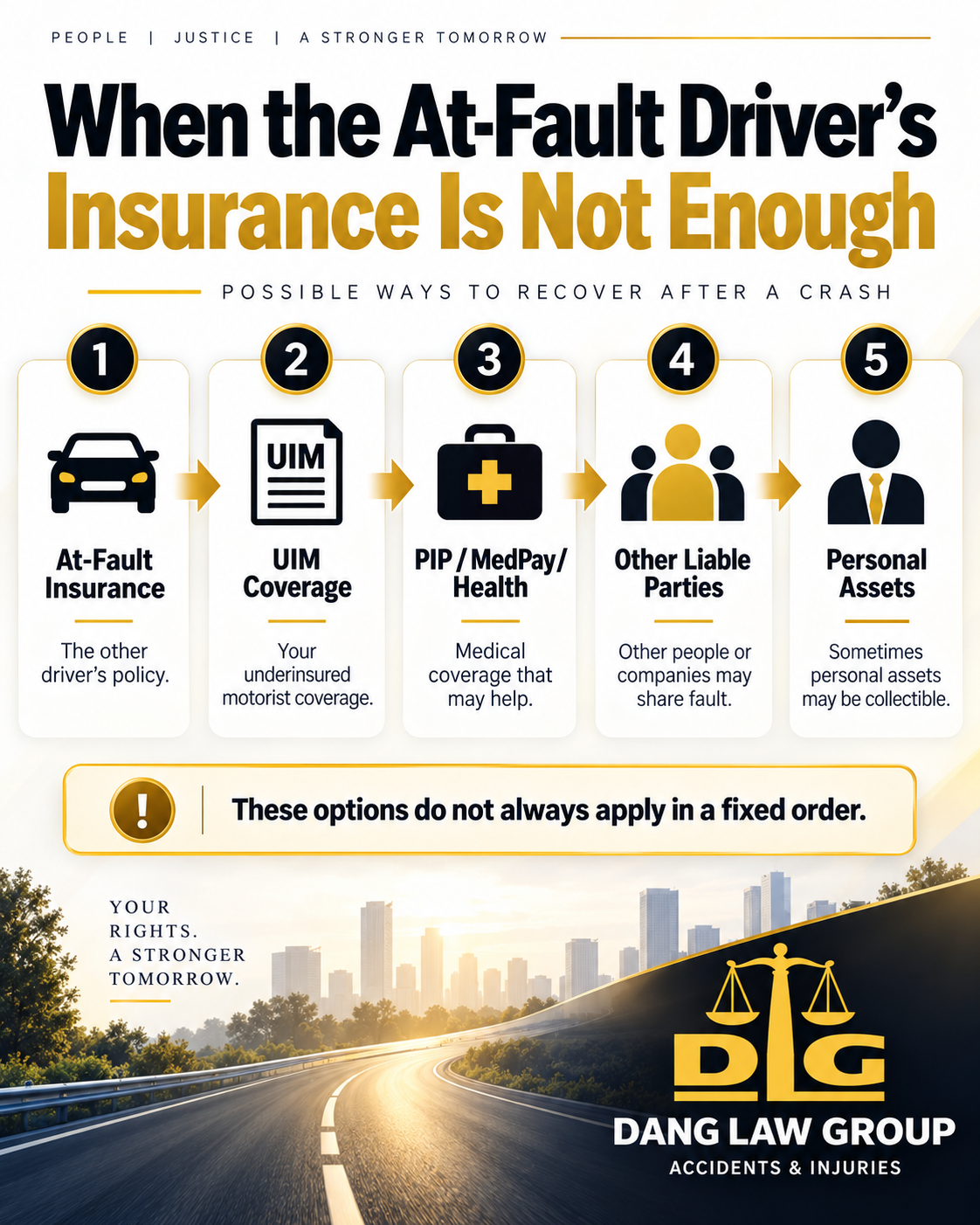
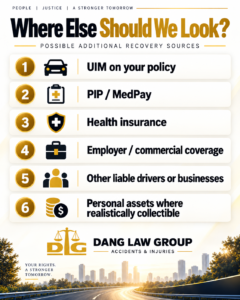
When the at-fault driver’s policy is not enough to cover your losses, other sources of recovery may include underinsured motorist coverage, PIP or MedPay, health insurance, additional liable parties, or in some cases the at-fault driver personally.
What If the At-Fault Driver’s Insurance Is Not Enough?
If your medical bills and other damages exceed the at-fault driver’s liability limits in Texas, the insurer generally will not pay more than the policy provides. However, other potential recovery sources may exist, including your own UIM coverage, first-party benefits, other legally responsible parties, and in some cases the at-fault driver personally.
The important distinction is that a policy limit is the maximum amount available under that particular policy.
It is not necessarily the maximum value of your claim.
For example, if your total damages are significantly greater than the available liability coverage, the remaining question becomes:
What other insurance, defendants, or benefits may legally apply?
Why Texas Minimum Liability Limits May Not Cover a Serious Injury
Texas law requires drivers to maintain minimum levels of financial responsibility.
Under Texas Transportation Code §601.072, the minimum required liability limits are commonly described as:
| Coverage type | Minimum required |
|---|---|
| Bodily injury, one person | $30,000 |
| Bodily injury, per accident | $60,000 |
| Property damage, per accident | $25,000 |
These are only the state minimums under the Texas Transportation Code. Serious injuries can exceed these limits quickly, and if the at-fault driver carries nothing more than the minimum, your own uninsured or underinsured motorist coverage may become the next source of recovery.
Those limits may be enough for a relatively minor crash.
They may be far less than the losses associated with:
- Hospitalization
- Surgery
- Diagnostic imaging
- Rehabilitation
- Ongoing specialist care
- Lost wages
- Reduced earning capacity
- Future medical treatment
Serious injuries can exceed minimum liability limits quickly.
If several people are injured in the same crash, the per-accident bodily injury limit must also be shared among eligible claims, which can reduce the amount available to each injured person.
How Can Underinsured Motorist Coverage Help?
Underinsured motorist, or UIM, coverage may provide an additional source of recovery when the at-fault driver has liability insurance but not enough to cover the damages you can prove.
In Texas, UM/UIM coverage is governed by the Texas Insurance Code, including §1952.101 and related provisions.
If you carry UIM coverage, it may apply when:
- The other driver is legally responsible
- The available liability coverage is insufficient
- Your damages exceed what has already been paid or credited
- The requirements of your own policy and Texas law are satisfied
UIM coverage does not automatically pay the difference between your bills and the other driver’s policy limit.
The amount available may depend on:
- Your UIM policy limits
- The damages you can establish
- Amounts already recovered
- Applicable offsets
- Policy conditions
- Notice or consent requirements
- The legal and factual basis of the underlying claim
How Do I Know If I Have UIM Coverage?
Check your auto insurance declarations page and policy documents.
Texas insurers generally offer UM/UIM coverage, although the exact coverage available depends on the policy and whether coverage was validly rejected or limited.
Do not assume you have or do not have UIM based only on memory.
Review the actual policy.
Could Another Person or Company Also Be Liable?
Sometimes the at-fault driver is not the only legally responsible party.
Depending on how the crash occurred, another person or business may also be liable.
Examples can include:
- An employer whose employee caused the crash while acting within the scope of employment
- A commercial trucking company
- A vehicle owner in certain negligent-entrustment situations
- A rideshare or delivery company, depending on the applicable facts and insurance structure
- A business that may be liable under Texas dram shop law
- A manufacturer in a product-defect case
- Another driver who contributed to a multi-vehicle collision
This does not mean another defendant exists in every case.
But when damages substantially exceed one driver’s policy limits, identifying all potentially responsible parties becomes especially important.
Can You Pursue the At-Fault Driver Personally?
The at-fault driver may remain personally liable for damages that exceed available insurance, depending on the claims, defenses, and judgment entered.

If you have suffered injuries, call Attorney Dang to give the insurance companies a Bang!
But personal liability and actual collectibility are not the same thing.
Even if a judgment exceeds insurance limits, collection may be limited if the defendant has few non-exempt assets or limited income.
Texas law also protects certain categories of property from judgment collection.
That is why pursuing a driver personally requires a practical evaluation of:
- Available assets
- Exempt versus non-exempt property
- Income
- Other judgments or liens
- Cost of litigation
- Likelihood of actual collection
For some defendants, pursuing personal assets may be meaningful.
For others, insurance and other liable parties are far more realistic sources of recovery.
What Other Sources May Help Cover the Gap?
Available payment and recovery sources do not always apply in one fixed order.
Several may operate at the same time, while others may require separate claims or procedures.
Potential sources include:
- The At-Fault Driver’s Liability Coverage: This is usually the first liability source considered, but the insurer is generally limited by the policy’s coverage limits.
- Your UIM Coverage: If applicable, UIM may provide additional recovery when the other driver is underinsured.
- Personal Injury Protection or MedPay: If included in your policy, these first-party benefits may help with certain medical costs regardless of fault, subject to the terms of the coverage.
- Health Insurance: Health insurance may pay medical providers while the liability claim remains unresolved, although liens, reimbursement, or subrogation issues can arise later.
- Other Liable Parties: Additional defendants may provide separate insurance or assets if the facts support legal responsibility.
- The At-Fault Driver Personally: Personal recovery may be possible in some cases, but collectibility must be evaluated realistically.
For a deeper explanation of PIP, MedPay, health insurance, and medical-bill payment after a crash, see Dang Law Group’s guide on who pays your medical bills after a Texas car accident.
Example: A Serious Injury Exceeds a $30,000 Liability Limit
Assume Daniel is injured in an Austin crash caused by another driver.
The at-fault driver carries only the minimum bodily injury liability limit.
Daniel later has:
- Emergency treatment
- An MRI
- Specialist care
- Physical therapy
- Missed work
- Possible future treatment
His total losses exceed the amount available under the at-fault driver’s policy.
The liability insurer’s policy limit does not automatically determine the total value of Daniel’s claim.
His next steps may include reviewing:
- Whether he has UIM coverage
- Whether PIP or MedPay applies
- Whether another party may share liability
- How health insurance payments affect the claim
- Whether pursuing the at-fault driver personally is realistic
The specific answer depends on the policies and facts involved.
Common Mistakes to Avoid
- Assuming the At-Fault Insurer Must Pay the Full Value of the Claim: An insurer generally is not obligated to pay beyond the coverage provided by the policy simply because the claimant’s damages are higher.
- Not Checking Your Own UIM Coverage: People sometimes focus entirely on the other driver’s insurance and overlook coverage available under their own policy.
- Assuming UIM Automatically Pays the Difference: UIM is not simply an automatic gap-filler. Coverage and recovery depend on policy terms, proof of damages, applicable offsets, and Texas law.
- Signing a Policy-Limits Release Too Quickly: Before accepting a policy-limits settlement or signing a release, review how the agreement could affect any UIM claim or other recovery source. Policy language, consent requirements, releases, and preservation of rights can matter.
- Ignoring Other Potentially Liable Parties: A driver may be the most obvious defendant without being the only one. This is especially important in commercial, rideshare, employer-related, and multi-vehicle crashes.
- Waiting Too Long to Review Coverage: Insurance policies may impose notice and cooperation requirements, while legal claims are subject to filing deadlines. Delay can complicate the claim even when valid coverage exists.
When Can a Lawyer Help?
A lawyer may be especially useful when your damages exceed the available liability insurance because the case becomes less about one claim and more about identifying every legally available source of recovery.
A lawyer can help:
- Confirm applicable policy limits
- Review your UM/UIM coverage
- Evaluate policy requirements
- Identify other potentially liable parties
- Analyze releases before settlement
- Address liens or reimbursement issues
- Evaluate whether personal collection is realistic
- Coordinate claims involving multiple insurers
No lawyer can create insurance coverage or collectible assets that do not exist.
The value of legal review is in identifying what is actually available and avoiding steps that unnecessarily reduce those options.
Frequently Asked Questions
What happens if the at-fault driver’s insurance does not cover all my medical bills in Texas?
If the at-fault driver’s liability limits are insufficient, other sources may include your own UIM coverage, PIP or MedPay, health insurance, other liable parties, or in some cases the at-fault driver personally. Which options apply depends on the facts, insurance policies, and damages involved.
Does UIM automatically pay everything the other driver’s insurance does not?
No. UIM coverage may provide additional recovery, but it does not automatically pay every unpaid bill or dollar of damages. Coverage depends on your policy limits, applicable terms, offsets, and the amount of legally recoverable damages.
Can I sue the at-fault driver personally if their insurance runs out?
Potentially. The driver may remain personally liable for damages beyond insurance limits, but whether a judgment can actually be collected depends on available non-exempt assets, income, and other collection factors.
Can there be more insurance than the other driver’s personal auto policy?
Yes. Depending on the facts, additional coverage may exist through an employer, commercial policy, rideshare arrangement, vehicle owner, or another liable party. Every case is different.
Should I accept the at-fault driver’s policy-limits offer?
A policy-limits offer may be appropriate in some cases, but review the release and how settlement could affect UIM coverage or claims against other parties before signing. The consequences can depend on policy language and the specific agreement.
The Policy Limit May Not Be the End of the Claim
Learning that the at-fault driver does not carry enough insurance can be frustrating, especially when your medical bills and lost income continue to grow.
But the liability policy is only one potential source.
Depending on the circumstances, your claim may also involve UIM coverage, first-party benefits, health insurance, other liable parties, or personal liability beyond insurance.
If your medical bills exceed the at-fault driver’s insurance limits after an Austin car accident, Dang Law Group can review the available coverage, identify potentially responsible parties, and explain which recovery options may apply to your case.
Contact Dang Law Group to discuss your options before signing a policy-limits release.
Information verified by lawyer Loc Dang
Loc Dang is a founder and member of our legal team. In this blog, Attorney Dang shares his expertise to guide accident victims.
CONTACT US
Where are we?
North Austin: 11442 N Interstate Hwy 35, Austin, TX 78753.South Austin: 2512 South IH 35, Suite 250, Austin TX 78704
You can contact us 24 hours a day if you have been in an accident and need legal help to fight for the maximum compensation you are legally entitled to. If you fill out this form , someone from our team will contact you.
 9 to 5pm
 512-973-8997