
Loc Dang 9 Sep 2026
Can I Refuse to Give a Recorded Statement to the Insurance Company in Texas?
Whether you can say no depends on which insurer is asking – and the difference can affect how your claim is handled.
A few days after your accident, the phone rings. An insurance adjuster says they just need a few minutes to record your version of what happened. The request may sound routine, but before you agree, it is important to know who is asking and what obligations actually apply to you.
In Texas, the answer is usually different depending on whether the request comes from the other driver’s insurance company or your own insurer. That distinction can affect whether you may decline, whether your policy requires cooperation, and how carefully you should prepare before speaking on the record.
1. Can You Refuse a Recorded Statement in Texas?
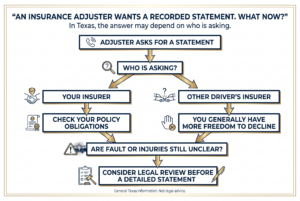
In Texas, you generally do not have to give the other driver’s insurance company a recorded statement. Your own insurer is different because your policy may include a duty to cooperate with its investigation. Before refusing any request, identify which insurer is asking and review what your policy requires.
If the other driver’s insurer is requesting the statement, you can generally decline politely or ask whether questions can be provided in writing. If your own insurer is asking, it is better to review your policy obligations before refusing outright.
That one distinction – your insurer versus the other driver’s insurer – drives much of what comes next.
2. The At-Fault Driver’s Insurer vs. Your Own Insurer
The two insurers do not stand in the same relationship to you.
The other driver’s insurer
You are not that company’s policyholder, so you generally do not owe it the same contractual cooperation duties that may apply under your own policy. A third-party insurer may ask for a recorded statement as part of its investigation, but that does not necessarily mean you are legally required to give one.
There is usually no need to agree immediately. You can ask who the adjuster represents, what information is being requested, and whether you may respond in another format.
Your own insurer
Your policy may contain a cooperation clause requiring you to assist with the investigation of a covered claim. Depending on the policy and type of coverage involved, refusing every request without reviewing your obligations could create coverage issues.
That does not mean you must answer every question immediately or without preparation. You may be able to schedule the interview, review relevant records first, or have counsel involved when appropriate.
3. Why Does the Insurance Company Want a Recorded Statement?
An adjuster’s role is to investigate and evaluate the claim on behalf of the insurance company. That means the questions are designed to help the insurer assess liability, injuries, damages, and potential exposure — not to give you legal advice or protect your interests.
A recorded statement can help the insurer:
- Create an early record of your account: Your statement may later be compared with police reports, photographs, medical records, or testimony.
- Evaluate inconsistencies: Differences between your early statement and later evidence may be examined when the insurer evaluates credibility.
- Assess fault: Statements about speed, visibility, braking, lane position, or what you saw can affect the insurer’s view of responsibility.
- Evaluate injuries: Early descriptions of pain or symptoms may later be compared with medical treatment and diagnostic findings.
The concern is not that every recorded statement is harmful. The concern is that people often answer questions before they know the full facts, before injuries have fully developed, or while they are still trying to remember a stressful event.
4. How Can a Recorded Statement Affect Your Claim?
A recorded statement may become part of the insurer’s evaluation of both liability and damages.
Statements About Fault
Texas uses a modified comparative-responsibility system under Chapter 33 of the Texas Civil Practice and Remedies Code. Section 33.001 generally bars recovery when a claimant is more than 50% responsible, while Section 33.012 generally reduces recoverable damages in proportion to the claimant’s percentage of responsibility.
That means statements about how the crash happened can matter.
A casual comment such as:
“I didn’t see the other car until the last second.”
may be interpreted differently depending on the surrounding facts.
An apology does not automatically establish legal fault, but insurers may evaluate the wording alongside other evidence.
Statements About Injuries
A person may feel relatively normal immediately after a crash and develop symptoms later. If you say, “I’m fine,” an insurer may later compare that statement with medical records showing neck pain, back pain, headaches, or other symptoms that appeared afterward.
If you do not yet know the full extent of your injuries, it is better to say that than to minimize or speculate.
Estimates and Guessing
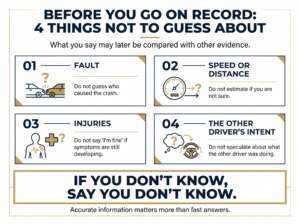
Questions about speed, distance, timing, or vehicle position can be difficult to answer accurately after a collision.
If you do not know, say you do not know.
Guessing can create unnecessary inconsistencies if later evidence shows something different.
5. What Should You Do When an Adjuster Asks for a Recorded Statement?
Use this decision path before going on the record.
Step 1: Ask who is calling
Confirm the adjuster’s name, insurance company, claim number, and whether they represent your insurer or the other driver’s insurer.
Step 2: Ask whether the call is being recorded
Do not assume a conversation is informal. Confirm whether the adjuster intends to record the interview.
Step 3: If it is the other driver’s insurer, do not feel pressured to answer immediately
You can generally decline the recorded statement while you decide whether giving one is appropriate for your situation.
A simple response may be:
“I’m not prepared to give a recorded statement at this time.”
Step 4: If it is your own insurer, review your policy obligations
Your policy may require cooperation. Ask whether the statement is required under a specific policy provision and whether the interview can be scheduled for a later time.
Step 5: Do not guess or speculate
Describe only what you actually know.

If you have suffered injuries, call Attorney Dang to give the insurance companies a Bang!

Do not guess about:
- fault
- speed
- distance
- medical prognosis
- whether your symptoms will improve
- what another driver intended to do
Step 6: If your injuries are still developing, say so
If you are still being evaluated or do not yet know the full extent of your condition, say that rather than minimizing your injuries.
Step 7: Pause if the claim is serious or disputed
If the crash involves significant injuries, disputed fault, multiple vehicles, commercial drivers, or policy-limit issues, it may make sense to speak with a lawyer before giving a detailed recorded statement.
6. Common Mistakes People Make
Treating Both Insurers the Same
People often assume that because their own insurer may require cooperation, the other driver’s insurer has the same authority.
That is not necessarily true.
Speaking Before They Understand Their Injuries
Some injuries become more noticeable hours or days after a crash. Giving a definitive statement too early can create unnecessary confusion later.
Guessing About Fault
It is better to say, “I don’t know,” than to estimate speed, distance, timing, or blame.
Minimizing Symptoms
Avoid saying you are “fine” simply to be polite if you are still sore, shaken, or unsure how you feel.
Assuming Refusal Automatically Ends the Claim
Declining a third-party insurer’s recorded statement does not automatically mean you lose the right to pursue compensation.
Trying to Correct the Record With Another Unprepared Call
If you already gave a statement and later realize something was inaccurate, do not create multiple conflicting versions of events. Preserve what was said and address any material issue carefully.
7. What If I Already Gave a Recorded Statement?
Giving a recorded statement does not automatically destroy your claim.
If you later realize that something you said was incomplete or inaccurate, the importance of the issue depends on what was said and how it relates to the evidence.
A minor estimate about distance may matter less than a statement about:
- who had the right of way
- whether you were injured
- whether you had prior pain
- whether you were distracted
- whether you saw the other vehicle before impact
If the statement concerns a significant issue, it may be useful to get legal advice before trying to correct it.
8. Example: Saying “I’m Fine” Before Symptoms Appear
Maria is rear-ended in Austin. The next morning, the other driver’s adjuster calls and asks whether she is injured.
Maria says:
“I think I’m okay.”
Two days later, she develops persistent neck pain and seeks medical evaluation.
Her early statement does not automatically decide the claim. But the insurer may compare what she said with later medical records.
That is why timelines, medical documentation, and accurate explanations matter.
9. When Can a Lawyer Help With a Recorded Statement?
You do not need a lawyer for every insurance phone call.
Legal help may be more valuable when:
- you suffered significant injuries
- fault is disputed
- multiple parties may be responsible
- the insurer is questioning your credibility
- a commercial vehicle was involved
- policy limits may be an issue
- your own insurer is requesting a statement under a specific coverage provision
A lawyer can communicate with the insurer, help you understand whether a statement is required, prepare you for questions, review the known evidence, and participate in the process when appropriate.
The goal is not to avoid legitimate cooperation. It is to make sure you understand what you are being asked to provide and why.
10. Texas Legal Sources
- Texas Civil Practice and Remedies Code §33.001 — generally bars recovery when a claimant is more than 50% responsible.
- Texas Civil Practice and Remedies Code §33.012 — generally reduces recoverable damages based on the claimant’s percentage of responsibility.
- Applicable automobile insurance policy — cooperation, notice, statement, and investigation obligations depend on the actual policy language and coverage involved.
Attorney review should confirm the applicable insurance-policy provisions and any Texas case law used before publication.
11. Frequently Asked Questions
Do I have to give the other driver’s insurance company a recorded statement in Texas?
Generally, you are not required to give the other driver’s insurer a recorded statement simply because an adjuster asks for one. You can usually decline while you decide whether providing a statement is appropriate.
Can my own insurance company deny my claim if I refuse a recorded statement?
Possibly, depending on your policy and the coverage involved. Your policy may contain cooperation requirements, so refusing your own insurer’s request without reviewing the policy can create risk.
What if the adjuster says the recorded statement is required?
Ask which insurer they represent and, if it is your own insurer, which policy provision requires the statement. If it is the other driver’s liability insurer, ask the adjuster to explain the basis for saying the statement is mandatory before agreeing.
What happens if I already gave a recorded statement?
One recorded statement does not automatically decide your claim. If you later realize that something you said was inaccurate or incomplete, preserve the statement if possible and consider getting advice before attempting to correct a material issue.
Can I ask the insurance company to send questions in writing?
You can ask. Whether the insurer agrees may depend on the claim and the policy involved. Written questions may give you more time to provide accurate information without guessing.
12. Protect Your Words Before You Speak
A recorded statement may seem routine, but what you say can become part of the insurer’s evaluation of fault, injuries, and damages.
In Texas, you generally have more freedom to decline a recorded statement from the other driver’s insurer than from your own insurer, where policy cooperation duties may apply.
If an adjuster is requesting a recorded statement after an Austin car accident and you are unsure what your policy requires, Dang Law Group can review the situation and communicate with the insurer when appropriate.
Contact Dang Law Group before going on the record if you want help understanding your options.
Information verified by lawyer Loc Dang
Loc Dang is a founder and member of our legal team. In this blog, Attorney Dang shares his expertise to guide accident victims.
CONTACT US
Where are we?
North Austin: 11442 N Interstate Hwy 35, Austin, TX 78753.South Austin: 2512 South IH 35, Suite 250, Austin TX 78704
You can contact us 24 hours a day if you have been in an accident and need legal help to fight for the maximum compensation you are legally entitled to. If you fill out this form , someone from our team will contact you.
 9 to 5pm
 512-973-8997