
Loc Dang 27 Sep 2026
Will My Insurance Rates Go Up After a Not-at-Fault Accident in Texas?
You did not run the light. You did not cause the collision. Then your renewal arrives and the premium is higher, and it is natural to connect the two events.
Texas has specific rules about how insurers can treat a not-at-fault accident, and a higher premium does not automatically mean you were charged for causing the crash. Understanding the difference is what tells you whether to dispute the increase or look elsewhere for the reason.
Will Your Insurance Rates Go Up After a Not-at-Fault Accident in Texas?
Short answer
Yes, your premium can still go up after a not-at-fault accident in Texas, but that does not mean the accident caused the increase. Under Texas rules, your insurer generally cannot refuse to renew your policy solely because of a crash you clearly did not cause. Premiums can still change for other reasons, so ask how the accident was classified.
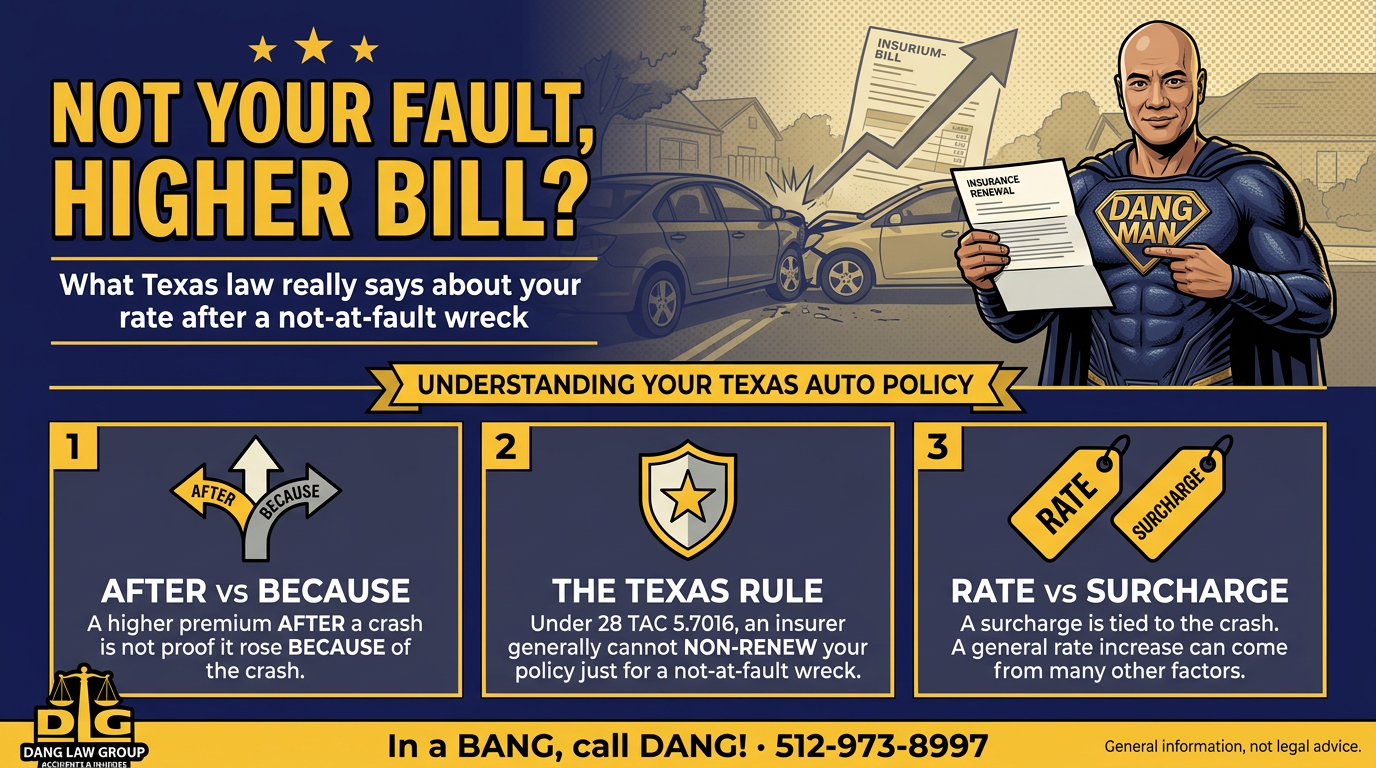
A higher premium after a crash is not the same as a higher premium because of that crash. The useful question is not whether your rate went up after the accident. It is what specifically caused the increase, and how the insurer classified the accident. If your renewal rises, ask the insurer whether the accident was used in the calculation, how it was classified, whether a specific accident surcharge was applied, and what other rating factors changed.
What Is the Difference Between a Rate Increase and an Accident Surcharge?
An accident surcharge is a pricing adjustment tied specifically to a crash or driving event. A general renewal increase is broader. Your premium can move because of carrier-wide rates, vehicle costs, location, coverage selections, household drivers, lost discounts, or other rating factors.
That is why these two statements are not the same thing:
| What it describes | What the statement means |
|---|---|
| Timing | My premium increased after the crash. The increase simply happened to follow the accident. |
| Causation | My insurer increased my premium because it treated me as responsible for the crash. The accident itself drove the change. |
Before disputing an increase, work out which one actually occurred. The first may have nothing to do with the crash at all.
What Does Texas Law Say About Not-at-Fault Accidents?
Texas regulates how an auto insurer can respond to a not-at-fault accident, though the protection is narrower than many drivers assume.
Under 28 Texas Administrative Code § 5.7016, an insurer generally may not refuse to renew a personal auto policy using a not-at-fault accident as the sole basis. Nonrenewal means the carrier declines to continue your policy when the term ends. The rule protects accidents in which an insured cannot reasonably be considered to be at fault, along with certain weather, animal, and flying-object claims. In plain terms, a crash that was clearly not your fault generally cannot, by itself, cost you your policy at renewal. The protection has limits, though: it does not apply when there are two or more such claims or accidents in any 12-month period.
What the rule does not do is prohibit every premium change. Section 5.7016 addresses nonrenewal, not surcharges or broad rate increases. So an insurer that cannot drop you may still adjust your premium through lawful rating factors. That gap is exactly why the classification of your accident matters so much.
Insurance Rating and Civil Liability Are Not the Same Thing
A civil injury claim and an insurance-rating decision run on two different legal tracks, and confusing them leads to bad assumptions.
Texas proportionate-responsibility law, under Chapter 33 of the Texas Civil Practice and Remedies Code, governs how fault reduces or bars what you can recover in a civil claim. Premium calculations are governed separately, by insurance regulation, the carrier’s approved rating plan, your policy, and underwriting practices.
Key point
An insurer’s internal classification of an accident is not the same as a court’s legal allocation of responsibility. One decides how a claim is priced. The other decides how damages are recovered.
Treating the insurer’s label as a final legal ruling is a common and costly mistake.
Who Decides Whether an Accident Was Not at Fault?
There is no single decision-maker whose conclusion controls every purpose. Fault can be assessed differently by different parties, drawing on:
- The police report. Important evidence, but it does not by itself decide legal liability.
- The insurer’s claim investigation. This produces the internal classification used for the claim, not a court ruling.
- Physical and witness evidence. Photos, vehicle damage, video, and witness statements.
- Civil litigation findings. These exist only if the matter reaches that stage.
If you believe the accident was recorded incorrectly, ask the insurer how the loss was classified, what evidence supported that classification, whether it affects premium or underwriting, and what process exists to dispute or correct it.

If you have suffered injuries, call Attorney Dang to give the insurance companies a Bang!

Why Can Your Premium Still Change After a Not-at-Fault Crash?
Even when an accident is not being treated as your fault, your renewal can still move for reasons that have little or nothing to do with the crash:
- Carrier-wide rate changes. Approved pricing changes applied to a large group of policyholders, driven by repair costs, vehicle values, claim-severity trends, or regional losses.
- Coverage changes. Raising or lowering limits, changing deductibles, adding coverage, or losing a discount.
- Vehicle changes. A newer or harder-to-repair vehicle can cost more to insure.
- Address or territory changes. Location influences risk and claim costs.
- Household-driver changes. Adding a driver or changing who regularly drives.
- A separate driving event. A ticket or other incident unrelated to the not-at-fault crash.
If you want to know whether the crash itself affected your premium, ask the carrier directly rather than assuming it from timing alone.
What Should You Do If Your Rate Goes Up After a Not-at-Fault Accident?
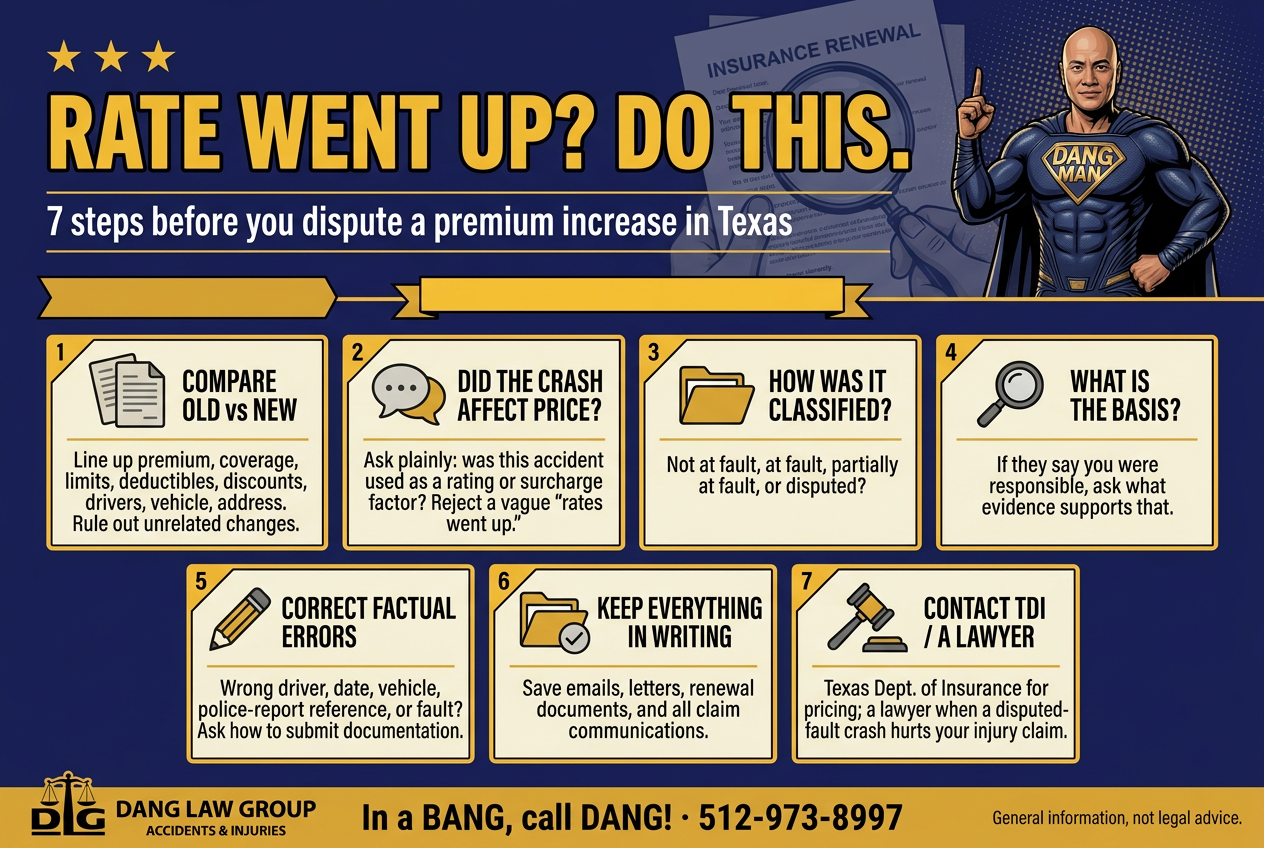
Work the problem in order instead of assuming the worst:
- Compare the renewal with the prior policyLine up total premium, coverages, limits, deductibles, discounts, listed drivers, vehicles, and address. Make sure the increase is not explained by an unrelated change.
- Ask whether the accident affected the priceAsk plainly whether this accident was used as a rating or surcharge factor on your renewal. Do not accept a vague answer about rates going up generally.
- Ask how the accident was classifiedNot at fault, at fault, partially at fault, or disputed.
- Ask for the basis of the classificationIf the insurer says you were responsible, ask what evidence supports that.
- Correct factual errorsIf the file has the wrong driver, date, vehicle, police-report reference, or fault description, ask how to submit supporting documentation.
- Keep everything in writingSave emails, letters, renewal documents, and claim communications.
- Contact the Texas Department of Insurance if neededIf a carrier is applying a rating practice incorrectly, or cannot explain the basis for an increase, the Texas Department of Insurance is a regulatory resource for consumers.
Does Partial Fault or Filing a Claim Automatically Raise Your Rates?
Not automatically, and the reasons trace back to the two-track distinction above.
On partial fault, under Texas Civil Practice and Remedies Code § 33.001, a claimant generally cannot recover damages if found more than 50 percent responsible, and under § 33.012, recoverable damages are generally reduced by the claimant’s percentage of responsibility. Those provisions affect civil recovery. They do not, by themselves, dictate how your insurer must rate a partially disputed accident.
On filing a claim, simply reporting or filing does not prove that the claim caused a later premium change. A carrier may hold information about prior losses, but whether and how that affects rating depends on applicable law and the insurer’s practices. If your rate rises, ask whether the claim itself was used as a factor, or whether something else changed.
Common Mistakes People Make
When fault is disputed, small assumptions can cost real money. The frequent errors:
- Assuming every increase is an accident surcharge. A renewal can rise for reasons unrelated to the crash.
- Assuming a not-at-fault crash means nothing can change. Section 5.7016 protects your renewal, not every rating factor.
- Accepting an incorrect classification without asking why. If the insurer assigns you fault, ask what evidence supports it.
- Failing to compare the old and new policy. The difference is often coverage, vehicle, address, or a lost discount.
If you were hit by another driver and fault is being disputed, an experienced Austin car accident lawyer can help develop the crash evidence and address the underlying liability dispute, which is often what the premium question really turns on. You can also read more about how Texas comparative fault works when responsibility is shared.
When Can a Lawyer Help?
Most premium questions can start with your insurer or the Texas Department of Insurance. A personal injury lawyer becomes more relevant when the premium issue is tied to a broader dispute about how the crash happened, for example when the insurer is assigning you fault you dispute, the same fault determination is reducing your injury claim, another insurer denies liability, significant injuries are involved, or evidence needs to be preserved.
A lawyer can help develop the evidence surrounding the accident and address the underlying liability dispute. The goal is to protect the injury claim and clarify the record, not to promise a particular insurance premium. If your insurer has denied or undervalued the claim itself, the steps in what to do when the insurance company denies your claim may also help.
Frequently Asked Questions
Why did my premium increase after a wreck I did not cause?
The increase may come from a carrier-wide rate change, coverage or vehicle changes, location, household drivers, a separate driving event, or how the accident was classified. Ask the insurer for the specific reason rather than assuming the crash caused it.
Does filing a claim raise my rates if I was not at fault?
Filing a claim does not by itself prove the claim caused a future increase. Ask whether the loss was used as a rating or underwriting factor and how it was classified.
Can I dispute an accident classification?
Potentially. Ask the insurer what process exists to review or correct the claim record, and provide supporting evidence such as photographs, reports, video, or witness information.
Key takeaways
- A higher premium after a not-at-fault crash does not automatically mean you were charged an at-fault surcharge. Timing is not proof of causation.
- Under 28 TAC § 5.7016, a Texas insurer generally cannot refuse to renew your policy solely because of a not-at-fault accident, but the rule does not ban every premium change and does not apply when there are two or more such claims or accidents in 12 months.
- An insurer’s internal fault classification is separate from a court’s allocation of responsibility under Chapter 33 of the Civil Practice and Remedies Code.
- Your renewal can rise for reasons unrelated to the crash, including carrier-wide rate changes, coverage, vehicle, location, or household-driver changes.
- Before disputing, compare your old and new policy and ask the insurer exactly how the accident was classified and whether it affected the price.
- A lawyer helps most when the premium issue is tied to a disputed-fault crash affecting your injury claim, not as a way to control rating decisions.
Texas legal sources
- 28 Texas Administrative Code § 5.7016 (Prohibition of Nonrenewal for Not-at-Fault Accidents or Claims, Personal Auto Policy).
- Texas Civil Practice and Remedies Code, Chapter 33 (Proportionate Responsibility, including § 33.001 and § 33.012).
- Texas Department of Insurance (consumer guidance and complaint resources).
Find Out Why the Rate Changed Before Assuming the Worst
A higher premium after a not-at-fault accident is frustrating, but timing alone does not tell you whether the crash caused it. Start by separating three questions: how was the accident classified, was an accident-related rating factor applied, and what other renewal factors changed?
If the increase is connected to a disputed-fault crash in Austin, Dang Law Group can review the underlying crash evidence and explain how the fault dispute may affect your injury claim. For questions purely about insurance pricing, your insurer and the Texas Department of Insurance are the right resources. Reach out today to talk through what happened.
Information verified by lawyer Loc Dang
Loc Dang is a founder and member of our legal team. In this blog, Attorney Dang shares his expertise to guide accident victims.
CONTACT US
Where are we?
North Austin: 11442 N Interstate Hwy 35, Austin, TX 78753.South Austin: 2512 South IH 35, Suite 250, Austin TX 78704
You can contact us 24 hours a day if you have been in an accident and need legal help to fight for the maximum compensation you are legally entitled to. If you fill out this form , someone from our team will contact you.
 9 to 5pm
 512-973-8997
