

Loc Dang 14 Oct 2026
Can You Sue Uber or Lyft Directly After a Texas Accident?
A crash involving Uber or Lyft can raise a different question from an ordinary car accident: is the rideshare driver the only person who may be responsible, or can the rideshare company itself be part of the claim?
In Texas, the answer depends on how the crash happened, what the driver was doing in the app, and whether the claim is based on the driver’s conduct, the company’s own conduct, or both. Insurance coverage matters, but it is not the same question as who may be legally responsible. If you were hurt in an Austin rideshare accident, sorting out that difference is usually the first step.
Can You Sue Uber or Lyft After an Accident in Texas?
Short answer
You may be able to pursue compensation after an Uber or Lyft crash in Texas, but the responsible party and available insurance depend on the facts. A claim may involve the rideshare driver, another negligent driver, applicable rideshare insurance, and in some circumstances the rideshare company itself.
Uber and Lyft generally classify drivers as independent contractors rather than employees. That can make some direct claims against the company more complicated, but it does not automatically answer every liability question. The key is separating liability for the driver’s conduct from liability based on the company’s own actions.
Who Can Be Held Responsible After an Uber or Lyft Crash?
Depending on how the collision happened, more than one person or entity may need to be evaluated:
| Party | When they may be responsible |
|---|---|
| The rideshare driver | When the Uber or Lyft driver caused the crash through negligent driving, the driver’s conduct is a central part of the claim. |
| Another driver | When a third-party motorist caused the collision, that driver’s liability insurance may be the primary source of recovery. |
| Uber or Lyft | In limited circumstances, when the facts support a theory based on the company’s own conduct rather than the driver’s. |
| Another responsible party | Vehicle owners, contractors, or other parties may become relevant depending on the facts of the crash. |
The fact that Uber or Lyft is involved does not automatically make the company liable, and it does not automatically remove the company from the analysis either.
When Could Uber or Lyft Be Directly Liable?
A direct claim against Uber or Lyft is different from a claim based only on the rideshare driver’s negligence. The question is whether there is evidence that the company’s own conduct contributed to the injury.
Depending on the facts and the legal theory, that may include allegations involving negligent screening or retention, failure to act on known safety concerns, or other company-level conduct connected to the crash or the driver.
These claims are fact-specific and should not be assumed merely because the driver was using the Uber or Lyft platform. Records about the driver’s history, complaints, account status, and the company’s response may become important when a direct-liability theory is being evaluated.
Does Independent Contractor Status Prevent a Lawsuit Against Uber or Lyft?
Not automatically. Uber and Lyft generally treat drivers as independent contractors. That classification can limit theories of vicarious liability, which hold an employer responsible for an employee’s negligence on the job. It is one reason a direct lawsuit against the rideshare company can be more difficult than a routine negligence claim against a driver.
But independent-contractor status is not the same as blanket immunity. A separate question is whether the rideshare company may be responsible for its own conduct. Whether that theory is available depends on the evidence and Texas law.
Does Rideshare Insurance Replace a Lawsuit?
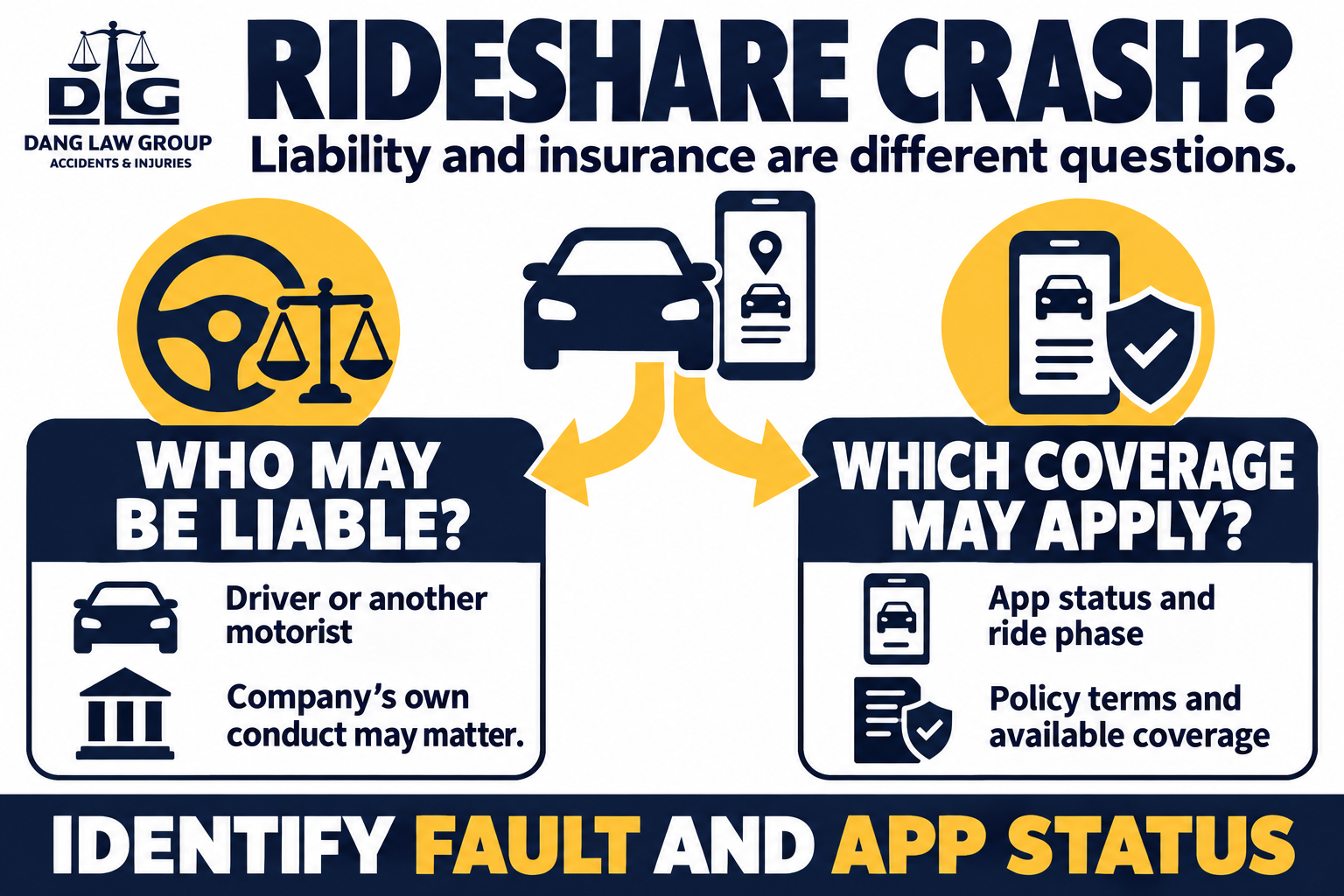
No. Insurance coverage and legal liability are related, but they are not the same thing.
Texas Insurance Code Chapter 1954 sets insurance requirements for transportation network company activity, and the required coverage changes depending on the driver’s app status and whether a prearranged ride is underway. That insurance may provide an important source of recovery even when a direct claim against Uber or Lyft is not available.
This article focuses on who may be legally responsible. For a detailed breakdown of the insurance phases and how rideshare coverage differs from traditional taxi coverage, see our guide to rideshare vs. taxi accidents.

If you have suffered injuries, call Attorney Dang to give the insurance companies a Bang!

What Evidence Matters in an Uber or Lyft Accident Lawsuit?
Rideshare cases often depend on digital evidence in addition to the evidence used in an ordinary crash claim. Useful evidence may include:
- Trip and app-status records. These show whether the driver was offline, waiting for a request, en route to a passenger, or completing a ride.
- Screenshots and receipts. Trip details from the passenger or driver’s app can establish the same timeline independently.
- Standard crash evidence. Crash reports, photographs, video, witness statements, and vehicle-damage evidence.
- Communications. Messages involving the driver, passenger, rideshare platform, or insurer.
- Medical records. Documentation of the injuries and treatment following the crash.
- Driver-history or company records. These matter when a direct-liability theory makes them relevant and legally obtainable.
Preserving evidence early can matter because the app status, trip record, and other digital information may affect both the liability analysis and the available insurance.
What If Another Driver Caused the Uber or Lyft Crash?
An Uber or Lyft passenger does not need the rideshare driver to be at fault in order to have a potential claim. If another motorist caused the collision, the claim may focus first on that driver’s liability insurance. Depending on the circumstances, rideshare uninsured or underinsured motorist coverage or other applicable coverage may also become relevant.
The correct path depends on who caused the crash, the driver’s app status, and the available policies. A rideshare vehicle being involved does not change the need to determine fault from the evidence.
How Fault Affects an Uber or Lyft Accident Claim
Texas comparative fault rules are addressed through proportionate responsibility under Chapter 33 of the Texas Civil Practice and Remedies Code. If a claimant is assigned 50 percent or less of the responsibility, recovery is generally reduced by that percentage. A claimant who is more than 50 percent responsible generally cannot recover.
In a multi-vehicle rideshare crash, responsibility may be allocated among more than one driver. Passengers generally are not responsible for how either driver operated a vehicle, although every case depends on its facts.
For more detail, see our guides to Texas comparative fault and who determines fault in a traffic accident.
Common Mistakes When Considering an Uber or Lyft Claim
A few early decisions can quietly limit what a rideshare claim can become:
- Failing to document the ride and app status. Screenshots, receipts, and trip details can help establish what the driver was doing at the time of the crash.
- Assuming independent-contractor status means there is no claim. That classification affects some liability theories, but it does not eliminate claims against negligent drivers or every possible direct claim against a company.
- Giving a recorded statement before the facts are clear. A statement becomes part of the claim file, so avoid guessing about fault, symptoms, or details you do not clearly remember.
- Accepting a settlement before the injuries and available coverage are understood. Policy limits do not determine what a claim is worth, and an early settlement may not account for future treatment or other documented losses.
Frequently Asked Questions
Can I sue Uber if my Uber driver caused the crash?
Possibly. A claim against the driver may be available when the driver caused the crash, while a direct claim against Uber depends on additional facts and the legal theory involved. Applicable rideshare insurance may also provide a source of recovery based on the driver’s app status.
Can a passenger sue Lyft after an accident?
A passenger injured in a Lyft crash may have a claim against the driver or drivers whose negligence caused the collision. Whether Lyft itself may also be a defendant depends on the facts and whether there is a legally supported theory based on the company’s own conduct.
How long do I have to file a lawsuit after an Uber or Lyft accident in Texas?
Texas generally provides a two-year limitations period for filing a personal injury lawsuit after a crash, subject to exceptions that may affect the deadline. Acting sooner can also help preserve app records, witness information, and other evidence.
Key takeaways
- An Uber accident lawsuit may involve the rideshare driver, another negligent driver, applicable insurance, and in limited circumstances a direct claim involving the rideshare company’s own conduct.
- Independent-contractor status can make some direct claims against Uber or Lyft more complicated, but it does not create blanket immunity.
- Rideshare insurance and direct company liability are separate questions. App status affects insurance coverage, while direct liability depends on the facts and legal theory.
- Trip records, app status, crash evidence, and relevant company records can be important when evaluating an Uber or Lyft claim.
- Texas proportionate-responsibility rules can reduce recovery based on a claimant’s percentage of responsibility and generally bar recovery above 50 percent.
- Texas generally provides a two-year limitations period for personal injury lawsuits, subject to exceptions.
Legal sources
- Texas Insurance Code, Chapter 1954 (Transportation Network Company Insurance).
- Texas Civil Practice and Remedies Code, Chapter 33 (Proportionate Responsibility).
- Texas Civil Practice and Remedies Code § 16.003 (two-year limitations period).
Injured in an Uber or Lyft Crash in Austin? Talk to Dang Law Group
A rideshare crash can leave you with injuries, medical bills, and difficult questions about who is responsible and which insurance applies.
At Dang Law Group, we help injured Texans preserve evidence, determine the driver’s app status, identify potentially applicable coverage, and evaluate the legal issues affecting the claim. Learn more about how our Austin Uber and Lyft accident lawyers handle rideshare cases.
Information verified by lawyer Loc Dang
Loc Dang is a founder and member of our legal team. In this blog, Attorney Dang shares his expertise to guide accident victims.
CONTACT US
Where are we?
North Austin: 11442 N Interstate Hwy 35, Austin, TX 78753.South Austin: 2512 South IH 35, Suite 250, Austin TX 78704
You can contact us 24 hours a day if you have been in an accident and need legal help to fight for the maximum compensation you are legally entitled to. If you fill out this form , someone from our team will contact you.
 9 to 5pm
512-973-8997

