

Loc Dang 4 Nov 2026
I Was a Passenger in a Car Accident in Texas: Who Do I Sue?
The crash happened in a second. You were in the passenger seat, maybe talking with the driver or checking your phone. You had no control over the wheel, the brakes, or the decision to change lanes. Now your neck aches, the bills are arriving, and one question keeps coming back: I was a passenger in a car accident, so who do I sue? It feels even harder when the driver is your friend, your spouse, or your parent.
Texas law has specific rules about who is responsible when a passenger gets hurt, and most of them work in your favor. This guide walks through each crash scenario, the insurance that typically pays, and the few situations that can complicate a passenger injury claim in Texas.
Who Do You Sue If You Were a Passenger in a Car Accident?
Short answer
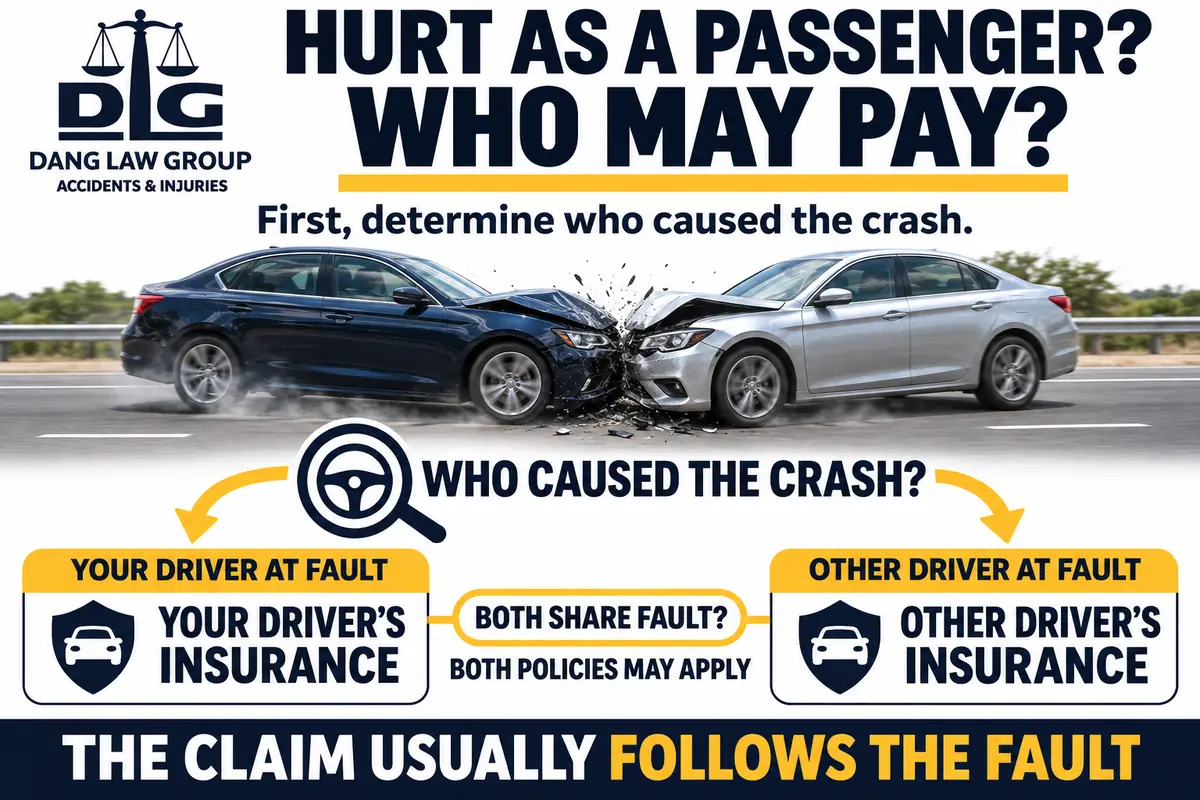
As a passenger, you generally bring a claim against whichever driver caused the crash, which may be your own driver, the other driver, or both. In practice, that claim usually goes to the at-fault driver’s liability insurance, not to the driver personally.
Liability insurance is the part of an auto policy that pays for injuries the insured driver causes to other people. Most passenger claims start as an insurance claim, not a courtroom fight. Texas follows an at-fault system, which means the driver who caused the crash, through their insurer, is generally responsible for the harm. A lawsuit typically becomes necessary only when the insurer will not offer a fair settlement or the filing deadline is getting close. For a broader overview of injury claims after a collision, see our guide to car accident claims in Austin.
Why Passengers Are Rarely Found at Fault
This is the biggest difference between your claim and a driver’s claim. Under the modified comparative fault rule in Texas Civil Practice and Remedies Code Chapter 33, a jury assigns each party a percentage of responsibility. A person found more than 50 percent responsible generally cannot recover, and anyone found partly responsible has their recovery reduced by that share.
Passengers usually sit outside that fight for a few reasons:
- You did not control the car: Speed, braking, lane changes, and following distance were the driver’s decisions, so fault is rarely assigned to the person in the passenger seat.
- The drivers argue with each other, not with you: When both drivers blame each other, the dispute is usually about which insurer pays you, not whether you deserve payment.
- Your account carries weight: You saw the crash from inside a vehicle, so your description can help show which driver made the mistake.
What If the Driver Was Your Friend or Family Member?
This is where many injured passengers stop. You may not want to sue your best friend, your brother, or the coworker who drove you to lunch. The reality is less personal than it sounds. A claim against the driver is, in practice, a claim against their auto liability insurance, which they bought for exactly this situation.
Key point
In most cases, a passenger’s claim against a friend or relative is paid by that person’s insurance company, up to the policy limits, not out of their own pocket.
A few points are worth knowing before you decide:
- No guest statute: Texas once had a guest statute, a law that limited claims by nonpaying passengers against their driver. The Supreme Court of Texas struck it down in 1985, so riding along as a friend generally does not bar your claim.
- Policy language matters: Some policies limit or exclude coverage for household members, so a claim against a spouse or parent may depend on how the policy is written.
- There are honest trade-offs: The driver’s premiums may rise after a claim, which many families weigh against leaving medical bills unpaid.
- The insurer handles the conversation: Communication typically runs through the insurance company, which can keep the claim from turning into a family dispute.
Who Pays When the Other Driver or Both Drivers Are at Fault?
When the other driver caused the crash, your claim usually goes to that driver’s liability insurer. When both drivers share blame, Chapter 33 lets a jury divide responsibility between them, and you may be able to recover from each driver’s insurance according to their share. Crashes with three or more cars follow similar logic, and our guide on how fault is divided in a multi-vehicle accident explains it in more detail.
This table summarizes where a passenger’s claim typically goes in each scenario:

If you have suffered injuries, call Attorney Dang to give the insurance companies a Bang!

| Who was at fault | Where your claim usually goes | Possible backup coverage |
|---|---|---|
| Your driver | Your driver’s liability insurance | PIP or MedPay on the car you were in |
| The other driver | The other driver’s liability insurance | PIP or MedPay on the car you were in |
| Both drivers | Both liability insurers, split by percentage of fault | PIP, MedPay, or your health insurance |
| An uninsured driver | Uninsured motorist coverage that applies to you | PIP, MedPay, or health insurance |
| A driver with too little insurance | That driver’s insurer, then underinsured motorist coverage | Health insurance |
| A rideshare driver on an active trip | The rideshare company’s required policy | The other driver’s insurer, if that driver caused the crash |
What If You Were a Passenger in an Uber or Lyft?
Rideshare trips add another layer. Texas Occupations Code Chapter 2402 requires transportation network companies, the legal term for apps like Uber and Lyft, to carry insurance that covers passengers while a trip is in progress. If another driver caused the crash, that driver’s insurer may also be responsible, and the policy terms decide how the coverages interact. Whether you can claim against the company itself is a separate question, covered in our article on whether you can sue Uber or Lyft directly.
Which Insurance Can Cover a Car Accident Passenger Claim?
Knowing who is at fault tells you who is responsible. The next question is which policies may actually pay. Depending on the circumstances, a passenger may have access to several:
-
- Liability insurance: The at-fault driver’s policy is usually the main source for pain and suffering, lost wages, and other losses beyond medical bills.
- Personal injury protection (PIP): PIP is no-fault coverage, meaning it pays regardless of who caused the crash. Texas Insurance Code §1952.152 requires insurers to include PIP unless the policyholder rejects it in writing, and it often covers people riding in the insured car.
- Medical payments coverage (MedPay): MedPay is optional coverage that pays crash-related medical bills regardless of fault.
- Uninsured and underinsured motorist coverage (UM/UIM): UM/UIM protects you when the at-fault driver has no insurance or not enough, and Chapter 1952 also requires insurers to offer it.
- Your health insurance: Health coverage can pay for treatment while the claim is pending, though the insurer may later seek repayment from your settlement.
The order these policies pay in is its own topic. Our guide on who pays your medical bills after a Texas car accident walks through it step by step.
Were You a Passenger in a Car Accident Without Insurance?
Not having your own auto policy does not stop you from bringing a claim. Your right to compensation follows the driver who caused the crash, not your own coverage. Texas Transportation Code Chapter 601 requires drivers to carry liability insurance of at least $30,000 per injured person and $60,000 per accident, so the at-fault driver usually has a policy you can claim against.
Even without your own car insurance, you may be able to use:
- PIP or MedPay on the car you were riding in: Those coverages typically follow the vehicle and its occupants.
- A household member’s policy: Some policies cover relatives who live in the same home, even when they ride in someone else’s car.
- UM coverage on the vehicle you were in: If the at-fault driver was uninsured, this coverage may apply to every occupant.
When Can a Passenger Claim Get More Complicated?
Passenger claims are usually simpler than driver claims, but not always. Knowing the limits helps you plan:
- Riding with an impaired driver: If you knew the driver was drunk and got in anyway, the insurer may argue you share some responsibility under Chapter 33.
- Not wearing a seat belt: Since the Supreme Court of Texas decided Nabors Well Services v. Romero in 2015, evidence that you were unbelted may be used to argue your injuries were worse than they would otherwise have been, which can reduce damages.
- Low policy limits: When several passengers are hurt, they may share one policy, and serious injuries can exceed what a single driver carries.
- The filing deadline: Texas Civil Practice and Remedies Code §16.003 sets the statute of limitations, the legal deadline to file a lawsuit, at generally two years from the date of the crash.
- Early statements and quick offers: An adjuster may ask for a recorded statement or offer a fast settlement before you know how serious your injuries are.
These are the moments where guidance from someone who handles passenger cases regularly can matter. At Dang Law Group, attorney Loc Dang helps injured passengers identify every policy that may apply, gather evidence showing which driver was at fault, and deal with insurers so you can focus on recovery.
What to Do After You Are Injured as a Passenger in a Car Accident
The steps you take in the first days can help protect your claim. A simple sequence looks like this:
- Get medical careSee a doctor promptly, even if you feel fine. Some injuries, like whiplash or concussions, may not show symptoms right away, and medical records connect your injuries to the crash.
- Collect both drivers’ informationGet names, phone numbers, insurance details, and plate numbers from every driver involved, including the driver you rode with.
- Document the scenePhotograph the vehicles, the road, traffic signals, and your visible injuries. Ask for the crash report number if police respond.
- Write down what you sawRecord your memory of the crash while it is fresh, including speeds, signals, phone use, and anything either driver said.
- Be careful with insurersReport the crash, but consider getting advice before giving a recorded statement or signing a release.
- Keep every recordSave bills, receipts, and proof of missed work, and keep the two-year deadline in mind.
Frequently Asked Questions
Can a passenger be a witness in a car accident?
Yes. A passenger can give a witness statement to the responding officer, which may appear in the crash report, and both drivers’ insurers may ask for that account while still handling the passenger’s own injury claim.
Can a child passenger file an injury claim in Texas?
Generally, yes, but a parent or guardian brings the claim on the child’s behalf. Under Texas Civil Practice and Remedies Code Chapter 16, the two-year limitations period is typically paused until the child turns 18. Parents may have a separate, earlier deadline for medical expenses they paid, so acting early is usually wise.
Key takeaways
- A passenger injured in a Texas car accident generally brings a claim against the driver who caused the crash, which may be their own driver, the other driver, or both.
- Passengers are rarely assigned fault under Texas Civil Practice and Remedies Code Chapter 33 because they do not control the vehicle.
- A passenger’s claim against a friend or family member who was driving is usually paid by that driver’s liability insurance, up to the policy limits.
- PIP, MedPay, and UM/UIM coverage may help an injured passenger in Texas even when the passenger has no auto policy of their own.
- Texas Civil Practice and Remedies Code §16.003 generally allows two years from the crash to file a personal injury lawsuit.
Legal sources
- Texas Civil Practice and Remedies Code, Chapter 33 (Proportionate Responsibility).
- Texas Civil Practice and Remedies Code, Chapter 16 (Limitations), including §16.003.
- Texas Insurance Code, Chapter 1952 (Policy Provisions and Forms for Automobile Insurance), including §1952.152.
- Texas Transportation Code, Chapter 601 (Motor Vehicle Safety Responsibility).
- Texas Occupations Code, Chapter 2402 (Transportation Network Companies).
Injured as a Passenger? Take the First Step Toward Your Claim
Being hurt in a crash you could not control is frustrating. Sorting out which driver and which policy is responsible should not fall on you while you heal. Dang Law Group helps injured passengers in Austin and across Central Texas understand their options, in English or Spanish, from offices in North Austin at 11442 N Interstate Hwy 35, Austin, TX 78753 and South Austin at 2512 South IH 35, Suite 250, Austin, TX 78704. Reach out today to talk through what happened. A conversation is the first step.
Information verified by lawyer Loc Dang
Loc Dang is a founder and member of our legal team. In this blog, Attorney Dang shares his expertise to guide accident victims.
CONTACT US
Where are we?
North Austin: 11442 N Interstate Hwy 35, Austin, TX 78753.South Austin: 2512 South IH 35, Suite 250, Austin TX 78704
You can contact us 24 hours a day if you have been in an accident and need legal help to fight for the maximum compensation you are legally entitled to. If you fill out this form , someone from our team will contact you.
 9 to 5pm
512-973-8997
