

Loc Dang 11 Nov 2026
Slip and Fall in a Store in Texas: What to Do in the First 24 Hours
You were reaching for something on a low shelf, or turning the corner of the produce aisle, and suddenly you were on the floor. Your hip hurts, your hands are shaking, and an employee is asking if you are okay while someone else mops the spot where you fell. You may be wondering what you should do now, and whether anything you do in the next day really matters.
It does. Texas law has specific rules about when a store is responsible for a fall, and most of them depend on evidence that can be cleaned up, thrown out, or recorded over within days. This guide walks you through what to do in the first 24 hours after a slip and fall in a store, and how Texas premises liability law looks at your situation afterward.
What Happens If You Slip and Fall in a Store in Texas?
If you slip and fall in a store in Texas, the store may be responsible for your injuries if it knew, or reasonably should have known, about the hazard and failed to fix it or warn you. A fall alone does not prove fault. Your claim usually depends on evidence of how the hazard got there and how long it sat.
This area of law is called premises liability, which is the responsibility property owners and occupiers have for injuries caused by unsafe conditions on their property. As a shopper, you are generally treated as an invitee, meaning a person who enters a business for a purpose that benefits both you and the owner. Stores typically owe invitees a duty to use reasonable care to protect them from dangers the store knows about or should discover. For a closer look at how these cases are handled locally, see our overview of slip and fall injury claims in Austin.
If You Fall in a Store, What to Do in the First 24 Hours
The steps below are listed roughly in the order they tend to matter. Your health comes first, so if you are badly hurt, let a friend or family member handle the rest.
- Report the fall to a manager before you leaveAsk for the manager on duty, not just the nearest employee, and describe what happened in plain words. Ask that an incident report be written, which is the store’s internal record of the fall. Write down the manager’s name, the date and time, and any report number.
- Photograph the spot where you fellTake pictures before the area is cleaned, from several angles and distances. Capture the substance on the floor, any footprints or cart tracks through it, the lighting, and whether a warning sign was present.
- Collect witness names and numbersShoppers and employees who saw the fall or the hazard can confirm details the store may later dispute. A name and phone number is usually enough.
- Keep your shoes and clothes as they arePut the shoes and clothing you wore in a bag and do not wash them. The soles may show what you stepped in.
- Ask the store to keep its camera footageTell the manager you want video of the area preserved, then follow up in writing the same day. The next section explains why this step is so time-sensitive.
- See a doctor, even if you feel okaySome fall injuries, such as concussions or soft tissue damage, may not show symptoms right away. A same-day or next-day visit creates a medical record linking your injuries to the fall.
- Write down what you rememberWhile it is fresh, note what you were doing, what you saw on the floor, and anything employees said, such as “we have been meaning to clean that.”
Why Store Camera Footage Can Disappear Within Days
Many store surveillance systems record on a loop, which means older video is automatically recorded over to make room for new footage. Depending on the system, that can happen within days. Video of the minutes before your fall may show who caused a spill, whether employees walked past it, and how long it sat on the floor.
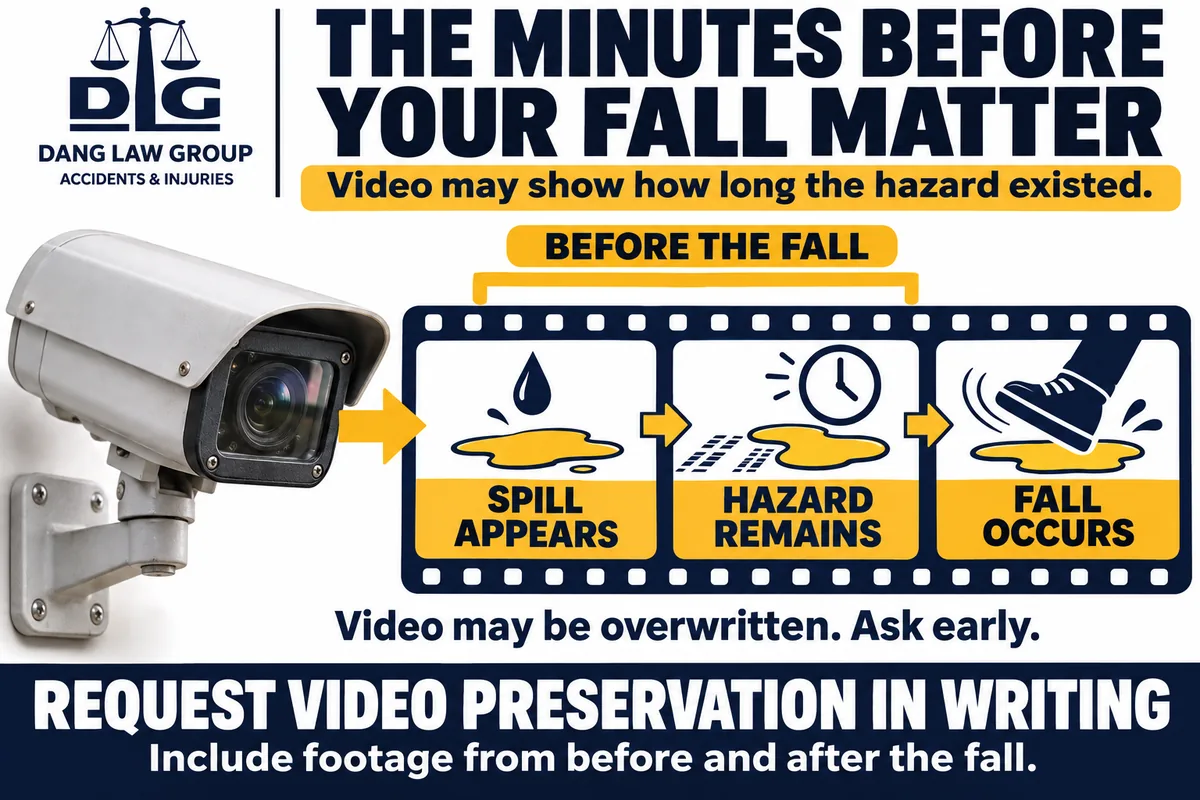
Texas courts have dealt with this problem directly. In Brookshire Brothers v. Aldridge (2014), a customer fell in a grocery store, and the store kept only a short clip of video around the fall while the rest was recorded over. The Texas Supreme Court used the case to set rules on spoliation, which is the loss or destruction of evidence. It generally limited the harshest consequences to evidence destroyed intentionally, or to rare cases where the loss leaves the other side without a meaningful way to prove its claim. The practical lesson is simple: a clear written request to preserve video, made early, is far better than arguing about lost footage later.
Can You Sue a Store for a Slip and Fall in Texas?
Yes, you can sue a store for a slip and fall in Texas, but you generally must prove the store had actual or constructive knowledge of the hazard, the hazard posed an unreasonable risk of harm, the store failed to use reasonable care to reduce or remove it, and that failure caused your injuries.
These elements come from Texas Supreme Court decisions such as Keetch v. Kroger Co., and each one carries weight. Here is what the key terms mean:
- Actual knowledge: The store really knew about the hazard. An employee saw the spill, a customer reported it, or store staff created it, for example by leaking a mop bucket while cleaning.
- Constructive knowledge: The store should have known because the hazard existed long enough that a reasonably careful store would have found it.
- Unreasonable risk of harm: The condition was dangerous enough that a careful store would have addressed it, such as a slick puddle in a busy aisle.
- Reasonable care: What a careful store would do, like cleaning promptly, placing a warning sign, or blocking off the area.
- Causation: The store’s failure was a real cause of your fall and your injuries, not just something that happened nearby.
How Texas Courts Look at Spills and Store Notice
Constructive knowledge is where many grocery and retail claims are won or lost. In Wal-Mart Stores, Inc. v. Reece (2002), a customer slipped on a clear liquid, and the Texas Supreme Court held that showing an employee was nearby was not enough on its own. There generally has to be some evidence of how long the hazard was on the floor. Courts often call this the time-notice rule.
That is why the details from your first 24 hours matter so much. Evidence that may help show time includes:

If you have suffered injuries, call Attorney Dang to give the insurance companies a Bang!

- Cart tracks or footprints: Marks through a spill can suggest it sat long enough for other shoppers to pass through it.
- Dirt or drying edges: A spill that looks dirty or partly dried may have been there for a while.
- Video timestamps: Footage can show exactly when a spill happened and who walked past it.
When a Store May Not Be Liable, and How Your Own Actions Count
Honest limits matter here. Not every fall in a store leads to a successful claim, and you deserve to know where these cases commonly struggle:
- Very recent spills: If a customer dropped a jar seconds before you stepped in it and the store had no chance to see it, the store may not be liable.
- Open and obvious hazards: Texas courts have generally held that a store may not owe a further duty when a hazard is open and obvious or you already knew about it, though there are exceptions.
Your own conduct also counts. Under Chapter 33 of the Texas Civil Practice and Remedies Code, Texas follows modified comparative fault, a rule that assigns each party a percentage of responsibility. If you are found partly at fault, for example because you were looking at your phone, your recovery may be reduced by your percentage. If you are found more than 50 percent responsible, you generally cannot recover at all. You can read more about how partial fault affects your recovery in Texas.
This is where experienced counsel can make a real difference. At Dang Law Group, attorney Loc Dang and the team can send a preservation letter for store video, request incident records, and help you understand how a store’s arguments may affect your claim, in English or Spanish.
How Long You Have to File a Slip and Fall in Store Lawsuit
Under §16.003 of the Texas Civil Practice and Remedies Code, you generally have two years from the date of your injury to file a personal injury lawsuit. Some situations can change that deadline, so it is worth checking early rather than assuming you have time.
A filed lawsuit may become necessary if the store denies responsibility. If you want to see how these cases move once they reach court, this guide on what to expect in an Austin slip and fall lawsuit covers the broader process.
Frequently Asked Questions
How are grocery store slip and fall settlements valued in Texas?
Grocery store slip and fall settlements typically depend on the severity of your injuries, medical costs, lost wages, and the strength of the evidence showing the store knew about the hazard. Any percentage of fault assigned to you under Texas law may also reduce the amount. No two claims are valued the same way.
Does it matter if I fell in the store’s parking lot?
It can. Premises liability rules may still apply, but the responsible party depends on who controls the area. A shopping center owner or property manager, rather than the store itself, may be in charge of the parking lot. Identifying who maintains that space is often an early step in the claim.
Key takeaways
- After a slip and fall in a store, reporting the fall, photographing the hazard, and seeing a doctor within 24 hours can protect important evidence.
- Many store surveillance systems record over older footage automatically, so a written request to preserve video should be made as early as possible.
- Under Texas premises liability law, a store is generally responsible to shoppers only if it knew or should have known about a hazard and failed to fix it or warn about it.
- Under Chapter 33 of the Texas Civil Practice and Remedies Code, a shopper found more than 50 percent responsible for a fall generally cannot recover damages.
- Texas generally allows two years from the date of injury to file a personal injury lawsuit under §16.003 of the Texas Civil Practice and Remedies Code.
Legal sources
- Texas Civil Practice and Remedies Code, Chapter 33 (Proportionate Responsibility).
- Texas Civil Practice and Remedies Code, Chapter 16 (Limitations, including §16.003).
- Premises liability duty owed to invitees (Texas common law).
Hurt in a Fall at a Texas Store? Take the First Step Today
A fall in a store can leave you with medical bills, missed work, and a store that may already be building its own version of events. The evidence that matters most, especially camera footage, often has the shortest life. Dang Law Group helps injured shoppers in Austin and across Central Texas understand their options, with offices in North Austin at 11442 N Interstate Hwy 35, Austin, TX 78753 and in South Austin at 2512 South IH 35, Suite 250, Austin, TX 78704. Help is available in English and Spanish. Reach out today to talk through what happened and the first step that makes sense for you.
Information verified by lawyer Loc Dang
Loc Dang is a founder and member of our legal team. In this blog, Attorney Dang shares his expertise to guide accident victims.
CONTACT US
Where are we?
North Austin: 11442 N Interstate Hwy 35, Austin, TX 78753.South Austin: 2512 South IH 35, Suite 250, Austin TX 78704
You can contact us 24 hours a day if you have been in an accident and need legal help to fight for the maximum compensation you are legally entitled to. If you fill out this form , someone from our team will contact you.
 9 to 5pm
512-973-8997
