
Loc Dang 22 Sep 2026
What Happens If the Insurance Company Denies My Car Accident Claim in Texas?
Short answer
If a Texas car accident claim is denied, first identify which insurer denied it, get the reason in writing, preserve the claim file, and gather evidence addressing the dispute. A denial by your own insurer can raise policy or insurance-law issues. A denial by the at-fault driver’s insurer does not itself determine legal liability.
You report the accident, submit the documents, and wait. Then the insurer says it will not pay. The first question is not simply whether you can appeal. It is whether the denial came from your own insurance company or from the at-fault driver’s insurance company. That distinction matters because your own insurer has a contract with you, while the other driver’s insurer generally does not. The available procedures, legal duties, and potential insurance-law remedies can therefore be very different. If you were hurt in a car accident in Austin, the type of denial shapes everything that follows.
Was the Claim Denied by Your Insurer or the Other Driver’s Insurer?
This is the most important distinction in the whole process, and it determines which rules apply to everything that comes next.
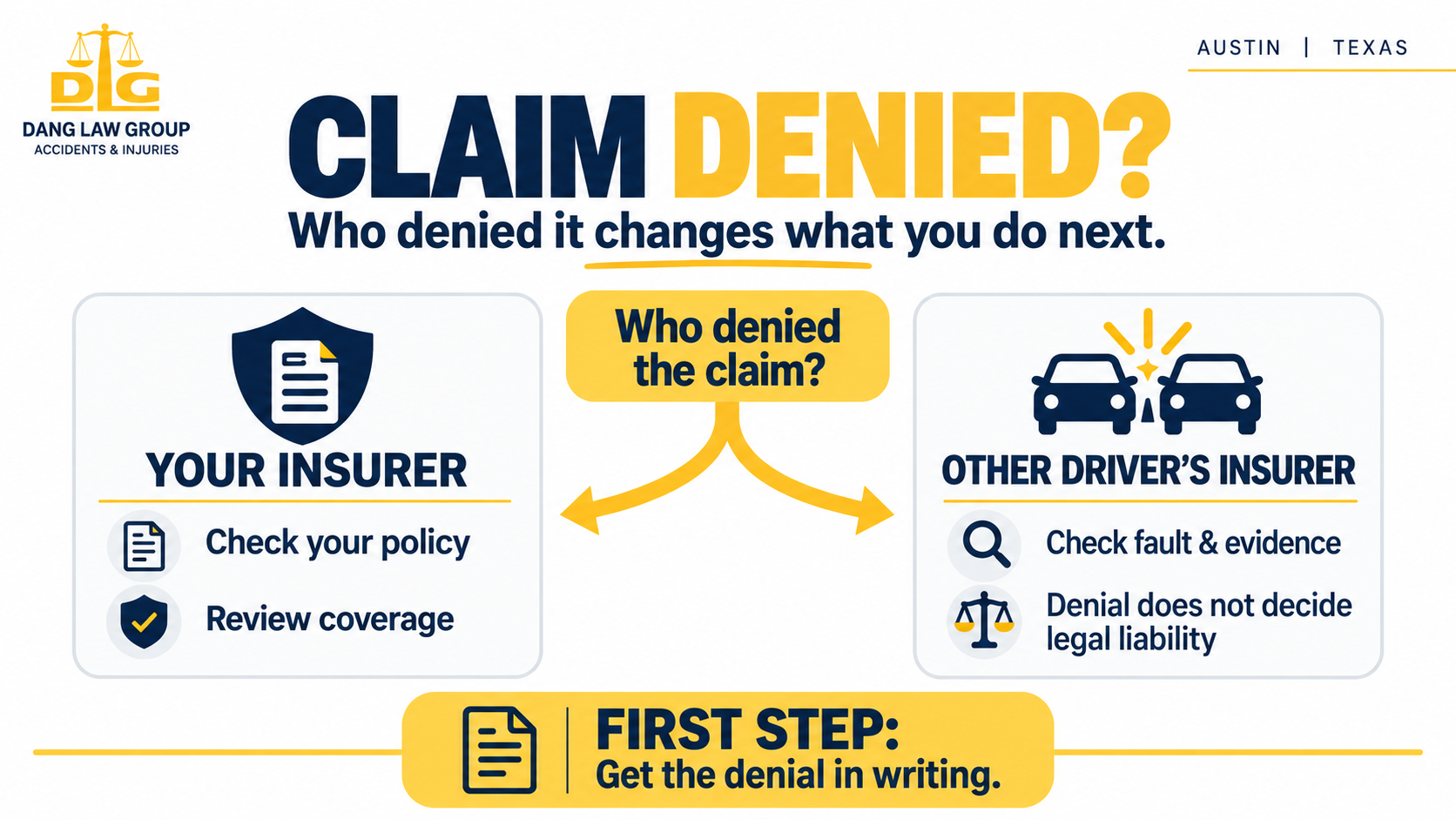
If your own insurance company denied the claim, it is a first-party claim, which can involve coverage such as collision, comprehensive, PIP, MedPay, UM/UIM, or another applicable first-party benefit. Because you have an insurance contract with your carrier, the policy language matters. The insurer may rely on an exclusion, a coverage limitation, failure to satisfy a policy condition such as notice or cooperation, a dispute over causation, or a disagreement about the amount of loss. Depending on the facts, Texas insurance statutes and common-law obligations may also become relevant.
If the at-fault driver’s insurance company denied the claim, the situation is different. You generally do not have an insurance contract with the other driver’s carrier. If that insurer denies liability, disputes your injuries, or refuses to make an acceptable offer, your underlying legal claim is generally against the person or entity responsible for causing your damages.
| Issue | Your own insurer | At-fault driver’s insurer |
|---|---|---|
| Contract with you | Yes. The policy language governs. | Generally none. |
| Typical coverage | Collision, comprehensive, PIP, MedPay, UM/UIM. | The other driver’s liability coverage. |
| Common denial reasons | Exclusions, limits, notice or cooperation conditions, causation, amount of loss. | Disputed fault, disputed injuries, or an unacceptable offer. |
| Insurance-law duties | Contractual, statutory, and common-law duties may apply. | Those duties generally do not apply in the same way. |
Key point
An adjuster can deny a liability claim. A court can still reach a different conclusion based on the evidence and the applicable law.
Get the Reason for the Denial and Preserve the Claim File
Do not rely on your memory of a phone conversation. If possible, obtain or preserve the insurer’s stated reason for refusing payment. Be careful in any communication with an insurer, and know what not to say to an insurance adjuster before you give a detailed statement.
For your own insurer, review the denial letter, the policy provision cited, the declarations page, endorsements, exclusions, correspondence requesting documents, and prior claim communications. For a third-party liability claim, preserve adjuster emails and letters, the claim number, the stated liability position, any explanation of disputed fault, and any challenge to medical causation or damages.
Keep a simple claim timeline showing when the accident occurred, when the claim was reported, when documents were submitted, when the insurer requested information, when the denial occurred, and what reason was given. That record may become important if the insurer later changes its position or if the dispute becomes litigation.
Why Do Texas Car Accident Claims Get Denied?
Not every denial means the insurer acted improperly. Common disputes include:
- Liability is contested. The insurer may argue its insured did not cause the crash, that you were partly responsible, that another driver caused it, or that there is not enough evidence to establish fault. Texas proportionate-responsibility rules can make disputed fault especially important.
- The insurer disputes causation. The carrier may argue an injury existed before the accident, resulted from another event, is inconsistent with the crash, or is not supported by medical documentation.
- There is a coverage problem. With your own insurance, the dispute may concern exclusions, limits, policy status, who qualifies as an insured, covered vehicles, or notice and cooperation requirements.
- Documentation is incomplete. A missing medical record, repair estimate, or proof of wage loss can sometimes be addressed with additional documentation.
- The insurer disagrees about damages. A carrier may accept that an accident occurred but dispute the amount of treatment, future medical needs, lost income, vehicle value, or whether particular expenses resulted from the crash.
Can You Appeal a Denied Insurance Claim in Texas?
Sometimes, but an appeal is not one universal Texas car-accident procedure. If your own insurer denied coverage or benefits, your policy or insurer may provide a process for reconsideration, supplemental documentation, appraisal, dispute resolution, or another form of review depending on the coverage involved.
If the at-fault driver’s insurer rejects your liability claim, there may not be a contractual appeal in the same sense. You can still challenge the decision by identifying the specific reason for the denial, submitting evidence that addresses that reason, presenting a written response or demand, correcting factual misunderstandings, negotiating further, and pursuing the underlying legal claim when appropriate. The important point is to respond to the actual disputed issue rather than simply sending the same claim again.
What Evidence Can Help Challenge a Denial?
The useful evidence depends on why the insurer said no.

If you have suffered injuries, call Attorney Dang to give the insurance companies a Bang!

- For a fault dispute. Police reports, crash-scene and vehicle-damage photographs, witness statements, surveillance or dashcam footage, traffic-camera evidence where available, and electronic or vehicle data in appropriate cases.
- For an injury or causation dispute. Medical records, imaging, treatment chronology, prior medical records when relevant, physician opinions, and documentation showing symptom progression.
- For lost income. Pay records, employer verification, tax documents where appropriate, and medical work restrictions.
- For coverage disputes. Start with the insurance contract itself, including declarations, the insuring agreement, definitions, endorsements, exclusions, and conditions. The policy language, not an adjuster’s summary of it, controls the contractual analysis. If your bills are larger than the coverage available, understanding what happens when medical bills exceed insurance limits can help you find other sources of recovery.
When Can an Insurance Denial Raise Bad-Faith or Insurance-Code Issues in Texas?
Not every wrong or disputed denial is automatically bad faith. Texas law recognizes insurance-law duties in certain circumstances, particularly in the relationship between an insurer and its insured.
- Texas Insurance Code Section 541.060. This section addresses certain unfair settlement practices, which may include misrepresenting material policy provisions, failing in applicable circumstances to attempt a fair settlement when liability has become reasonably clear, failing to provide a reasonable explanation for certain claim decisions, or refusing to pay a claim without conducting a reasonable investigation. Whether a particular claimant can bring a Chapter 541 claim, and which subsection applies, depends on the relationship, coverage, facts, and current Texas law.
- Texas Insurance Code Chapter 542. This chapter contains prompt-payment requirements governing certain first-party insurance claims. When applicable, it establishes timelines concerning claim acknowledgment, investigation, acceptance or rejection, and payment. Statutory consequences may apply when an insurer violates those requirements, but the remedy depends on the claim type and current statutory framework.
- Common-law bad faith. Texas also recognizes a common-law duty of good faith and fair dealing in certain insurer-insured relationships. This should not be confused with an ordinary disagreement between an injured claimant and the at-fault driver’s liability insurer. A third-party claimant generally should not assume that a denial by the at-fault driver’s insurer creates the same bad-faith cause of action that may exist between an insurer and its own insured.
Does Chapter 542 Always Mean an 18 Percent Penalty?
Do not treat the 18 percent penalty as an automatic add-on to every denied insurance claim. Texas Insurance Code Section 542.060 provides statutory remedies for certain violations of prompt-payment requirements, but whether it applies, and how interest and attorney-fee provisions operate, depends on the type of policy, claim, statute, and current Texas law. The rule is not that a denied claim automatically entitles you to 18 percent plus attorney fees. Whether Chapter 542 applies to a particular first-party claim is a legal question to evaluate case by case.
What If the Denial Is Based on a Pre-Existing Injury?
A pre-existing condition does not automatically mean a new accident caused no additional harm. The relevant question may be whether the collision caused a new injury, aggravated an existing condition, accelerated symptoms, or created additional treatment needs. Medical records and causation evidence become especially important in this type of denial. This topic is covered in more detail in our guide to pre-existing injuries and Texas car accident claims.
Two Denials That Look Similar but Are Legally Different
The same word can describe two situations that the law treats very differently:
- The at-fault driver’s insurer denies liability. James is injured in an Austin intersection collision. The other driver’s insurer says its insured had the green light and denies the claim. James is not appealing his own insurance policy. The dispute is about the other driver’s liability, and evidence such as witnesses, traffic footage, photographs, or crash reconstruction may determine what happens next.
- James’s own UIM carrier denies coverage. James later makes a claim under his own underinsured motorist policy, and his insurer denies coverage based on a policy provision. Now the dispute involves his own insurance contract, and different contractual and potentially statutory duties may apply. The word is the same. The legal analysis is not.
Common Mistakes After an Insurance Claim Is Denied
A few reactions to a denial come up repeatedly, and several of them can quietly weaken a claim:
- Assuming a denial means the case is over. An insurer’s position is not necessarily the final determination of liability or damages.
- Treating a third-party claim like your own insurance claim. The legal relationship is different, and policy rights, statutory remedies, and insurer duties may not be the same.
- Calling repeatedly without addressing the reason for denial. First identify what the insurer actually disputes, then provide evidence directed at that issue.
- Signing a release to accept partial payment. A release can affect further rights. Understand exactly what claims and parties the document covers before signing.
- Missing deadlines. Legal claims have filing deadlines, and insurance contracts may contain separate notice, cooperation, proof-of-loss, or dispute provisions.
- Calling every disagreement bad faith. A disputed claim and actionable bad faith are not the same thing, and that distinction matters both legally and strategically.
When Can a Lawyer Help With a Denied Claim?
Legal review may be particularly useful when your own insurer denies coverage, when fault is heavily disputed, when the insurer says your injuries were pre-existing, when significant medical bills are involved, when the available coverage may be insufficient, when multiple insurers are involved, when the carrier relies on policy language you do not understand, when the insurer repeatedly delays or changes its explanation, or when litigation may be necessary.
A lawyer can help determine what kind of claim was denied, which policy or legal duty applies, what evidence addresses the denial, whether additional insurance exists, whether statutory or common-law remedies are potentially available, and whether the underlying claim should proceed through litigation. A lawyer cannot turn every denial into a bad-faith case. The value is in identifying why the claim was denied and what legally supported response is available.
Frequently Asked Questions
Can I sue an insurance company for denying my claim?
It depends on which insurer denied the claim and why. A dispute with your own insurer can involve contractual and potentially statutory or common-law remedies. A claim against the at-fault driver’s insurer is legally different, and not every denial creates a direct bad-faith claim against that carrier.
What is bad-faith insurance in Texas?
In general terms, bad faith concerns certain unreasonable conduct by an insurer toward an insured when handling a covered claim. The exact standard and available remedies depend on Texas law, the policy, and the facts. A denial alone does not automatically establish bad faith.
Does a denied claim qualify for an 18 percent penalty in Texas?
Not automatically. Texas prompt-payment statutes can provide remedies in covered circumstances, but their application depends on the insurance claim involved and the statutory requirements. Whether Chapter 542 applies should be evaluated before any penalty is assumed.
Key takeaways
- A denied car accident claim in Texas is often the insurer’s current position, not a final determination of liability or damages.
- Your first step is identifying whether your own insurer or the at-fault driver’s insurer denied the claim, because your legal rights differ sharply between the two.
- A denial by your own insurer can involve contractual, statutory, and common-law duties that generally do not apply to the at-fault driver’s insurer.
- Not every denial is bad faith, and the Chapter 542 prompt-payment remedies do not apply automatically to every claim.
- Respond to the specific reason the insurer gave, with targeted evidence, rather than resubmitting the same claim.
Legal sources
- Texas Insurance Code, Chapter 541 (Section 541.060, certain unfair settlement practices).
- Texas Insurance Code, Chapter 542 (prompt-payment requirements, including the Section 542.060 statutory remedy).
- The applicable automobile insurance policy, which governs coverage, exclusions, notice, cooperation, and claim procedures.
- Texas common law regarding insurer good faith and fair dealing.
A Denial Is a Decision to Analyze, Not a Reason to Give Up
An insurance denial can feel final. Legally, it is often only the insurer’s current position. What happens next depends first on who denied the claim, why it was denied, what evidence exists, and what insurance contract or legal duties apply.
If an insurer denied your claim after an Austin car accident, Dang Law Group can review the denial, identify the disputed issue, evaluate available coverage and evidence, and explain what options may remain. Contact Dang Law Group to discuss the denial before assuming the claim is over.
Information verified by lawyer Loc Dang
Loc Dang is a founder and member of our legal team. In this blog, Attorney Dang shares his expertise to guide accident victims.
CONTACT US
Where are we?
North Austin: 11442 N Interstate Hwy 35, Austin, TX 78753.South Austin: 2512 South IH 35, Suite 250, Austin TX 78704
You can contact us 24 hours a day if you have been in an accident and need legal help to fight for the maximum compensation you are legally entitled to. If you fill out this form , someone from our team will contact you.
 9 to 5pm
 512-973-8997
