
Loc Dang 5 Aug 2026
What Not to Say to an Insurance Adjuster in Texas
Careless words to an adjuster can quietly shrink your claim – here’s what to avoid.
The phone rings a day or two after your accident, and a friendly voice introduces themselves as the insurance adjuster handling your claim. They sound helpful. They say they just need a few quick details to get things moving. What they do not say is that the conversation is being recorded, that their job is to pay you as little as possible, and that a few offhand words from you can shrink your claim before it has even begun.
Texas law gives you rights after an accident, but it does not stop an adjuster from using your own words against you. Knowing what not to say is one of the simplest ways to protect the value of your claim.
1. What Is an Insurance Adjuster and Whose Side Are They On?
An insurance adjuster is a person the insurance company assigns to investigate your claim, decide how much it is worth, and settle it for the lowest reasonable amount. Even a polite, sympathetic adjuster works for the insurer, not for you. Their questions are designed to gather information that can be used to reduce or deny what you are paid.
It helps to understand the two adjusters you may deal with. Your own insurer’s adjuster handles your policy, and you generally do have a duty to cooperate with them. The at-fault driver’s adjuster is different. You are usually under no obligation to give them a recorded statement at all, and this is where the most damage tends to happen.
2. “I’m Fine” — Why You Should Never Guess About Your Injuries
One of the most costly things you can say is any version of “I’m fine” or “I’m not really hurt.” Adrenaline after a crash routinely masks injuries, and conditions like whiplash, concussions, and soft-tissue damage can take hours or days to appear.
- Do not describe your condition. A simple “I feel okay” can be quoted later to argue your injuries are minor or unrelated to the crash.
- Do not rule injuries out. Saying “nothing’s broken” before a doctor has examined you hands the adjuster a statement you may have to walk back.
- Let the medical records speak. Your diagnosis should come from a physician, not from a phone call. Point the adjuster to your treatment, not your own guesses.
3. “It Was My Fault” — Never Admit or Guess at Fault
Never apologize for the accident or speculate about who caused it. Even a reflexive “I’m sorry” or “I didn’t see them” can be treated as an admission and used to shift blame onto you.
This matters enormously in Texas because of a rule called modified comparative fault, set out in Chapter 33 of the Texas Civil Practice and Remedies Code. Under Section 33.001, you can recover damages only if you are found 50 percent or less at fault, and your compensation is reduced by your share of the blame. If your responsibility is found to be greater than 50 percent, you recover nothing at all.
Because your recovery drops with every percentage point of fault assigned to you, an adjuster has a strong incentive to coax you into language that sounds like an admission. Stick to the facts of what happened, and leave the conclusions about fault to the investigation.
4. Do Not Give a Recorded Statement Without Thinking First
Adjusters often ask for a recorded statement early, framing it as routine. For the at-fault driver’s insurer, you are generally not required to give one.

If you have suffered injuries, call Attorney Dang to give the insurance companies a Bang!

- You can decline politely. It is reasonable to say you are not prepared to give a recorded statement at this time.
- Recorded words are permanent. Anything you say can be transcribed and quoted back months later, out of context.
- Early is not better. Before you have finished treatment or understood the full extent of your injuries, any statement about damages is premature.
5. Do Not Talk About Money or Accept the First Offer
Two money mistakes come up again and again. The first is discussing the value of your claim before you know it. The second is accepting the first number the adjuster puts on the table.
- Do not estimate your damages. You will not know the true cost until treatment is complete and future care is understood.
- The first offer is a floor, not a ceiling. Initial offers are frequently low, made in the hope you will take quick cash and close the file.
- Do not sign a release. Signing a settlement or a medical authorization can end your claim or hand over records that have nothing to do with the accident.
6. Common Phrases That Quietly Hurt Your Claim
Even careful people slip. These are the statements that most often come back to reduce a claim:
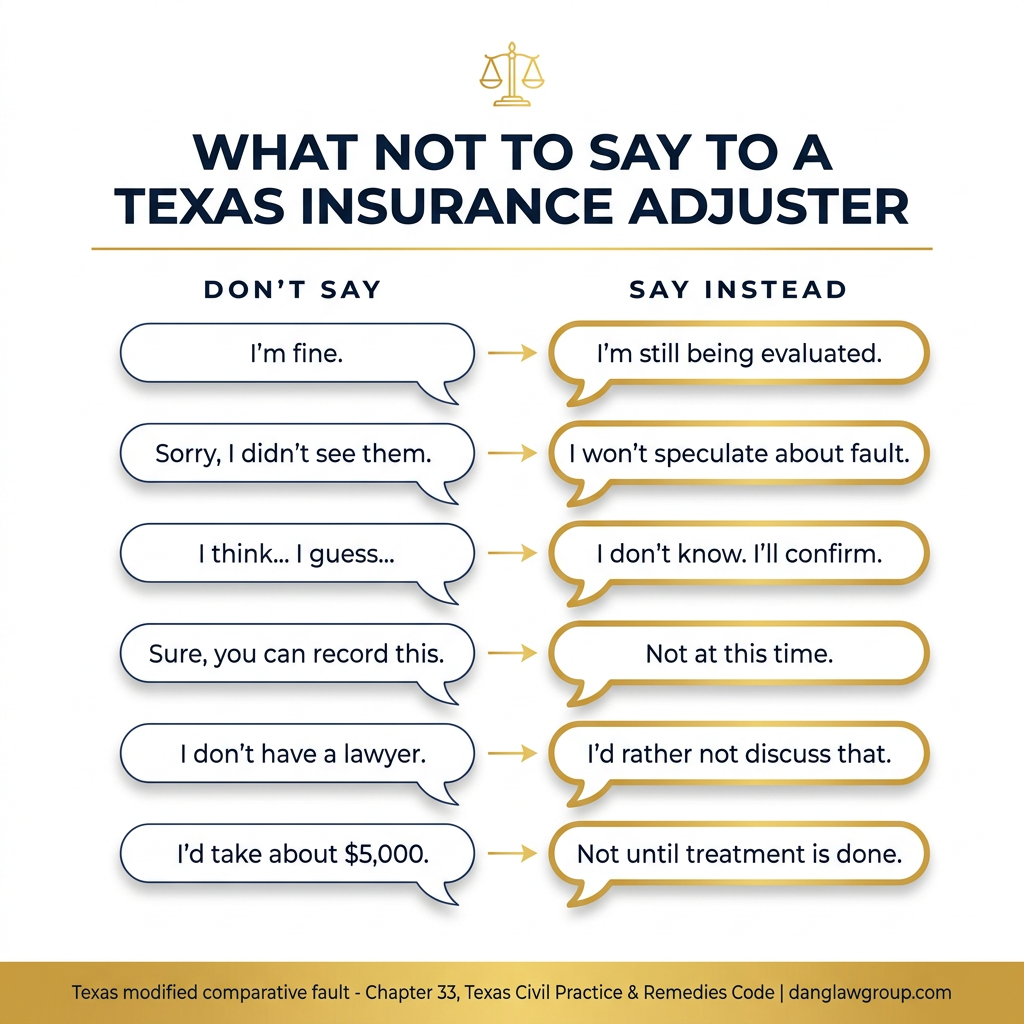
- “I think” or “I guess”: Speculation invites the adjuster to fill in the blanks in the insurer’s favor.
- “I don’t have a lawyer”: This signals you may be easier to settle with cheaply.
- “I feel great today”: A casual update becomes evidence your injuries have resolved.
- Anything on social media: A photo of you smiling at a family event can be used to argue you were not really hurt. Assume the adjuster is watching your public posts.
What You Should Do Instead
You do not have to be adversarial to protect yourself. A calm, limited approach works best:
- Give only the basic facts: your name, contact information, the date, and the location of the accident.
- Stick to what is verifiable and avoid characterizing your injuries or fault.
- Keep records of every call, including the adjuster’s name and what was discussed.
- Direct detailed questions about injuries, damages, and fault to your medical providers or your attorney.
Frequently Asked Questions
1. Do I have to talk to the other driver’s insurance adjuster in Texas?
Generally, no. You are usually not required to give a statement or a recorded interview to the at-fault driver’s insurer. You can politely decline and direct their questions elsewhere, which protects you from saying something that could reduce your claim.
2. Can what I say to an adjuster really reduce my settlement?
Yes. Because Texas uses modified comparative fault under Chapter 33 of the Civil Practice and Remedies Code, any statement that shifts blame toward you can lower your recovery, and a finding of more than 50 percent fault bars it entirely.
3. Should I give a recorded statement after a car accident?
Usually not before understanding your rights. Recorded statements are permanent, easy to quote out of context, and often requested before your injuries are fully known. It is reasonable to decline until you have spoken with an attorney.
Protect Your Words, Protect Your Claim
After a crash, the insurance company starts building its position from your very first phone call. A few careless words about your injuries, an apology said out of habit, or a quick “I’m fine” can quietly cost you thousands in the compensation you are owed. You have the right to be careful, to decline a recorded statement, and to let your medical records and the facts tell the story. If an adjuster is pressuring you after an accident in Austin, the team at Dang Law Group can handle those conversations for you and work to protect the full value of your claim. Reach out today before you say something that cannot be unsaid.
Information verified by lawyer Loc Dang
Loc Dang is a founder and member of our legal team. In this blog, Attorney Dang shares his expertise to guide accident victims.
CONTACT US
Where are we?
North Austin: 11442 N Interstate Hwy 35, Austin, TX 78753.South Austin: 2512 South IH 35, Suite 250, Austin TX 78704
You can contact us 24 hours a day if you have been in an accident and need legal help to fight for the maximum compensation you are legally entitled to. If you fill out this form , someone from our team will contact you.
 9 to 5pm
 512-973-8997