

Loc Dang 21 Sep 2026
Can a Pre-Existing Injury Hurt My Car Accident Claim in Texas?
Short answer
A prior condition does not automatically defeat your Texas car accident claim. The claim generally focuses on what the crash changed, meaning any new injury or aggravation of an existing condition, and what additional harm can be attributed to the accident.
Maybe you had back pain before the crash. Maybe an old knee injury flared up occasionally. Maybe imaging already showed arthritis or degeneration. Then the accident happened, and now the pain is more frequent, treatment has increased, you cannot do what you could before, or a doctor is recommending care you did not previously need.
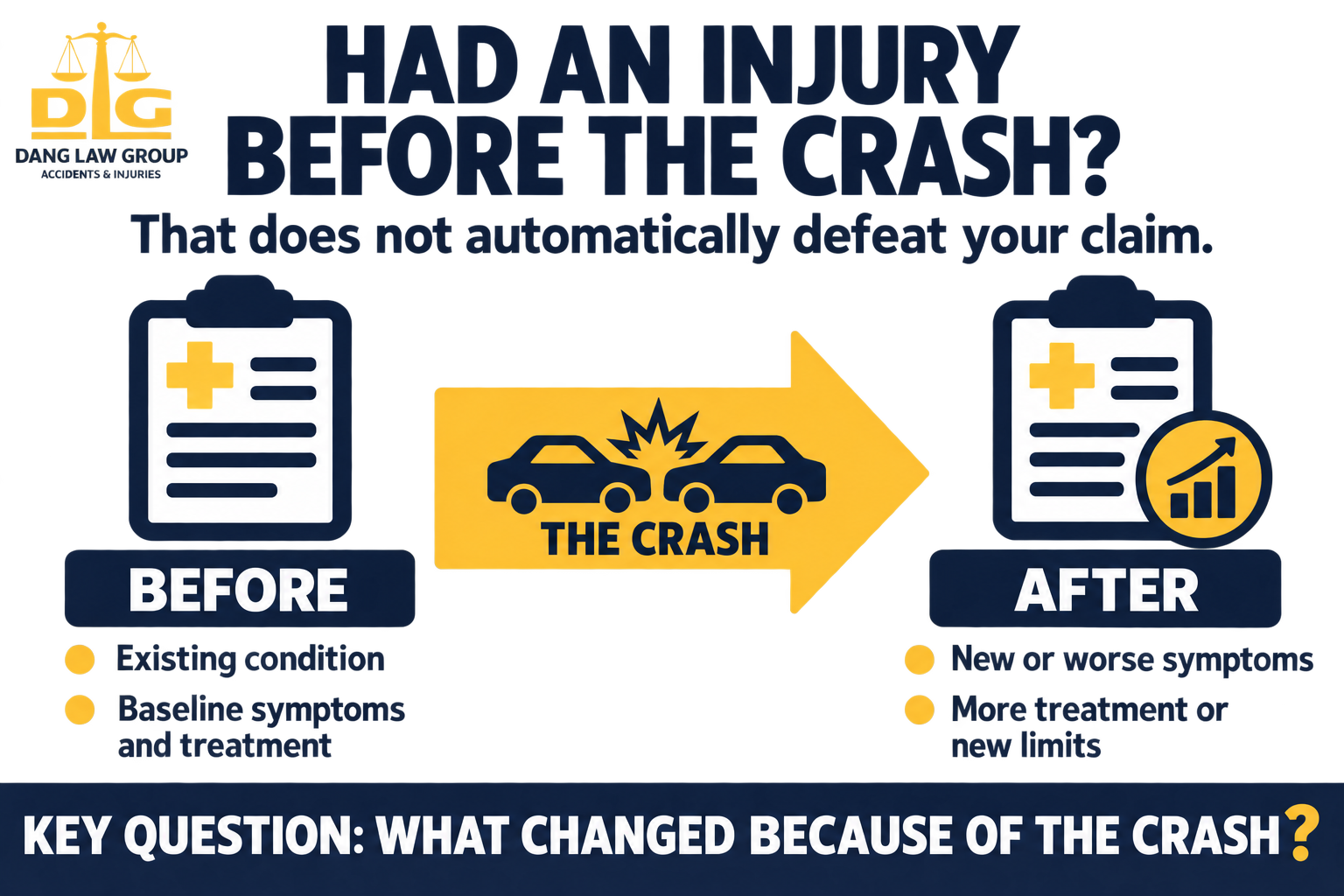
An insurance company may focus heavily on your medical history in that situation. But the existence of a pre-existing condition does not automatically mean the crash caused no new harm. If you were hurt in a collision, an Austin car accident lawyer can help sort out what the crash actually changed. The central question is usually what changed because of the crash.
Can You Still Have a Car Accident Claim If You Had a Pre-Existing Injury?
Yes. A pre-existing injury or medical condition does not automatically prevent you from recovering damages in a Texas car accident claim. The key issue is whether the crash caused a new injury or aggravated an existing condition, and what additional harm can be attributed to the accident.
You generally are not seeking compensation simply because an old condition existed. The claim focuses on the additional harm caused by the crash, which may include increased pain, new symptoms, more intensive treatment, reduced mobility, new work restrictions, surgery or other care that was not previously necessary, or a worsening of functional limitations. The stronger the evidence showing your condition before versus after the accident, the easier it is to explain that difference.
What Is the Eggshell Skull Rule in Texas?
The eggshell skull rule describes the general principle that a negligent person does not avoid responsibility simply because the injured person was unusually vulnerable to harm. In plain terms, a defendant generally must take the injured person as that person actually was, rather than as a perfectly healthy person.
That means a person’s medical vulnerability can matter. If the same crash causes significantly greater harm to someone with a fragile spine, prior surgery, arthritis, or another condition than it would to a healthier person, the pre-existing vulnerability does not necessarily eliminate responsibility for the accident-related harm. Two related concepts should not be treated as identical:
| Concept | What it means |
|---|---|
| Increased susceptibility | A prior condition may make someone more vulnerable to suffering a severe injury in the first place. |
| Aggravation of an existing condition | An accident may make an injury or medical condition that already existed measurably worse. |
Both concepts can arise in personal injury cases, but the precise Texas jury instruction and measure of damages depend on the evidence and legal issues involved.
Key point
The practical line is your baseline. The question is what your condition would likely have been without the accident, compared with what actually happened after it.
Your baseline is what existed immediately before the crash: occasional back pain, arthritis on imaging, a prior surgery, an old neck injury that had stabilized. The aggravation is the additional harm the accident caused: pain that becomes daily instead of occasional, more intensive treatment, work you can no longer do, or a stable condition that becomes symptomatic. Establishing that comparison usually takes medical evidence rather than assumptions drawn from an old diagnosis.
When an Old Back Problem Becomes a Much Bigger One
Consider James, who has had intermittent lower-back pain for several years. Before the crash, he works full time, exercises regularly, sees a doctor only occasionally, and has not been recommended for surgery.
Then another driver hits his vehicle in Austin. After the collision, his pain becomes constant, he develops additional symptoms, he resumes frequent treatment, an MRI is ordered, his doctor restricts his work, and more invasive treatment is discussed.
The existence of the earlier back condition does not answer whether the crash caused additional harm. The evidence must address the difference between James’s pre-crash baseline and his post-crash condition.
How Insurers Use Your Medical History Against You
An insurer can dispute whether the accident actually caused the injuries or treatment being claimed. But the fact that a person had a pre-existing condition does not, by itself, establish that the crash caused no compensable harm. Be careful in these conversations and know what not to say to an insurance adjuster before discussing your history.
An insurer may argue that current symptoms existed before the crash, that imaging shows age-related degeneration, that treatment would have been needed anyway, that there is no objective evidence of worsening, that a different event caused the symptoms, or that the medical timeline does not support causation. Those are causation arguments. They should be evaluated against the actual medical history and post-accident evidence rather than treated as automatic conclusions.
An adjuster saying you had back problems before, so the claim is denied, does not by itself resolve the legal or medical question. The relevant issue is whether the accident caused new or additional harm. If an insurer has already denied the claim, that denial is not necessarily the final word.

If you have suffered injuries, call Attorney Dang to give the insurance companies a Bang!

Two of the insurer’s most common moves deserve a direct response:
- The broad medical-authorization request. An insurer may seek prior records when a pre-existing condition is relevant, but the proper scope depends on the claim, litigation status, and the issues actually in dispute. Do not assume every request for unlimited history is necessary, and do not assume prior records should always be withheld. In many aggravation cases, relevant prior records are exactly what establish that the condition was stable before the crash. If an insurer requests a broad authorization, review what it covers before signing.
- The degeneration argument. In back and neck cases, terms like degeneration, degenerative disc disease, arthritis, or spondylosis do not by themselves answer what caused your current symptoms. Imaging findings must be read together with your symptoms before and after the crash, examination findings, prior imaging if available, treatment history, and physician opinions. The real question is whether the accident caused a new injury, aggravated an existing condition, or made a previously manageable condition symptomatic.
What Evidence Helps Prove an Aggravated Pre-Existing Injury?
Pre-existing-condition cases are often evidence-heavy because the claim depends on establishing a credible before-and-after picture.
- Prior medical records establish the baseline. How often you sought treatment, what symptoms existed, whether the condition was stable, and whether surgery had ever been recommended. These are not bad evidence. They are often what proves the condition was stable before the crash.
- Post-accident records show the change. New complaints, increased pain, new symptoms, changes in treatment, new imaging, or new work restrictions.
- Treating-physician evidence connects the two. Your doctor can explain what changed after the accident and whether future care relates to the crash.
- Work and activity evidence shows the difference outside medical records. Missed work, reduced hours, or activities you can no longer do.
Should You Tell the Insurance Company About a Prior Injury?
You should not conceal relevant medical history. A prior condition may be discoverable through records, testimony, or other evidence, and inaccurate statements about your history can create credibility problems. Being careful is different from giving a recorded statement you are not prepared for. Understand your rights on giving a recorded statement first.
Honesty does not require guessing or giving an off-the-cuff medical analysis to an adjuster. There is an accurate distinction between saying you had back pain before the accident and saying your symptoms, treatment, and limitations changed after it. Both can be true at the same time. Avoid claiming you were never injured before if that is untrue, guessing about causation, or describing the problem as the same as before when you do not actually know. Let the medical records and your providers establish the comparison.
How Does Comparative Responsibility Affect a Pre-Existing-Injury Claim?
Comparative responsibility and pre-existing medical conditions are separate issues. Texas Civil Practice and Remedies Code Chapter 33 addresses responsibility for causing the incident and resulting damages. Under Section 33.001, a claimant generally cannot recover if the claimant’s percentage of responsibility is greater than 50 percent. Under Section 33.012, recoverable damages are generally reduced based on the claimant’s percentage of responsibility.
A pre-existing medical condition does not itself mean the claimant was at fault for being injured more severely. Having arthritis before a crash is not the same thing as being responsible for causing the crash. The two analyses should remain distinct. Responsibility asks who caused the accident, while medical causation asks what harm the accident caused or aggravated. For more on how fault is shared, see our guide to Texas comparative responsibility.
Common Mistakes in Pre-Existing-Injury Claims
A few assumptions come up repeatedly in these claims, and each one can quietly weaken the evidence:
- Assuming the old condition destroys the claim. A prior diagnosis does not automatically answer whether the accident worsened it.
- Letting the insurer define the entire claim as pre-existing. The real question is not whether a condition existed before, but what changed afterward.
- Trying to diagnose yourself during an adjuster call. Medical causation is usually more complicated than a claimant can accurately explain by phone.
- Creating unexplained treatment gaps. Gaps in treatment are part of the causation analysis and should be understood accurately rather than ignored.
When Can a Lawyer Help With a Pre-Existing-Injury Claim?
Legal help may be more useful when the insurer attributes all current symptoms to a prior condition, when significant treatment or surgery is involved, when medical records span several years, when prior and new imaging must be compared, when the insurer requests broad medical authorizations, when causation is heavily disputed, when the accident caused major work or activity limitations, or when the claim has been denied or substantially undervalued. If you are weighing this decision, see our guide on whether you need a personal injury lawyer.
A lawyer can help organize the evidence around the correct question: what was your condition before the accident, and what additional harm followed the crash? That may involve reviewing prior records, obtaining post-accident documentation, working with medical providers, challenging inaccurate characterizations, and presenting the damages in a clear before-and-after framework. The goal is not to hide the prior injury. It is to distinguish it accurately from the harm caused by the new accident.
Frequently Asked Questions
Can insurance deny my claim because I had a pre-existing condition?
An insurer can dispute whether the accident caused the treatment or symptoms being claimed, but the existence of a prior condition does not automatically establish that the crash caused no additional harm. Medical and before-and-after evidence become important.
Can I recover for an injury I already had before the accident?
The claim generally focuses on additional harm attributable to the accident rather than simply compensating the condition as it existed beforehand. Evidence of increased symptoms, treatment, limitations, or other worsening can be important.
What if my MRI already showed degeneration before the crash?
Pre-existing degenerative findings do not automatically determine the cause of your post-accident symptoms. The analysis may include your prior symptoms, treatment history, post-crash changes, examination findings, imaging, and medical opinions.
Should I disclose my prior injury?
Do not misrepresent your medical history. Relevant prior records may also help establish your pre-accident baseline. If an insurer requests a broad medical authorization, review the scope and understand what information is being requested.
Key takeaways
- A pre-existing injury does not automatically prevent recovery in a Texas car accident claim. The claim focuses on the additional harm the crash caused.
- Texas recognizes that a negligent party generally must take the injured person as they were, so being medically vulnerable does not by itself eliminate the other driver’s responsibility.
- The decisive issue is causation: what your condition was before the crash versus after it, proven with before-and-after medical evidence.
- A pre-existing condition and fault are separate questions. Having arthritis before a crash is not the same as being responsible for causing it.
- Do not conceal prior injuries or guess at medical causation with an adjuster. Let the records and your treating physician establish the comparison.
Legal sources
- Texas Civil Practice and Remedies Code, Chapter 33 (Proportionate Responsibility). Section 33.001 generally bars recovery when the claimant’s responsibility exceeds 50 percent, and Section 33.012 generally reduces recoverable damages according to that percentage. Chapter 33 addresses responsibility for the accident and is not the legal basis for the aggravation doctrine itself.
- Texas law concerning aggravation of pre-existing conditions and increased susceptibility to injury, including the applicable Texas Pattern Jury Charge on aggravation.
A Prior Injury Changes the Evidence, Not the Right to Make a Claim
A pre-existing medical condition does not mean a new accident caused no additional harm. It means the evidence has to answer a more precise question: what was your condition before the crash, and what changed afterward? Prior medical records, new treatment, diagnostic evidence, work limitations, and medical opinions can all help establish that distinction.
If a car accident in Austin worsened a condition you already had and the insurer is attributing your current problems entirely to your medical history, Dang Law Group can review the before-and-after evidence and explain what issues may matter in your claim. Contact Dang Law Group to discuss your options if a pre-existing condition has become a major point of dispute.
Information verified by lawyer Loc Dang
Loc Dang is a founder and member of our legal team. In this blog, Attorney Dang shares his expertise to guide accident victims.
CONTACT US
Where are we?
North Austin: 11442 N Interstate Hwy 35, Austin, TX 78753.South Austin: 2512 South IH 35, Suite 250, Austin TX 78704
You can contact us 24 hours a day if you have been in an accident and need legal help to fight for the maximum compensation you are legally entitled to. If you fill out this form , someone from our team will contact you.
 9 to 5pm
 512-973-8997
