
Loc Dang 18 Sep 2026
Do I Need a Personal Injury Lawyer in Texas?
Not every personal injury claim requires a lawyer. A straightforward property-damage claim with clear fault and no injuries may be manageable on your own.
Legal help may matter more when injuries are serious or ongoing, fault is disputed, multiple insurers or parties are involved, coverage is limited, or an insurance company challenges or denies the claim.
The better question is not simply whether the accident was “big enough” for a lawyer. It is whether the claim contains legal, medical, or insurance issues that could affect your ability to evaluate and protect it.
Do You Need a Personal Injury Lawyer After a Car Accident in Texas?
You do not automatically need a personal injury lawyer after every Texas car accident.
A property-damage-only claim with no injuries, clear liability, and adequate insurance may be relatively straightforward.
Legal help may become more useful when:
- Injuries require significant or ongoing treatment;
- Fault is disputed;
- More than one driver or company may be responsible;
- Insurance coverage is limited;
- The insurer questions whether the accident caused your injuries;
- The claim is delayed, undervalued, or denied;
- Future medical treatment or lost income may be involved.
If you were injured in a collision, our Austin car accident lawyers can help evaluate the issues that may affect the claim.
When a Personal Injury Claim May Be More Straightforward?
Some claims involve fewer legal and factual disputes.
Examples may include:
- Property damage only: No one was injured and the dispute is limited to repairing or replacing the vehicle.
- Clear liability: The available evidence strongly supports one driver being responsible and the insurer is not contesting fault.
- Limited, resolved treatment: Any injury was minor, treatment was short, and there are no ongoing symptoms or future-care concerns.
- Complete documentation: Repair bills, medical records, wage-loss information, and other losses are easy to identify.
- No coverage dispute: There appears to be sufficient insurance and no dispute about exclusions, policy limits, or competing claims.
Even a relatively simple claim requires care before signing a release or accepting a settlement.
A claim that begins simply can become more complicated if symptoms worsen, the insurer changes its position, or another insurance issue appears.
What Are the Signs That Legal Help May Matter More?
Certain facts increase the legal or financial complexity of a personal injury claim.
Serious or Long-Term Injuries
Hospitalization, surgery, permanent limitations, future treatment, or reduced ability to work can make damages more difficult to evaluate.
A serious injury claim may involve:
- Future medical care;
- Future lost income;
- Reduced earning capacity;
- Permanent impairment;
- Pain and physical limitations;
- Long-term effects on daily life.
The issue is not only how much has already been billed. Future losses may also need to be considered.
Disputed Fault
If an insurer argues that you caused all or part of the accident, the percentage of responsibility assigned to you may affect your recovery.
Texas uses a proportionate-responsibility system. Learn more about how Texas comparative fault works.
Multiple Vehicles or Responsible Parties
A multi-vehicle crash can involve:
- Several drivers;
- Multiple insurance carriers;
- Competing versions of what happened;
- Different policy limits;
- Disputes over each party’s responsibility.
Commercial vehicle, rideshare, and employer-related accidents may involve additional policies or responsible parties.
An Insurance Claim Is Delayed, Undervalued, or Denied
A disagreement about liability, medical causation, coverage, or damages may require more than simply submitting another bill or document.
If an insurer has already refused the claim, read what happens if an insurance company denies your claim in Texas.
Your Losses May Exceed Available Insurance
The at-fault driver’s liability limits may not always be enough to cover all accident-related losses.
Depending on the circumstances, other sources may include:
- UIM coverage;
- First-party benefits;
- Employer or commercial insurance;
- Coverage from another responsible party.
The Insurer Wants a Detailed Recorded Statement
A recorded statement may become part of the claim file and may later be compared with medical records, crash evidence, or testimony.
Before giving one, understand who is requesting it, why it is being requested, and whether your policy requires your cooperation.
Why Does Disputed Fault Matter So Much in Texas?
Texas uses a proportionate-responsibility system under Chapter 33 of the Texas Civil Practice and Remedies Code.
Under §33.001, a claimant generally cannot recover damages if the claimant’s percentage of responsibility is greater than 50%.
Under §33.012, recoverable damages are generally reduced according to the claimant’s percentage of responsibility.
For example, if a claimant has $100,000 in recoverable damages and is assigned 20% responsibility, the recoverable amount may generally be reduced to reflect that percentage, subject to the facts and applicable law.
Evidence relevant to disputed fault may include:
- Crash reports;
- Photographs;
- Witness statements;
- Video or dashcam footage;
- Vehicle damage;
- Phone records, when relevant;
- Expert analysis in more complex cases.
The issue is not simply whether someone says you were partly at fault. It is how responsibility is supported by the evidence.
What Does a Personal Injury Lawyer Actually Do?
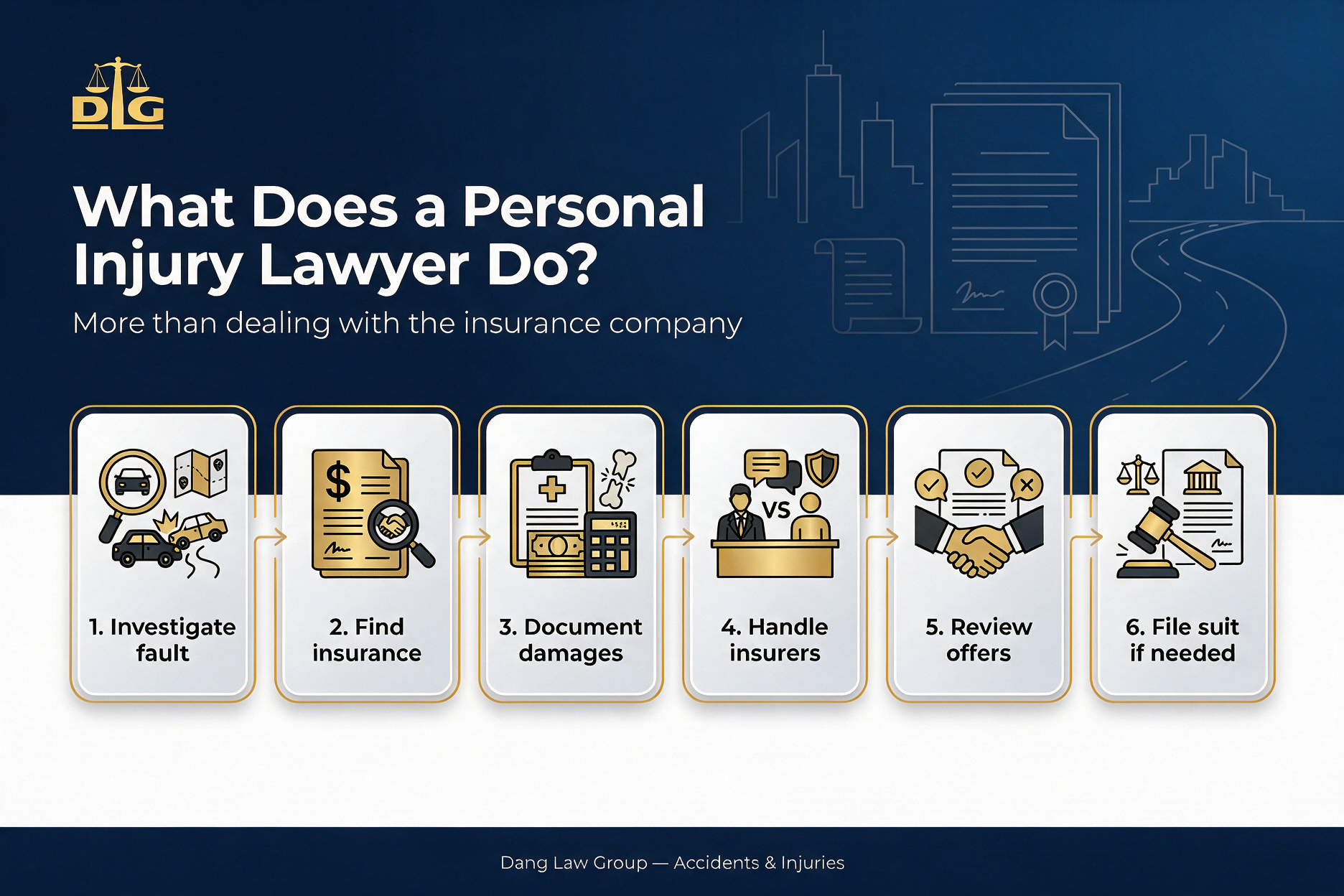
A personal injury lawyer may do considerably more than communicate with an insurance adjuster.
The work depends on the case.
Investigating Liability
A lawyer may collect and review:
- Police reports;
- Crash photographs;
- Witness information;
- Surveillance footage;
- Dashcam evidence;
- Vehicle records;
- Commercial-driver records;
- Other evidence relevant to how the accident occurred.
Identifying Available Insurance
An accident can involve more than one policy.
Potential sources of coverage may include:
- The at-fault driver’s liability policy;
- Your own UIM coverage;
- Employer or commercial insurance;
- Rideshare coverage;
- Insurance covering another responsible party.
Identifying coverage early can matter when injuries are serious or policy limits are an issue.

If you have suffered injuries, call Attorney Dang to give the insurance companies a Bang!

Documenting Damages
Medical bills are only one part of some personal injury claims.
Depending on the evidence, losses may include:
- Past medical expenses;
- Future medical needs;
- Lost wages;
- Reduced earning capacity;
- Property damage;
- Pain or impairment;
- Other legally recoverable losses.
Handling Insurance Communications
Legal representation may include:
- Responding to insurance adjusters;
- Reviewing recorded-statement requests;
- Presenting supporting evidence;
- Addressing disputed liability;
- Responding to medical-causation arguments;
- Challenging unsupported claim positions;
- Reviewing proposed settlement documents.
Evaluating Settlement Offers
The relevant question is not simply whether an offer seems “high” or “low.”
An offer may need to be compared with:
- Documented damages;
- Future medical risks;
- Available insurance;
- Liens or reimbursement claims;
- Costs associated with continuing the case;
- Uncertainties of litigation.
Before accepting a settlement, it is also important to understand what rights the release will end.
Filing a Lawsuit When Necessary
Not every personal injury claim becomes a lawsuit.
When liability, damages, or insurance issues cannot be resolved through the claims process, litigation may become necessary to preserve or pursue the claim.
What Does a Personal Injury Lawyer Cost in Texas?
Many personal injury lawyers use contingency-fee agreements instead of hourly billing.
Under a contingency-fee arrangement, the attorney fee is generally tied to a recovery rather than charged as an hourly fee upfront.
The exact terms depend on the written fee agreement.
Questions to ask before signing include:
- What percentage applies?
- Does the percentage change if a lawsuit is filed?
- How are litigation costs handled?
- Who is responsible for case expenses if there is no recovery?
- Are medical-record, expert, filing, or deposition costs treated separately?
- When is the attorney fee calculated?
Do not assume that “no attorney fee unless there is a recovery” necessarily means there can never be any other costs.
The written agreement should explain attorney fees, expenses, and financial obligations.
When Should You Hire a Personal Injury Lawyer?
There is no single point at which every injured person must hire an attorney.
A legal review may become more useful when:
- You suffered a serious injury;
- Treatment is ongoing;
- Surgery or future care is being discussed;
- You cannot return to work;
- Fault is disputed;
- Several drivers or companies may be responsible;
- The at-fault party has limited insurance;
- UIM coverage may apply;
- The insurer questions whether the accident caused your injuries;
- The claim has been denied;
- You received a settlement offer while treatment is still ongoing.
A consultation does not automatically mean you must hire the lawyer. It can also help you identify the legal and insurance issues involved before deciding what to do next.
Common Mistakes Before Deciding Whether to Hire a Lawyer
Settling Before the Medical Picture Is Clear
If treatment is still ongoing, you may not yet know:
- Whether symptoms will resolve;
- Whether additional imaging will be necessary;
- Whether surgery may be recommended;
- Whether future care will be required;
- Whether the injury will affect your ability to work.
Once a claim is fully released, later medical developments may not reopen it.
Assuming a Lawyer Is Always Necessary—or Never Useful
Neither assumption is particularly helpful.
Whether representation may matter depends on the complexity of the claim, the injuries, the evidence, the amount of insurance available, and the disputed issues.
Giving an Unprepared Recorded Statement
Statements about fault, symptoms, prior injuries, speed, or what happened before the crash can become part of the claim record.
Focusing Only on Current Medical Bills
The financial effect of a serious injury may extend beyond bills already received.
Future treatment, time away from work, reduced earning ability, and other losses may also matter.
Ignoring Other Available Insurance
A claim may involve more than the liability policy of the driver who caused the crash.
Depending on the facts, UIM coverage, employer policies, commercial insurance, rideshare coverage, or other responsible parties may also need to be considered.
Waiting Too Long
Texas personal injury claims are subject to legal deadlines, and insurance policies may impose separate notice or cooperation requirements.
Waiting can also make evidence more difficult to preserve.
Example: When a “Simple” Car Accident Claim Stops Being Simple
Consider a driver who is rear-ended in Austin.
At first, the claim appears straightforward. The other driver receives a citation, and the injured driver expects the insurance process to be simple.
A week later, back pain becomes significantly worse. An MRI is ordered, specialist treatment begins, and the injured person misses several weeks of work.
The insurer then argues that part of the condition existed before the accident and questions whether all of the treatment resulted from the crash.
The claim now involves:
- Medical causation;
- Prior medical history;
- Lost income;
- Future treatment;
- Claim valuation;
- Insurer disputes.
What initially appeared to be a simple rear-end accident has become a more complex personal injury claim.
Frequently Asked Questions
- Do I need a lawyer for a minor car accident in Texas? Not necessarily. A property-damage-only accident with no injuries, clear liability, adequate insurance, and no dispute may be manageable without legal representation. Legal help may matter more if injuries develop, fault becomes disputed, coverage problems arise, or the insurer challenges the claim.
- When should I hire a personal injury lawyer? Legal help may be more useful when you have serious or ongoing injuries, disputed fault, multiple responsible parties, limited insurance, a denied claim, or uncertainty about future damages.
- How much does a personal injury lawyer cost in Texas? Many personal injury lawyers use contingency-fee agreements rather than hourly billing. The attorney fee is generally tied to a recovery, but the percentage and treatment of case expenses depend on the written agreement.
- Can I talk to a personal injury lawyer without hiring one? Many personal injury firms offer an initial consultation before a client decides whether to retain the firm. Confirm the consultation terms and fee arrangements directly with the lawyer or law firm you contact.
- Do I need a lawyer if the insurance company already made an offer? Not automatically. Before accepting an offer, consider whether:
- Medical treatment is complete;
- Future medical needs are understood;
- Lost income is documented;
- All available coverage has been identified;
- The offer addresses the losses supported by the evidence;
- The release could affect other claims.
Make the Decision Based on the Claim, Not Just the Size of the Accident
Not every Texas personal injury claim requires a lawyer. A straightforward property-damage claim with clear fault may be manageable without representation.
But serious injuries, disputed responsibility, limited insurance, multiple parties, denied claims, questions about medical causation, or future medical needs can make a claim much more difficult to evaluate.
If you are unsure whether legal representation may be useful in your situation, contact Dang Law Group to discuss the facts of your claim, the insurance issues involved, and the options that may be available.
Information verified by lawyer Loc Dang
Loc Dang is a founder and member of our legal team. In this blog, Attorney Dang shares his expertise to guide accident victims.
CONTACT US
Where are we?
North Austin: 11442 N Interstate Hwy 35, Austin, TX 78753.South Austin: 2512 South IH 35, Suite 250, Austin TX 78704
You can contact us 24 hours a day if you have been in an accident and need legal help to fight for the maximum compensation you are legally entitled to. If you fill out this form , someone from our team will contact you.
 9 to 5pm
 512-973-8997