

Loc Dang 29 Dec 2025
Fatal Car Accidents in Texas: Pursuing a Wrongful Death Claim
You got the call no family is ready for. Someone you love was killed in a car crash, and now, in the middle of grief, you are facing insurance calls, unpaid bills, and questions about whether anyone will be held responsible. You may not even know whether you have the right to take legal action.
Texas law gives certain family members a specific way to pursue accountability after a fatal crash. Understanding who can file, how long you have, and what a claim can cover can help you protect your family’s options. If you are considering a claim, an Austin wrongful death lawyer can review what happened.
What Is a Wrongful Death Claim in Texas?
Short answer
In Texas, the surviving spouse, children, and parents of a person killed in a car accident may file a wrongful death claim. They generally have two years from the date of death to file. If none of them files within three months, the estate’s executor or administrator may bring the claim.
A wrongful death claim is a civil lawsuit brought by family members when someone dies because of another person’s wrongful act, neglect, carelessness, or default. The Texas Wrongful Death Act, found in Chapter 71 of the Texas Civil Practice and Remedies Code, creates this right. In most car crash cases, the claim rests on negligence, which means a driver failed to use the care a reasonably careful driver would have used.
Fatal crashes that lead to wrongful death claims often involve:
- Drunk or impaired driving: A driver under the influence of alcohol or drugs.
- Distracted driving: Texting, using a phone, or looking away from the road.
- Speeding: Driving too fast for the speed limit or for conditions.
- Running a light or stop sign: Entering an intersection without the right of way.
- Commercial vehicle errors: A tired, rushed, or poorly trained truck or delivery driver.
Who Can File a Wrongful Death Claim in Texas?
Under Section 71.004 of the Civil Practice and Remedies Code, a wrongful death claim is brought for the benefit of three groups of family members:
- The surviving spouse: The husband or wife of the person who died.
- The children: Including legally adopted children.
- The parents: Including adoptive parents.
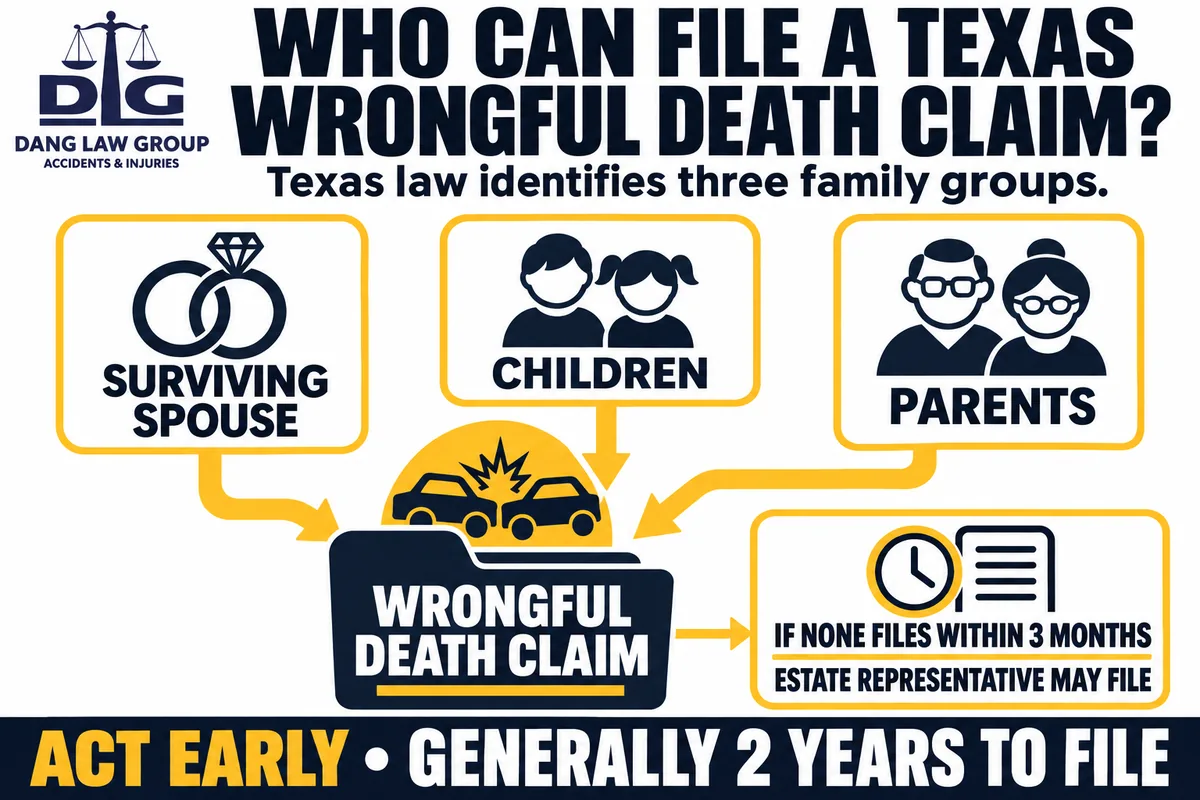
These family members may file together or separately, but the claim is generally resolved as one case for all of them. If none of them files within three months after the death, the executor or administrator of the estate may file the claim, unless all of the eligible family members ask that no claim be brought.
Key point
Brothers, sisters, grandparents, and other relatives cannot bring a wrongful death claim in Texas, even if they were very close to the person who died.
When a jury awards damages, it divides the amount among the eligible family members in proportion to the loss each person suffered, as Section 71.010 provides.
How Long Do You Have to File a Wrongful Death Claim?
Texas generally gives families two years from the date of death to file a wrongful death lawsuit, under Section 16.003 of the Civil Practice and Remedies Code. This deadline is called the statute of limitations. A claim filed after it runs is likely to be dismissed, no matter how strong the facts are.
The deadline may be paused, or tolled, in limited situations:
- A family member is a minor: Under Section 16.001, the time a person is younger than 18 is generally not counted.
- A family member is of unsound mind: A serious mental condition that prevents the person from managing their own affairs may also pause the clock.
- The cause of death was concealed: Courts may delay the deadline if the responsible party hid facts the family needed to discover the claim.
Tolling usually applies only if the condition existed when the claim arose, and these exceptions are narrow. Claims against a government driver or agency can also carry much shorter notice deadlines, so it is safer to act early than to count on an exception.
What Damages Can Families Recover After a Fatal Crash?
A wrongful death claim compensates the surviving family members for their own losses, not the losses of the person who died. Depending on the facts, damages may include:

If you have suffered injuries, call Attorney Dang to give the insurance companies a Bang!

- Lost financial support: The income and benefits the person would likely have provided to the family.
- Lost services, care, and advice: Household help, childcare, guidance, and counsel the family relied on.
- Lost inheritance: What the person would likely have saved and left to the family over a normal lifetime.
- Loss of companionship: The love, comfort, and society of the relationship.
- Mental anguish: The emotional pain and grief family members suffer because of the death.
- Funeral and burial expenses: Generally recoverable by the family members who paid them, or otherwise through the estate.
Exemplary damages, also called punitive damages, are meant to punish rather than compensate. Section 71.009 allows them when a death is caused by a willful act or by gross negligence, which is conscious indifference to an extreme risk of harm. Under the Texas Constitution, only the surviving spouse and the children may recover them, not the parents. They must also be proven by clear and convincing evidence under Chapter 41, and they are subject to limits explained in our guide to damage caps in Texas.
What Is the Difference Between a Wrongful Death Claim and a Survival Action?
After a fatal crash, Texas law often allows two separate claims. They are brought by different people and cover different losses.
| Wrongful death claim | Survival action | |
|---|---|---|
| Legal basis | Civil Practice and Remedies Code §71.002 | Civil Practice and Remedies Code §71.021 |
| Who brings it | Spouse, children, and parents | The estate, usually through its personal representative |
| What it covers | The family’s own losses after the death | What the person who died suffered before death, such as pain, medical bills, and lost wages |
| Where the money goes | Directly to the family members | To the estate, then distributed under the will or Texas inheritance law |
Both claims can usually be pursued together in the same lawsuit, depending on the circumstances.
How Is Fault Proven After a Fatal Car Accident?
A wrongful death claim generally requires proving the same elements as a personal injury case:
- Duty: The other driver owed a legal duty to drive safely.
- Breach: The driver failed to meet that duty, for example by speeding or driving drunk.
- Causation: That failure caused the crash and the death.
- Damages: The death caused real losses to the family.
Evidence often includes the crash report, witness statements, traffic or dashcam video, toxicology results, and accident reconstruction. When an intoxicated driver caused the crash, the bar or restaurant that overserved them may also share responsibility under the Texas Dram Shop Act.
What If the Person Who Died Was Partly at Fault?
Insurers often argue that the person who died contributed to the crash. Texas uses modified comparative fault under Chapter 33 of the Civil Practice and Remedies Code, which assigns each party a percentage of responsibility. In a wrongful death case, the share of fault assigned to the person who died generally reduces the family’s recovery, and if that share is greater than 50 percent, the family generally cannot recover from the other driver. Our article on recovering damages when fault is shared explains how these percentages work.
How Do Insurance Limits Affect a Wrongful Death Claim?
The at-fault driver’s liability insurance is usually the first source of payment. Texas Transportation Code Chapter 601 requires minimum coverage of $30,000 for injury or death to one person, $60,000 per accident, and $25,000 for property damage. Those minimums are often far below the losses a family faces after a death.
Other sources of compensation may include:
- Uninsured or underinsured motorist coverage: Coverage on the policy of the person who died, if they carried it.
- Commercial policies: Coverage held by an employer if the at-fault driver was working at the time.
- Other responsible parties: Such as a vehicle owner, an employer, or a business that overserved alcohol.
What Should Your Family Do First?
In the weeks after a fatal crash, a few early steps can help protect your family’s options:
- Request the crash reportAsk the investigating police agency for the report and note the report number.
- Preserve evidenceSave photos, videos, text messages, and the names of any witnesses.
- Keep records of expensesHold on to funeral, medical, and other bills, and track lost household income.
- Be careful with insurersAvoid recorded statements or quick settlement offers before you understand your rights.
- Talk with a lawyer before the deadlineA lawyer can confirm who may file and which deadlines apply to your case.
Frequently Asked Questions
Do criminal charges against the driver have to finish first?
No. A wrongful death claim is a civil case and is separate from any criminal prosecution. The family may generally pursue it whether or not the driver is charged or convicted, though evidence from the criminal case can sometimes help.
What if a government vehicle caused the fatal crash?
Claims against a city, county, or state agency fall under the Texas Tort Claims Act, which limits the damages available and generally requires written notice within six months. Some cities require notice even sooner, so these cases call for quick action.
Key takeaways
- Under Chapter 71 of the Texas Civil Practice and Remedies Code, only the surviving spouse, children, and parents may bring a wrongful death claim.
- Families generally have two years from the date of death to file under Section 16.003.
- Wrongful death damages cover the family’s own losses, while a survival action covers what the person who died suffered before death.
- Exemplary damages for gross negligence are available only to the surviving spouse and children, not the parents.
- Under Chapter 33, a family generally cannot recover if the person who died is found more than 50 percent at fault.
Legal sources
- Texas Civil Practice and Remedies Code, Chapter 71 (Wrongful Death; Survival).
- Texas Civil Practice and Remedies Code, Chapter 16 (Limitations), including §16.001 and §16.003.
- Texas Civil Practice and Remedies Code, Chapter 33 (Proportionate Responsibility).
- Texas Civil Practice and Remedies Code, Chapter 41 (Damages).
- Texas Civil Practice and Remedies Code, Chapter 101 (Texas Tort Claims Act).
- Texas Transportation Code, Chapter 601 (Motor Vehicle Safety Responsibility Act).
Lost a Loved One in a Crash? Talk With Someone About Your Family’s Options
No claim can undo what your family has lost, but it may help cover the financial harm and hold the responsible party accountable. Dang Law Group helps families in Austin and across Central Texas gather evidence, deal with insurers, and pursue the compensation the law allows, in English or Spanish. Reach out today for a free, confidential consultation.
Information verified by lawyer Loc Dang
Loc Dang is a founder and member of our legal team. In this blog, Attorney Dang shares his expertise to guide accident victims.
CONTACT US
Where are we?
North Austin: 11442 N Interstate Hwy 35, Austin, TX 78753.South Austin: 2512 South IH 35, Suite 250, Austin TX 78704
You can contact us 24 hours a day if you have been in an accident and need legal help to fight for the maximum compensation you are legally entitled to. If you fill out this form , someone from our team will contact you.
 9 to 5pm
 512-973-8997
