

Loc Dang 5 Nov 2026
Pain and Suffering Settlement Examples in Texas: How Value Is Determined
You were rear-ended at a red light on I-35 three months ago. The car is fixed and most of the medical bills are paid. But your neck still aches when you lift your daughter, and you have not slept through the night since. Then the adjuster calls with an offer, and you wonder whether that number covers any of this. You search for pain and suffering settlement examples and find figures from Florida, California, and the UK that seem to have nothing to do with your life.
Texas law has specific rules about how pain and suffering is defined, proved, and reduced. It has no official formula for putting a price on it. This guide explains how insurers and juries tend to weigh these losses. It walks through five hypothetical Texas cases and shows why two claims that look alike on paper can end in very different places.
What Counts as Pain and Suffering in a Texas Settlement?
Pain and suffering is the part of an injury claim that compensates you for how the injury affects your body and your life, rather than your wallet. Texas law groups it under noneconomic damages. These cover physical pain, mental anguish, physical impairment, disfigurement, and loss of enjoyment of life. Because these losses come with no receipt, their value depends on the evidence.
Chapter 41 of the Texas Civil Practice and Remedies Code draws the line between the two types of compensation. Economic damages compensate for actual economic or pecuniary loss, meaning losses you can measure in money. Noneconomic damages cover the nonfinancial losses, such as pain, emotional distress, and inconvenience. In a typical car accident case, Texas juries are generally asked about physical pain, mental anguish, physical impairment, and disfigurement as separate items.
| Question | Economic damages | Noneconomic damages |
|---|---|---|
| What it covers | Medical bills, lost wages, property damage | Physical pain, mental anguish, physical impairment, disfigurement |
| How it is proved | Bills, receipts, pay stubs | Medical records, your testimony, people who know you |
| Is there a fixed number? | Usually close to the documented amount | No; it is a judgment based on the evidence |
| Who sets the figure | The documents, subject to legal limits | Negotiation, or a jury if the case goes to trial |
One of those legal limits is §41.0105. Under this section, recovery of medical expenses is generally limited to the amount actually paid or incurred, which can be less than the amount first billed. Insurers usually start with the economic side because it is easier to check. The noneconomic side is where most of the negotiation happens. It is also where many people first talk with a car accident lawyer in Austin to understand what their records actually show.
How Is Pain and Suffering Calculated in Texas?
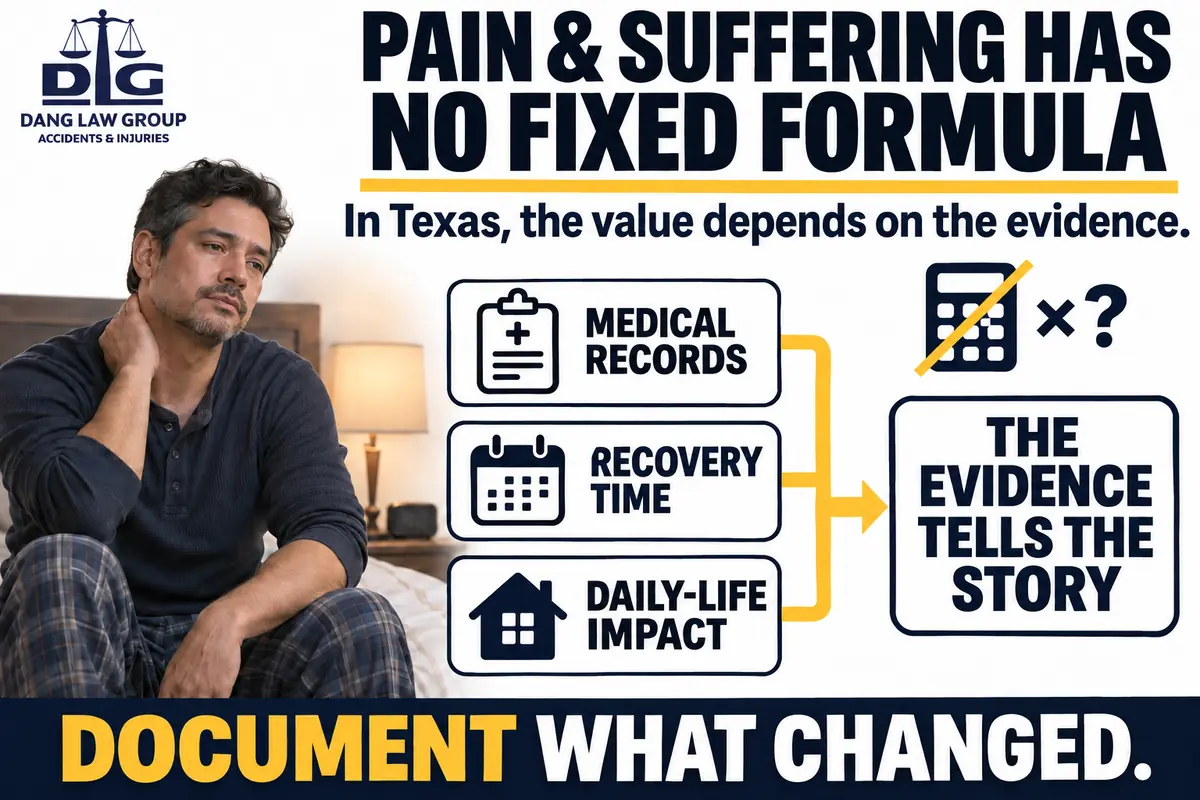
No Texas statute sets a formula for calculating pain and suffering. Lawyers, adjusters, and juries look at the injury, the treatment, the length of recovery, and how your daily life changed. They then reach a figure the evidence can support. Two methods appear on almost every website, but neither one is a legal rule:
- The multiplier method: Economic damages, usually medical bills, are multiplied by a number such as 1.5 or 3. If your medical bills were $10,000 and someone applied a multiplier of 2, the illustration would produce $20,000. That is arithmetic, not a valuation.
- The per diem method: A daily rate is assigned to each day of pain until maximum medical improvement, which is the point where your doctor expects no further significant recovery. At an illustrative rate of $100 a day for 90 days, the figure would be $9,000.
Some insurers use claims software that scores injuries based on the codes in your medical records. That internal score may shape the first offer. It does not bind you, and it cannot capture what the records leave out, like the hobby you had to give up.
Courts also push back on arbitrary numbers. In Gregory v. Chohan (2023), the Supreme Court of Texas said a noneconomic damages award needs a rational connection to the evidence of the injury. The court also criticized arguments that tie the amount to unrelated figures. In practice, the stronger your proof, the more weight these damages tend to carry.
Key point
A multiplier or daily rate is an illustration used online and in negotiation, not Texas law, and no insurer or court is bound by it.
Pain and Suffering Settlement Examples: Five Hypothetical Texas Cases
The examples below show how individual facts can change value. They are not real cases, not past results, and not a prediction of what your claim is worth. Each one involves an ordinary car crash in the Austin area.
| Scenario | What happened | How it may affect pain and suffering |
|---|---|---|
| Quick recovery | Rear-ended at a light; neck strain, an ER visit, and eight weeks of physical therapy; full recovery | Short duration and full recovery usually keep the value toward the lower end |
| Same injury, delayed care | Same crash and injury, but no doctor visit for ten weeks | The insurer may argue the pain came from something else, so the value is often disputed |
| Surgery and impairment | Broken wrist repaired with surgery and hardware; a guitarist cannot play for six months | Surgery, a visible scar, and lost activities may support a higher figure |
| Permanent injury | Herniated disc, spinal injections, and lasting restrictions documented by a doctor | Future pain and permanent impairment often carry the most weight |
| Shared fault | Same facts as the permanent injury case, but the injured driver is found 30 percent responsible | Total damages are reduced by 30 percent under Chapter 33 |
The first two scenarios teach the clearest lesson. The injury is identical in both, but the ten-week gap gives the insurer room to question whether the crash caused the pain at all. The last two show a different problem: strong medical proof can still be reduced by a finding of shared fault.
Timing matters too. Claims involving a permanent injury often take longer, because it may not be clear how much future care you need until treatment settles. Our guide on how long a Texas car accident settlement can take explains why waiting for maximum medical improvement is common.
What Factors Make Pain and Suffering Worth More or Less?
No single factor decides the outcome. These tend to move the number in one direction or the other:

If you have suffered injuries, call Attorney Dang to give the insurance companies a Bang!

- Severity of the injury: Fractures, surgeries, and nerve damage generally weigh more than soft-tissue strains that heal in a few weeks.
- Length of recovery: Pain that lasts for months, or that your doctor expects to continue, usually carries more value than pain that resolves quickly.
- Permanency: A lasting limitation, scar, or loss of function may support damages for future physical impairment and disfigurement.
- Consistent treatment: Regular visits and following your doctor’s plan help connect your pain to the crash, while gaps and missed appointments invite doubt.
- Impact on daily life: Missing your child’s games, giving up running, or needing help with chores count as real losses when someone can describe them.
- Pre-existing conditions: An old back injury does not erase a claim, but the insurer may argue the crash only made things slightly worse.
- Credibility: Records, photos, and witnesses that tell the same story you do tend to make noneconomic damages easier to support.
- Available insurance: In practice, a settlement is often limited by the at-fault driver’s policy limits, even when your losses are larger.
How Much Is Pain and Suffering Worth If You Were Partly at Fault?
Texas follows modified comparative fault. Under this rule, found in Chapter 33 of the Civil Practice and Remedies Code, your damages are reduced by your percentage of responsibility for the crash. If you are found more than 50 percent responsible, you generally cannot recover at all.
Here is how the math works in an illustration where a jury finds total damages of $100,000, including pain and suffering:
- 20 percent responsible: Recovery would be reduced to $80,000.
- 50 percent responsible: Recovery would be reduced to $50,000.
- 51 percent responsible: Recovery would generally be barred.
Fault is not the only thing that can shrink this part of a claim. Common mistakes include:
- Waiting to see a doctor: Insurers often read a delay as a sign that the injury was minor or unrelated to the crash.
- Downplaying your pain: Saying “I’m fine” at the scene or during a recorded call can be quoted back to you later.
- Posting on social media: A photo from a barbecue may be used to suggest you were not hurting, even if you left early.
- Accepting the first offer: Once you sign a release, you generally cannot reopen the claim if your pain turns out to be long-term.
This is where experienced guidance matters. At Dang Law Group, our attorneys review how your medical records, the fault evidence, and the available coverage fit together before any number is discussed. That way, you can make each decision with a clear picture of the risks.
Is There a Cap on Pain and Suffering in a Texas Car Accident?
In an ordinary Texas car accident claim against a private driver, there is generally no statutory cap on pain and suffering. Caps apply in specific situations. Examples include medical malpractice claims under Chapter 74 of the Civil Practice and Remedies Code and claims against government entities under the Texas Tort Claims Act, found in Chapter 101. Exemplary damages are limited separately under Chapter 41. These are damages meant to punish serious wrongdoing rather than to compensate you.
If a government vehicle or a medical provider is involved, the rules can change. You can read more about which Texas damage caps may apply to your claim. Even when no cap applies, the practical ceiling is often the amount of insurance available.
How Can You Document Pain and Suffering After a Car Accident?
Because pain and suffering has no bill attached, your records have to tell the story. These steps can help:
- Get checked earlySee a doctor as soon as you can after the crash, even if you only feel sore, and describe every symptom.
- Follow the treatment planKeep your appointments and finish therapy. If you have to stop, write down why, such as cost or a work conflict.
- Keep a pain journalNote your pain level, sleep, medications, and anything you could not do each day. Short daily entries are more credible than a summary written months later.
- Photograph visible injuriesTake pictures of bruises, stitches, casts, and scars over time to show how you healed or what marks remain.
- Ask others to noticeFamily, coworkers, and friends can describe changes in your mood, energy, and activities.
- Be careful with adjustersStick to the facts, and avoid guessing about your recovery in a recorded statement.
Frequently Asked Questions
What is the average pain and suffering settlement in Texas?
There is no reliable average pain and suffering settlement for Texas. Most settlements are confidential, and the figures published online mix different states, injuries, and insurance limits. A number that fits a permanent spinal injury tells you little about a sprain. Your own records, fault picture, and available coverage are better guides than any average.
How long do you have to file a pain and suffering claim in Texas?
Most Texas personal injury lawsuits, including claims for pain and suffering after a car accident, must be filed within two years under §16.003 of the Civil Practice and Remedies Code. This deadline is called the statute of limitations. Some situations, such as claims involving minors or government entities, follow different rules, so it helps to check your timeline early.
Is a pain and suffering settlement taxable?
Under federal tax rules, compensation for a physical injury, including pain and suffering, is generally not treated as taxable income. Some portions can be taxable, such as interest or damages for emotional distress unrelated to a physical injury. Because the outcome depends on how a settlement is structured, a tax professional can confirm how yours is treated.
Key takeaways
- Pain and suffering is a type of noneconomic damages under Chapter 41 of the Texas Civil Practice and Remedies Code, covering losses such as physical pain, mental anguish, physical impairment, and disfigurement.
- Texas has no official formula for pain and suffering, and the multiplier and per diem methods are illustrations rather than legal rules.
- Two car accident claims with the same injury can be valued very differently depending on treatment gaps, permanency, and documentation.
- Under modified comparative fault in Chapter 33, damages are reduced by the injured person’s share of responsibility and are generally barred above 50 percent.
- Ordinary Texas car accident claims against private drivers generally have no cap on pain and suffering, while medical malpractice and government claims follow separate limits.
- Most Texas personal injury lawsuits must be filed within two years under §16.003 of the Civil Practice and Remedies Code.
Legal sources
- Texas Civil Practice and Remedies Code, Chapter 41 (Damages).
- Texas Civil Practice and Remedies Code, Chapter 33 (Proportionate Responsibility).
- Texas Civil Practice and Remedies Code, Chapter 16 (Limitations).
- Texas Civil Practice and Remedies Code, Chapter 74 (Medical Liability).
- Texas Civil Practice and Remedies Code, Chapter 101 (Tort Claims).
Hurt in an Austin Car Accident? Talk to Dang Law Group
Pain and suffering is often the largest and most disputed part of an injury claim, and a first offer may not reflect what your records show. Before you sign a release, it can help to have someone review the medical evidence, the fault picture, and the insurance available.
Dang Law Group works with clients in English and Spanish at our North Austin office, 11442 N Interstate Hwy 35, Austin, TX 78753, and our South Austin office, 2512 South IH 35, Suite 250, Austin, TX 78704. Reach out today to take the first step.
Information verified by lawyer Loc Dang
Loc Dang is a founder and member of our legal team. In this blog, Attorney Dang shares his expertise to guide accident victims.
CONTACT US
Where are we?
North Austin: 11442 N Interstate Hwy 35, Austin, TX 78753.South Austin: 2512 South IH 35, Suite 250, Austin TX 78704
You can contact us 24 hours a day if you have been in an accident and need legal help to fight for the maximum compensation you are legally entitled to. If you fill out this form , someone from our team will contact you.
 9 to 5pm
512-973-8997
