

Loc Dang 9 Nov 2026
Who Is Liable in a School Bus Accident in Texas?
The call comes in the middle of the afternoon. Your child’s school bus was in a crash on the way home, and now you are in an emergency room waiting area wondering who is responsible. Maybe you were a rider on a CapMetro bus when it slammed on its brakes. Or maybe you were the driver whose car was clipped by a bus that never stopped.
Texas law has specific rules about bus crashes, and those rules depend heavily on who owns the bus. A public school bus or a CapMetro bus is run by a government entity. That brings special deadlines and limits on damages that do not apply to an ordinary car crash. Knowing which rules apply to you can shape every step that follows.
Who Is Liable for a School Bus Accident in Texas?
Short answer
Liability for a school bus accident in Texas depends on who owns and operates the bus. Public school districts and CapMetro are governmental units, so claims generally go through the Texas Tort Claims Act, with notice deadlines and damage caps. Private schools, charter companies, and contractors are generally held to ordinary negligence or common carrier rules.
A governmental unit is a public body, such as a school district, a city, a state university, or a transit authority. These bodies are generally protected by sovereign immunity, which is the legal rule that shields the government from lawsuits unless a statute allows them. The Texas Tort Claims Act is the statute that opens a limited door for injury claims.
The bus operator is not always the only party involved. Depending on the circumstances, responsibility may be shared with another driver who cut off the bus, a company that maintained it, or a manufacturer whose part failed. Sorting out who actually ran the bus and who contributed to the crash is often the first job of an Austin bus accident lawyer, because each party may follow a different set of rules.
| Bus type | Who usually answers for the crash | Rules that typically apply |
|---|---|---|
| Public school bus | The school district, or a private contractor if one runs the route | Texas Tort Claims Act notice deadline and damage caps for the district |
| CapMetro bus | Capital Metropolitan Transportation Authority, or its contracted operator | Tort Claims Act framework for the authority; ordinary rules may apply to a private operator |
| University shuttle | The university or the transit operator running the route | Depends on who operates it; public university claims generally fall under the Tort Claims Act |
| Private school bus | The private school or its transportation vendor | Ordinary negligence and the standard two-year deadline |
| Charter or tour bus | The charter company and its driver | Common carrier duty of high care toward passengers |
How Does the Texas Tort Claims Act Apply to a School Bus or CapMetro Crash?
The Texas Tort Claims Act, found in Chapter 101 of the Texas Civil Practice and Remedies Code, waives immunity in limited situations. One of them is injury that arises from the operation or use of a motor-driven vehicle by a government employee acting within the scope of their job, when the employee would be personally liable under Texas law.
School districts get even stronger protection than most public bodies. Under the Act, the only injury claims that generally reach a school district are those involving motor vehicles. That is why a bus crash is one of the few situations where you may be able to bring an injury claim against a public school district at all.
Capital Metro is a transit authority created under Chapter 451 of the Texas Transportation Code. It is generally treated as a governmental unit, so claims against the authority itself typically follow the Tort Claims Act. Several practical points follow from this:
- The crash must involve driving the bus: Courts generally look for a link between the injury and how the vehicle was actually operated, such as speeding, a sudden stop, or an unsafe turn.
- The driver must have been on the job: The employee generally has to be acting within the scope of their employment when the crash happens.
- No exemplary damages: The Act does not authorize exemplary damages, which are extra damages meant to punish the wrongdoer rather than repay your losses.
What Are the Damage Caps in a Texas School Bus Accident?
The Tort Claims Act limits how much a governmental unit can be required to pay. These limits are ceilings, not a measure of what any claim is worth. Your actual recovery, if any, typically depends on the evidence, your injuries, and who else shares fault.
| Type of governmental unit and claim | Maximum liability |
|---|---|
| Local government (such as a school district): bodily injury, per person | $100,000 |
| Local government: bodily injury, per occurrence | $300,000 |
| Local government: property damage, per occurrence | $100,000 |
| State government or municipality: bodily injury, per person | $250,000 |
| State government or municipality: bodily injury, per occurrence | $500,000 |
| State government or municipality: property damage, per occurrence | $100,000 |
The per occurrence cap matters most when many people are hurt in one crash, which is common with buses. If a bus carrying dozens of students crashes, every injured child’s claim against the district may share the same per occurrence limit. When other parties, like a negligent driver or a private contractor, also played a role, their insurance is generally not limited by these caps.
What Is the Notice Deadline for a Claim Against a School District or CapMetro?
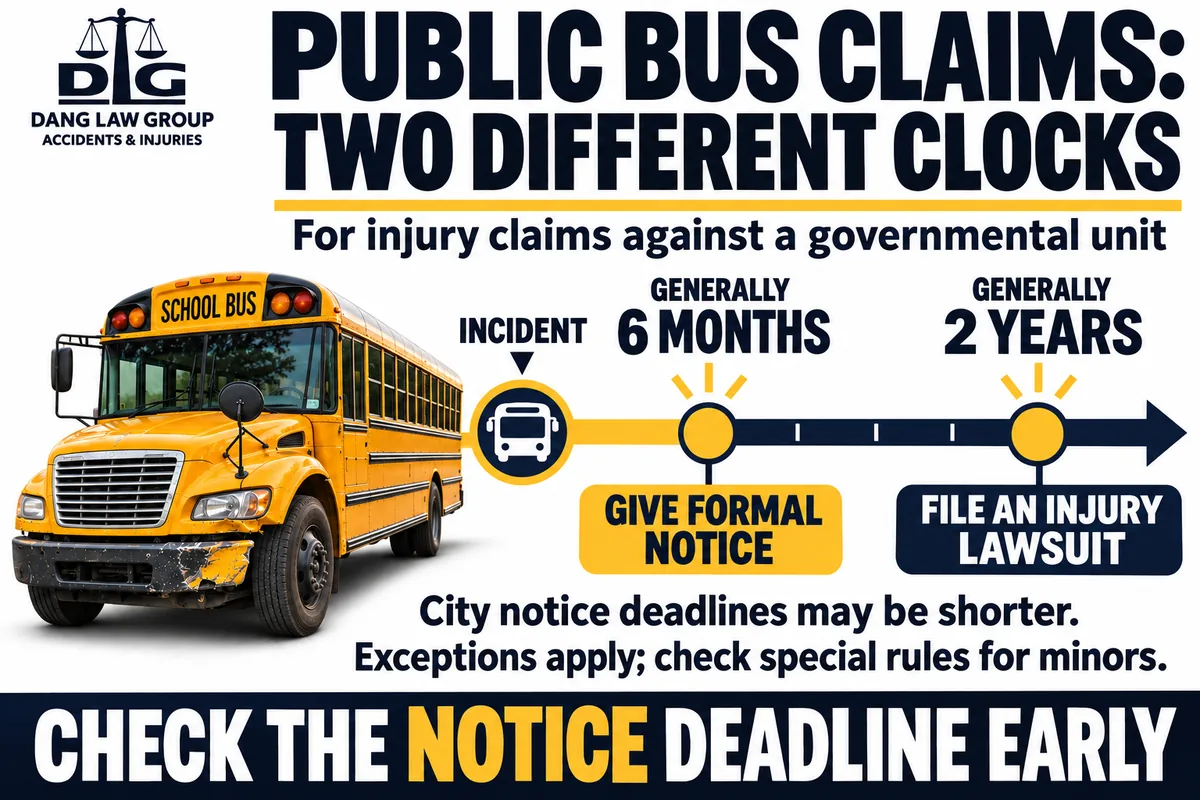
Under the Texas Tort Claims Act, you generally must give the governmental unit formal written notice of your claim within six months after the incident. The notice typically needs to describe the injury or damage, the time and place of the crash, and the incident itself. A city charter or ordinance may set a shorter deadline for claims against that city, so the window can be tighter than six months.
Key point
Against a public bus operator, the formal notice deadline may arrive long before the two-year deadline to file a lawsuit.

If you have suffered injuries, call Attorney Dang to give the insurance companies a Bang!

The usual statute of limitations, the deadline to file a lawsuit, is two years for most personal injury claims under Texas Civil Practice and Remedies Code §16.003. The notice requirement is separate and comes first. There is a narrow exception when the governmental unit already had actual notice, meaning it actually knew about the injury and its possible role in causing it. Relying on that exception is risky, because whether it applies depends on the facts.
How Is Liability Different for Private, Charter, and Shuttle Buses?
Private bus companies do not enjoy sovereign immunity. A charter coach, a tour bus, or a private airport shuttle is typically a common carrier, which is a business that transports the public for a fee. Texas courts generally hold common carriers to a high degree of care toward their passengers, a stricter standard than the ordinary care expected of a regular driver.
Shuttles are where ownership gets confusing. Picture a campus shuttle that clips your parked car and keeps going. Before you can file anything, you need to know who ran that vehicle:
- A public university: Claims may fall under the Tort Claims Act, with state-level caps and the six-month notice rule.
- A transit authority under contract: The authority, its private operator, or both may be involved, and each may follow different rules.
- A private company: Ordinary negligence rules and the company’s commercial insurance generally apply.
The route number, the time, the stop location, and any logo on the vehicle can help identify the operator. This is the kind of detective work where experienced counsel matters. At Dang Law Group, identifying every operator and insurer early is often the first step in a bus case, because the deadlines can differ for each one.
What If Your Child Was Hurt Getting On or Off the Bus?
Many school bus injuries happen outside the bus. Under Chapter 545 of the Texas Transportation Code, drivers generally must stop when a school bus is stopped and operating its visual signals, such as flashing red lights, to load or unload children. A driver who passes a stopped bus and hits a child may be liable for the injuries, separate from any claim against the district.
The area around schools brings its own rules, which are covered in our guide to liability when children are hurt in Texas school zones. For minors, Texas law generally pauses the two-year lawsuit deadline until the child turns 18. Do not assume the same pause applies to the six-month Tort Claims Act notice, and ask a lawyer about your child’s situation early.
What Should You Do After a Bus Accident in Austin?
Whether you were a passenger, a parent, a pedestrian, or a driver hit by a bus, these steps may help protect a future claim:
- Get medical care firstHave everyone checked, including children who say they feel fine. Some injuries show symptoms hours or days later.
- Call the policeOfficers typically complete a Texas Peace Officer’s Crash Report, known as the CR-3, which records the vehicles, drivers, and initial observations. You can typically request a copy through TxDOT.
- Write down the bus detailsNote the bus number, route, operator name or logo, driver name, and the exact time and place.
- Ask for the video to be preservedMany buses carry interior and exterior cameras. Footage may be overwritten after a period of time, so a written preservation request sent quickly can matter.
- Collect witness contactsOther passengers, parents at the stop, and nearby drivers may remember details you missed.
- Track the notice deadlineIf a school district, CapMetro, or a city may be involved, mark the six-month notice window on your calendar from the day of the crash.
When These Rules May Not Help You: Common Mistakes and Exceptions
Honest limits matter here, because a bus claim can fail for reasons that have nothing to do with how badly you were hurt. Watch for these issues:
- Injuries not tied to driving: A fight between students or a supervision problem on a parked bus may not count as operation or use of a vehicle, so the Tort Claims Act may not apply.
- Assuming the wrong defendant: If a private contractor drove the bus, the claim may follow ordinary negligence rules instead of the Act.
- Your own share of fault: Under modified comparative fault in Chapter 33 of the Civil Practice and Remedies Code, your recovery is reduced by your percentage of fault, and you generally recover nothing if you are found more than 50 percent responsible. You can read more in our article on recovering damages when you were partly at fault in Texas.
- Giving a recorded statement too soon: An adjuster for a bus company or a government risk pool may ask questions before you understand your injuries. You can generally decline until you have advice.
Frequently Asked Questions
Is there an average settlement for a school bus accident?
There is no reliable average settlement for a school bus accident. Each claim depends on the injuries, medical costs, lost income, and evidence. When a school district is responsible, Tort Claims Act caps limit what the district can pay, while other at-fault parties, such as a negligent driver, may carry separate insurance that is not capped.
Can you sue the bus driver personally in Texas?
Usually, claims against a public bus driver are handled through the governmental unit. The Texas Tort Claims Act contains an election of remedies rule, which generally means suing the government entity can bar a separate suit against its employee for the same incident. Private bus drivers and their employers follow ordinary negligence rules instead.
Do you need a school bus accident attorney for a minor crash?
Not every bus crash requires a school bus accident attorney. Even so, a short consultation may be worth it when a government entity is involved, because the six-month notice rule and damage caps differ from a normal car claim. A lawyer can typically confirm who operated the bus and which deadlines apply to you.
Key takeaways
- Liability after a school bus accident in Texas generally depends on who owns and operates the bus, not on the type of vehicle alone.
- Claims against public school districts and CapMetro generally fall under the Texas Tort Claims Act in Chapter 101 of the Civil Practice and Remedies Code.
- The Texas Tort Claims Act generally requires formal written notice within six months of the incident, and some cities set shorter deadlines.
- Local governments such as school districts generally face caps of $100,000 per person and $300,000 per occurrence for bodily injury claims.
- Private charter and tour bus companies are typically treated as common carriers and are held to a high degree of care toward passengers.
- Under Texas modified comparative fault, an injured person found more than 50 percent responsible generally recovers nothing.
Legal sources
- Texas Civil Practice and Remedies Code, Chapter 101 (Tort Claims).
- Texas Civil Practice and Remedies Code, Chapter 33 (Proportionate Responsibility).
- Texas Civil Practice and Remedies Code, Chapter 16 (Limitations).
- Texas Transportation Code, Chapter 545 (Operation and Movement of Vehicles).
- Texas Transportation Code, Chapter 451 (Metropolitan Rapid Transit Authorities).
- Common carrier duty of care (Texas common law doctrine).
Hurt in a School Bus or CapMetro Accident? Talk to Dang Law Group
A bus crash can leave you with medical bills, missed work, and a frightened child, all while a government deadline quietly runs in the background. You do not have to work out the notice rules, the caps, and the question of who ran the bus on your own. Dang Law Group, led by attorney Loc Dang, helps injured people across Austin in English and Spanish from offices in North and South Austin. Reach out today to talk through what happened and learn your options. Asking questions is the first step.
Information verified by lawyer Loc Dang
Loc Dang is a founder and member of our legal team. In this blog, Attorney Dang shares his expertise to guide accident victims.
CONTACT US
Where are we?
North Austin: 11442 N Interstate Hwy 35, Austin, TX 78753.South Austin: 2512 South IH 35, Suite 250, Austin TX 78704
You can contact us 24 hours a day if you have been in an accident and need legal help to fight for the maximum compensation you are legally entitled to. If you fill out this form , someone from our team will contact you.
 9 to 5pm
512-973-8997
