

Loc Dang 6 Nov 2026
Who Is at Fault in a Rear-End Collision in Texas?
You are stopped at a red light on Lamar Boulevard when you hear tires skid behind you. A second later, your car jolts forward. Or maybe you were the driver in back, and the car ahead slammed on its brakes for no reason you could see. Either way, the same question follows you home: who is at fault in a rear-end collision, and is it always the driver in back?
Texas law has specific rules about following distance, sudden stops, and how fault is divided between drivers. In most crashes the rear driver carries most of the blame, but not in every case. This guide walks you through when the general rule applies, when it does not, and how evidence can change the picture. If you are already dealing with an insurance claim, our overview of rear-end accident claims in Austin explains how these cases are typically handled.
Who Is at Fault in a Rear-End Collision in Texas?
Short answer
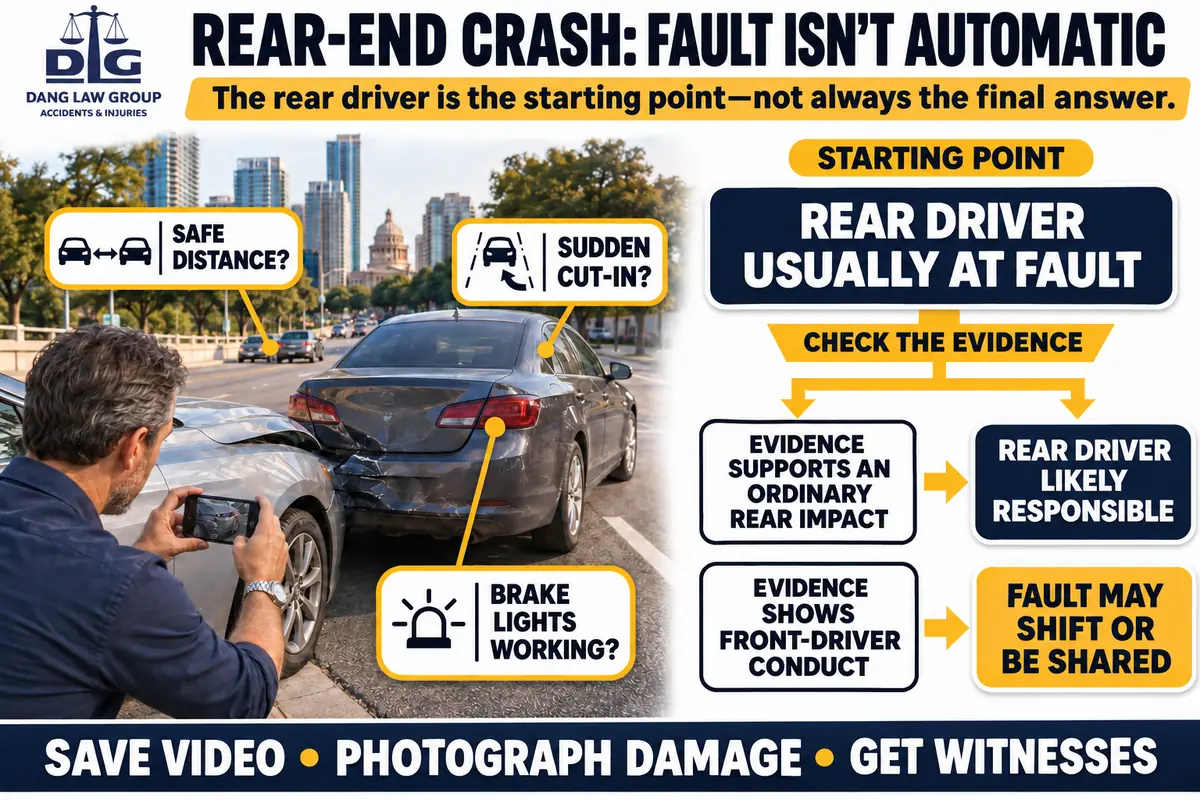
In Texas, the rear driver is usually found at fault in a rear-end collision because state law requires every driver to keep a safe following distance. That is a strong starting point, not an automatic rule. A front driver who brake-checks, backs up, cuts in, or drives with broken brake lights may share some or all of the fault.
Fault, in legal terms, means responsibility for causing the crash. It usually comes down to negligence, which is the failure to use the care a reasonably careful driver would use in the same situation. Texas has no statute that automatically blames the rear driver. Instead, insurers and courts look at what each driver did in the seconds before impact.
So if you have been wondering whether you are always at fault in a rear-end collision, the honest answer is no. You are often presumed to be in practice, but the facts can shift that presumption.
Why the Rear Driver Is Usually Found at Fault
The starting point is the Texas Transportation Code, §545.062. It requires a driver following another vehicle to keep an assured clear distance, which means enough space to stop safely without hitting the car ahead, given your speed, traffic, and road conditions. When you hit someone from behind, the natural question becomes why you did not have that space.
Insurance adjusters commonly point to these rear-driver errors:
- Following too closely: Tailgating leaves too little time to react when traffic slows.
- Distraction: A glance at a phone or the radio can mean missing brake lights entirely.
- Speed for conditions: Driving at the posted limit may still be too fast in rain, fog, or heavy traffic.
- Poor vehicle maintenance: Worn brakes or tires can lengthen your stopping distance.
Rear-end crashes start from a clearer baseline than many other crash types. In an intersection crash, for example, the questions center on right of way, as our guide to fault in side-impact collisions explains.
When Is a Rear-End Collision Not Your Fault?
The front driver also has duties under Texas law. When the front driver breaks one of them, part or even all of the rear-end accident fault may shift forward. These are the situations that come up most often:
| Situation | What the front driver may have done | Texas rule involved |
|---|---|---|
| Brake-check | Stopped or slowed suddenly with no traffic reason and no chance for you to react | Transportation Code §545.105 (signaling stops) |
| Backing up | Reversed into your car in traffic or a parking lot | Transportation Code §545.415 (backing a vehicle) |
| Broken brake lights | Gave no visible warning that the car was stopping | Transportation Code Chapter 547 (vehicle equipment) |
| Unsafe lane change | Cut in so close that you had no room to stop | Transportation Code §545.060 (driving within a lane) |
| Stopping in a travel lane | Stopped without reason or warning lights, especially at night | General duty of reasonable care |
| Driving far below traffic speed | Impeded the normal flow of traffic without cause | Transportation Code §545.363 (minimum speed) |
Even in these situations, the rear driver is still expected to keep a safe distance. That is why many of these cases end with fault shared between both drivers rather than placed entirely on one. The unsafe lane change is often the strongest exception, because a driver who cuts in front of you can take away the following distance you had.
If I Get Rear-Ended, Is It My Fault?
If you were the front driver and you were stopped or slowing for traffic, you are generally not at fault. Most people asking “I was rear-ended, who is at fault?” were simply waiting at a light or in a line of cars, and the rear driver’s insurer typically accepts responsibility.
Some front-driver conduct can still be raised against you, depending on the circumstances:
- A sudden, unexplained stop: Slamming the brakes to make a point, or to cause a crash, can shift fault to you.
- Equipment problems: A burned-out brake light may let the other driver argue you gave no warning.
- A recent lane change: If you merged in just before impact, the other driver may claim you cut them off.
- Stopping where traffic does not expect it: Halting on a highway without hazard lights can draw scrutiny.
How Texas Divides Fault Between Two Drivers
When both drivers did something wrong, Texas uses modified comparative fault, set out in Civil Practice and Remedies Code Chapter 33. This system, also called proportionate responsibility, assigns each driver a percentage of the blame. Your damages are reduced by your share. If your share is greater than 50 percent, you generally cannot recover from the other driver at all. This is often called the 51 percent bar.
Here is how that may work in practice, using a simple example:
| Your share of fault | What you may recover |
|---|---|
| 0 percent | $100,000 |
| 20 percent | $80,000 |
| 40 percent | $60,000 |
| 50 percent | $50,000 |
| 51 percent | $0 |
Percentages are not fixed by a formula. Adjusters propose them during negotiation, and a jury decides them if a case goes to trial. To understand who weighs in along the way, see our explanation of how fault is determined after a Texas traffic accident.

If you have suffered injuries, call Attorney Dang to give the insurance companies a Bang!

Who Is at Fault in a Three-Car Rear-End Collision?
In a three-car rear-end collision, the middle car is often pushed into the front car by the driver at the back. In that case, the rearmost driver may be responsible for both impacts. If the middle driver was following too closely and hit the front car first, though, that driver may share fault for the first impact. The order of the impacts usually decides who pays for what, so the evidence matters even more.
Evidence That Can Change Who Is at Fault
Because the rear driver starts at a disadvantage, evidence is what turns a presumption into a fair answer. These are the pieces that tend to matter most:
- Dashcam footage: Video can show a brake-check, a cut-in, or how close the cars were.
- Brake light condition: Photos of the front car’s lights, taken before repairs, can prove or disprove a warning.
- Witness statements: Other drivers or bystanders may confirm a sudden stop or lane change.
- The crash report: The officer’s notes and diagram often carry weight with insurers, though they are not the final word.
- Damage patterns: Angled damage can suggest a lane change rather than a straight-on rear impact.
- Vehicle data: Many cars record speed and braking in the seconds before a crash.
Key point
In Texas, being the car in back is a starting point for fault, and the evidence decides how far that starting point holds.
Common Mistakes That Can Shift Fault Onto You
Whether you were in front or in back, a few early missteps can make your side of the story harder to prove:
- Apologizing at the scene: A polite “sorry” can later be framed as an admission of fault.
- Guessing in a recorded statement: Estimating speed or distance off the top of your head can be used against you.
- Repairing before documenting: Fixing brake lights or bumpers before photographing them can erase key evidence.
- Losing dashcam files: Many cameras record over old footage within days.
- Delaying medical care: Gaps in treatment can let an insurer argue your injuries came from something else.
This is where experienced guidance can make a real difference. At Dang Law Group, attorney Loc Dang and the team can help you preserve evidence, review the crash report, and respond to fault arguments from the insurer. No lawyer can promise a result, but a careful review of the facts can help make sure fault is assigned fairly.
What to Do After a Rear-End Collision in Texas
If you can do so safely, these steps can help protect your claim:
- Check for injuries and call 911Get medical help for anyone who needs it and ask for police to come to the scene.
- Photograph both vehiclesCapture the damage, the brake lights, lane positions, and any skid marks.
- Save any videoDownload your dashcam footage and ask nearby businesses about their cameras.
- Collect witness informationWrite down names and phone numbers before people leave.
- See a doctorSome injuries, such as whiplash, may not show symptoms right away.
- Be careful with the insurerStick to basic facts and avoid guessing about fault or speed.
Frequently Asked Questions
Whose insurance pays if I am rear-ended in Texas?
Texas is an at-fault state, so the at-fault driver’s liability insurance generally pays for your damages. While fault is being sorted out, your own coverage, such as collision or personal injury protection if you carry it, may help with repairs and medical bills. Your insurer may later seek repayment from the other driver’s company.
How long do I have to file a claim after a rear-end collision?
Under Civil Practice and Remedies Code §16.003, you generally have two years from the date of the crash to file a personal injury lawsuit in Texas. Insurance claims should be reported much sooner. Certain situations, such as claims against government entities, can involve shorter notice requirements, so it helps to act early.
What if the driver who rear-ended me has no insurance?
If the at-fault driver has no insurance, you may be able to turn to your own uninsured motorist coverage, if your policy includes it. You can also pursue the driver personally, although collecting may be difficult. Reviewing your policy soon after the crash can help you understand which options may be available to you.
Key takeaways
- In a Texas rear-end collision, the rear driver is usually found at fault because Transportation Code §545.062 requires an assured clear distance.
- The rear driver is not automatically at fault, because Texas has no statute that presumes fault in a rear-end crash.
- A front driver who brake-checks, backs up, cuts in, or drives without working brake lights may share fault for a rear-end crash.
- Under Texas modified comparative fault in Chapter 33, a driver more than 50 percent at fault generally cannot recover damages.
- Dashcam video, brake light photos, witness statements, and vehicle data can change how fault is assigned after a rear-end collision.
Legal sources
- Texas Transportation Code, Chapter 545 (Operation and Movement of Vehicles), including §545.060, §545.062, §545.105, §545.363, and §545.415.
- Texas Transportation Code, Chapter 547 (Vehicle Equipment).
- Texas Civil Practice and Remedies Code, Chapter 33 (Proportionate Responsibility).
- Texas Civil Practice and Remedies Code, Chapter 16 (Limitations), including §16.003.
Hurt in a Rear-End Crash? Get Answers About Fault Today
A rear-end collision can leave you with medical bills, a damaged car, and an insurer that has already decided who is to blame. You do not have to accept that answer without understanding the facts. Dang Law Group helps injured drivers across Austin review the evidence, understand how Texas fault rules apply, and decide what comes next, in English or Spanish. You can visit our North Austin office at 11442 N Interstate Hwy 35, Austin, TX 78753, or our South Austin office at 2512 South IH 35, Suite 250, Austin, TX 78704. Reach out today and take the first step toward clear answers.
Information verified by lawyer Loc Dang
Loc Dang is a founder and member of our legal team. In this blog, Attorney Dang shares his expertise to guide accident victims.
CONTACT US
Where are we?
North Austin: 11442 N Interstate Hwy 35, Austin, TX 78753.South Austin: 2512 South IH 35, Suite 250, Austin TX 78704
You can contact us 24 hours a day if you have been in an accident and need legal help to fight for the maximum compensation you are legally entitled to. If you fill out this form , someone from our team will contact you.
 9 to 5pm
512-973-8997
