
Loc Dang 19 Sep 2026
Do Pedestrians Always Have the Right of Way in Texas?
Short answer
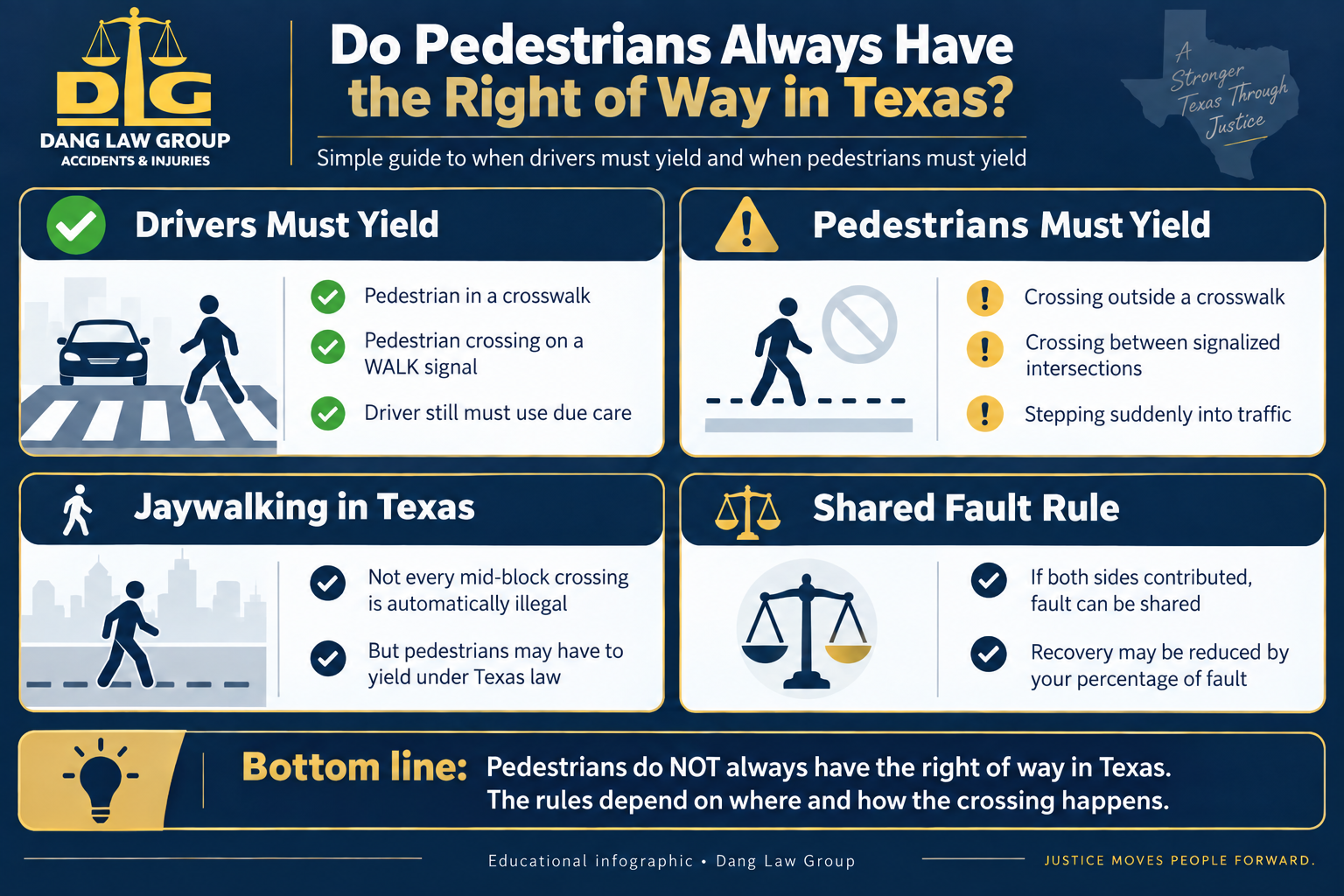
No. Pedestrians do not always have the right of way in Texas. Drivers must yield in certain crosswalk and signal situations, while pedestrians must yield when crossing outside a crosswalk. Fault depends on the specific facts of the crash.
If a pedestrian accident happens in Austin, the location of the crossing, traffic signals, visibility, driver conduct, and the pedestrian’s actions can all affect how responsibility is evaluated.
Who Has the Right of Way, the Pedestrian or the Driver?
Texas law does not give pedestrians the right of way in every situation. It depends on where the person is crossing and what the signals show. The Texas Transportation Code sets out the rules for each common scenario:
| Situation | Who must yield |
|---|---|
| Pedestrian lawfully crossing in a crosswalk | The driver must yield to the pedestrian. |
| Pedestrian crossing on a “Walk” signal | The pedestrian may cross in the direction of the signal, and drivers must yield as the law requires. |
| Pedestrian crossing outside a marked or unmarked crosswalk at an intersection | The pedestrian must yield to vehicles under Section 552.005. |
| Pedestrian suddenly steps into the path of a vehicle that is too close to stop | The pedestrian generally cannot rely on the right of way under Section 552.003(b). |
| Driver sees a pedestrian anywhere in the roadway | The driver still has a duty to exercise due care under Section 552.008. |
That last rule matters more than most people realize. Even when a pedestrian was crossing where they should not have been, a driver who had a chance to avoid the collision may still bear some share of responsibility.
When Must Drivers Yield to Pedestrians?
Texas Transportation Code Chapter 552 identifies situations in which drivers must yield to pedestrians. The exact rule depends on the type of crossing and the traffic-control signal in use.
- Crosswalk with no traffic-control signal. Under Section 552.003, a driver must stop and yield when a pedestrian is crossing in a crosswalk on the driver’s half of the roadway, or approaching closely enough from the opposite half to be in danger.
- “Walk” signal. Under Section 552.002, a pedestrian facing a “Walk” signal may cross in the direction of the signal, and drivers must yield as the statute requires.
- Green signal. A pedestrian facing a green signal may cross within a marked or unmarked crosswalk, unless the only green signal is a turn arrow.
Failing to yield can be evidence of negligence. Whether the driver is legally responsible for the crash still depends on the full facts and the conduct of everyone involved. If you are unsure what the duty to yield actually requires, it helps to understand what yielding the right of way means in Texas before assuming who was at fault.
When Must a Pedestrian Yield to Drivers in Texas?
Texas law places duties on pedestrians too. The common belief that a pedestrian always has priority is simply too broad, and in several situations the law requires the person on foot to yield:
- Crossing outside a crosswalk. Under Section 552.005, a pedestrian crossing at any point other than a marked crosswalk, or an unmarked crosswalk at an intersection, must yield the right of way to vehicles already on the roadway.
- Crossing between signalized intersections. The same section limits crossing between two adjacent intersections where traffic-control signals are operating.
- Stepping suddenly into traffic. Under Section 552.003(b), a pedestrian may not leave a curb or other place of safety and enter a crosswalk in the path of a vehicle that is so close the driver cannot reasonably stop in time.
- Ignoring pedestrian signals. Pedestrians are required to follow the pedestrian signals and traffic-control devices that apply to them.
Key point
Breaking a pedestrian traffic rule can make the pedestrian partly responsible for a crash. It does not automatically erase the driver’s responsibility.
Is Jaywalking Illegal in Texas?
Texas law does not treat jaywalking as a single blanket rule that makes every mid-block crossing unlawful. Instead, Chapter 552 sets specific duties for where and how pedestrians may cross.
Under Section 552.005, a pedestrian who crosses outside a marked crosswalk or an unmarked crosswalk at an intersection must yield to vehicles. Where two adjacent intersections have operating traffic-control signals, pedestrians must use a marked crosswalk.
Crossing outside a crosswalk does not automatically end an injury claim. If the driver also contributed to the crash, Texas proportionate-responsibility rules determine how shared fault affects recovery.
How Right of Way Can Affect a Texas Pedestrian Injury Claim
Right-of-way rules can become important evidence when responsibility is disputed after a pedestrian crash. They are not only traffic rules. They can affect how fault is allocated in a civil injury claim.
Texas uses a proportionate-responsibility system under Chapter 33 of the Texas Civil Practice and Remedies Code. If a claimant is 50 percent or less responsible, any damages awarded are reduced by that percentage. Under Section 33.001, a claimant who is more than 50 percent responsible cannot recover damages.
Suppose a pedestrian crosses outside a crosswalk while a driver is speeding and looking at a phone. If a fact finder assigns 30 percent responsibility to the pedestrian and 70 percent to the driver, the pedestrian’s damages would be reduced by 30 percent.

If you have suffered injuries, call Attorney Dang to give the insurance companies a Bang!

Learn more about Texas comparative fault and how shared responsibility can affect damages. Determining fault is only one part of a pedestrian injury claim. The next question is which insurance coverage may pay for medical bills and other losses. Learn more about who pays when a pedestrian is hit by a car in Texas, including liability insurance, UM/UIM, PIP, and other potential sources of coverage.
Drivers Still Have a Duty to Exercise Due Care
A pedestrian’s mistake does not automatically eliminate a driver’s legal duties. Under Section 552.008 of the Texas Transportation Code, a vehicle operator must exercise due care to avoid colliding with a pedestrian on a roadway, give warning by sounding the horn when necessary, and exercise proper precaution around a child or an obviously confused or incapacitated person.
A pedestrian’s own negligence does not automatically eliminate the claim. If the driver also failed to use reasonable care, responsibility can be shared.
What Evidence Can Matter After a Pedestrian Crash?
When fault is disputed, small details can matter. Useful evidence may include:
- The exact location of the crossing
- Whether the crosswalk was marked or unmarked
- The traffic or pedestrian signal in use
- Surveillance, dashcam, or nearby business video
- Vehicle speed and braking evidence
- Visibility, lighting, and weather conditions
- Witness statements
- Phone or distraction evidence when relevant
- The police report and scene photographs
An insurer may ask detailed questions about these issues when evaluating whether comparative fault applies. Statements about where the pedestrian crossed, the signal, visibility, or sudden movement can affect how the insurer evaluates fault and the claim.
Common Misunderstandings About Pedestrian Right of Way
A few beliefs about pedestrian accidents come up again and again, and acting on them can hurt a claim before it ever starts:
- “Pedestrians always have the right of way.” Not necessarily. Texas law assigns duties to both pedestrians and drivers, and which one applies depends on where and how the person was crossing.
- “If I was in a crosswalk, the driver is automatically at fault.” Not automatically. Being in a crosswalk is important evidence, but Section 552.003(b) and the surrounding facts can still affect how responsibility is divided.
- “If I was jaywalking, I cannot recover anything.” Not necessarily. Under Texas proportionate-responsibility rules, you may still recover as long as your share of responsibility does not exceed 50 percent, though your compensation may be reduced by that share.
- “The police report decides who is liable.” A police report can carry real weight as evidence, but it does not by itself determine the final allocation of legal responsibility in a civil claim.
When Should You Talk to a Lawyer?
Fault allocation can be a major issue in pedestrian injury claims, especially when an insurer argues that the pedestrian crossed outside a crosswalk, ignored a signal, or entered traffic suddenly.
A lawyer may review traffic-signal evidence, crosswalk markings, witness accounts, video, driver conduct, medical records, and insurance coverage to evaluate the issues that may affect the claim.
If you or a loved one was injured while walking in Austin, an Austin pedestrian accident lawyer at Dang Law Group can review the circumstances and explain the legal options that may be available.
Frequently Asked Questions
Can I still recover damages if I was crossing outside a crosswalk?
Yes, potentially. Crossing outside a crosswalk can reduce recovery if the pedestrian is assigned part of the responsibility, but it does not automatically bar the claim. The driver’s conduct is also considered under Texas proportionate-responsibility law.
Do pedestrians have the right of way in an unmarked crosswalk in Texas?
Texas law can recognize unmarked crosswalks at intersections. Whether a driver must yield depends on the circumstances and the applicable provisions of Chapter 552, including traffic-control signals and the pedestrian’s position in the roadway.
Key takeaways
- Texas law assigns duties to both drivers and pedestrians under Chapter 552, depending on where and how the person was crossing.
- Crossing outside a crosswalk does not bar a claim. Under Section 33.001, you may still recover if your share of responsibility is 50 percent or less.
- A driver keeps a duty of due care under Section 552.008 even when the pedestrian was crossing improperly.
Primary legal sources
- Texas Transportation Code, Chapter 552 (Pedestrians), including Sections 552.001, 552.002, 552.003, 552.005, and 552.008.
- Texas Civil Practice and Remedies Code, Chapter 33 (Proportionate Responsibility), including Section 33.001.
Know the Rule Before You Need It
Pedestrians do not always have the right of way in Texas. Drivers and pedestrians each have specific duties, and those duties can affect how responsibility is allocated after a crash.
If you were injured in a pedestrian accident in Austin and fault is disputed, Dang Law Group can review the circumstances, available evidence, insurance issues, and legal questions that may affect your claim. Contact Dang Law Group to discuss your options.
Information verified by lawyer Loc Dang
Loc Dang is a founder and member of our legal team. In this blog, Attorney Dang shares his expertise to guide accident victims.
CONTACT US
Where are we?
North Austin: 11442 N Interstate Hwy 35, Austin, TX 78753.South Austin: 2512 South IH 35, Suite 250, Austin TX 78704
You can contact us 24 hours a day if you have been in an accident and need legal help to fight for the maximum compensation you are legally entitled to. If you fill out this form , someone from our team will contact you.
 9 to 5pm
 512-973-8997
