
Loc Dang 30 Jan 2025
What Is the Two-Second Rule When Driving?
The two-second rule is a simple way to estimate a safe following distance between your vehicle and the vehicle ahead.
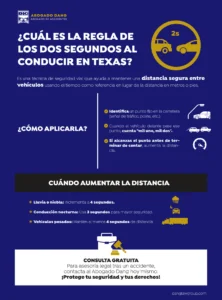
To use it, choose a fixed point on the road. When the vehicle in front passes that point, count at least two seconds before your vehicle reaches the same location. If you arrive sooner, increase your following distance.
The two-second rule is a driving-safety technique rather than a specific two-second requirement under Texas law. Texas law instead requires drivers to maintain enough distance to stop safely based on speed, traffic, and road conditions.
In rain, fog, heavy traffic, or other difficult conditions, drivers should leave more space than the basic two-second interval.
What Is the 2-Second Rule in Driving?
The two-second rule helps drivers estimate whether they are following another vehicle too closely.
Instead of trying to calculate the distance in feet, the rule measures following distance in time.
For example:
- Choose a stationary object such as a road sign, bridge, or light pole.
- Watch the vehicle ahead pass that object.
- Begin counting: “one thousand one, one thousand two.”
- Your vehicle should not reach the same object before you finish counting.
- If it does, slow down and create more space.
Because the measurement is based on time rather than a fixed number of feet, the distance naturally increases as your speed increases.
Why Is the Two-Second Rule Important?
Drivers need time to recognize a hazard, react, and stop their vehicles.
If you follow another vehicle too closely, sudden braking can leave too little time to avoid a rear-end collision.
Maintaining more space can give you additional time to respond when:
- Traffic suddenly slows;
- The vehicle ahead brakes unexpectedly;
- An object enters the roadway;
- Visibility changes;
- Another driver makes an unexpected maneuver.
Following distance becomes even more important at highway speeds because a vehicle travels much farther during the driver’s reaction time.
Is the Two-Second Rule a Texas Law?
No. Texas law does not specifically require every driver to maintain exactly two seconds of following distance.
Texas Transportation Code § 545.062 addresses following distance. It generally requires a driver following another vehicle to maintain an assured clear distance so that, considering the speed of the vehicles, traffic, and highway conditions, the driver can safely stop without colliding with the vehicle ahead.
That means the legally appropriate following distance depends on the circumstances.
The two-second rule can be used as a practical way to estimate space under favorable driving conditions, but following it does not automatically establish that a driver was complying with Texas law in every situation.
What Is the Texas Following-Distance Rule?
Texas does not use one fixed following distance for every passenger vehicle and every driving situation.
Instead, drivers are expected to leave enough space based on factors such as:
- Vehicle speed;
- Traffic conditions;
- Road conditions;
- Weather;
- Visibility;
- The type and size of the vehicles involved.
A distance that may be adequate on a dry road at a moderate speed may be insufficient during heavy rain, dense traffic, or highway driving.
This is why safe following distance should increase when conditions become more difficult.
Should You Use the Two-Second or Three-Second Rule?
Both the two-second and three-second rules are used as methods for estimating following distance.
A two-second interval provides a basic reference under favorable conditions, while leaving three seconds or more gives the driver additional reaction and braking time.
For safety, drivers should treat the two-second rule as a minimum reference rather than a distance that is appropriate in every situation.
When traffic, speed, weather, visibility, or road conditions increase the risk of a collision, leaving additional time is the safer approach.
What Is the Three-Second Rule in Driving?
The three-second rule uses the same method as the two-second rule but provides an additional second of space.
Choose a fixed object, watch the vehicle ahead pass it, and count approximately three seconds before your vehicle reaches the same point.
A longer interval provides more room to react and brake.
Many drivers may prefer three seconds or more as their normal following distance, particularly at higher speeds.
How Many Seconds Should You Stay Behind Another Car?
There is no single number that works in every situation.
Under favorable conditions, two or three seconds can be used as a basic reference. Drivers should increase that interval when conditions make stopping more difficult.
More space may be appropriate when:
- Roads are wet or slippery;
- Visibility is limited;
- Traffic is unpredictable;
- You are driving at highway speeds;
- You are following a motorcycle;
- You are following a truck or bus;
- Your vehicle is carrying a heavy load.
The goal is not simply to count a particular number of seconds. The goal is to maintain enough distance to respond safely if traffic suddenly changes.

If you have suffered injuries, call Attorney Dang to give the insurance companies a Bang!

When Should You Increase Your Following Distance?
Rain and Wet Roads
Wet pavement can reduce traction and increase stopping distance.
Drivers should reduce their speed and leave more room behind the vehicle ahead instead of relying on the normal two-second interval.
Fog or Reduced Visibility
Fog makes it harder to see stopped traffic, brake lights, road hazards, and changing conditions.
Increasing your following distance gives you more time to identify and respond to hazards.
Night Driving
Reduced visibility at night can make hazards more difficult to recognize.
Leaving additional space can give you more time to react when another vehicle brakes or an unexpected object appears in the roadway.
Heavy Traffic
Stop-and-go traffic frequently creates sudden braking.
Avoid following closely simply because another vehicle enters the space ahead of you. Adjust your speed and recreate a safe following distance.
Following Trucks and Buses
Large commercial vehicles can block your view of traffic ahead and may require substantial space to slow or stop.
Leaving additional distance improves visibility and gives you more time to respond.
If you were injured in a collision involving a commercial vehicle, learn more about our Austin truck accident lawyers.
What Happens If You Follow Another Vehicle Too Closely in Texas?
Following too closely can increase both the risk of a crash and the possibility of a traffic citation.
The issue is not whether the driver counted exactly two seconds. The relevant question under Texas law is whether the driver maintained a reasonable and sufficient distance under the circumstances.
After a rear-end collision, evidence may include:
- Vehicle damage;
- Photographs or video;
- Witness statements;
- Traffic-camera or dashcam footage;
- Vehicle speed;
- Road and weather conditions;
- Statements from the drivers;
- The police crash report.
Following too closely may be evidence considered when determining how the collision occurred, but fault depends on the complete circumstances of the accident.
Is the Rear Driver Always at Fault in a Rear-End Collision?
Not automatically.
A rear-end impact may suggest that the following driver did not leave enough space or failed to respond in time, but liability still depends on the facts.
Other circumstances may contribute to a collision, including:
- Unsafe lane changes;
- Sudden merging;
- Disabled vehicles;
- Multiple-vehicle crashes;
- Road hazards;
- Actions by other drivers.
Texas also follows proportionate-responsibility rules, so more than one person may share responsibility for an accident.
If you were injured in a rear-end crash, our Austin car accident lawyers can review the available evidence and explain the issues that may affect your claim.
Can Following Too Closely Affect an Accident Claim?
Yes.
Following distance can be relevant when insurers, attorneys, or courts evaluate how a crash happened.
For example, evidence that a driver was traveling too close to the vehicle ahead may support an argument that the driver did not leave enough room to react safely.
However, a violation or unsafe following distance does not automatically resolve every liability question. Other drivers’ actions and the surrounding circumstances may also matter.
For broader information about roadway collision claims, visit our Austin motor vehicle accident lawyers page.
How Can Drivers Avoid Following Too Closely?
A few habits can help drivers maintain safer spacing:
- Keep your attention on traffic ahead;
- Avoid using your phone while driving;
- Choose a fixed object to check your following interval;
- Leave additional space at higher speeds;
- Increase following distance in rain or poor visibility;
- Avoid tailgating even when traffic is congested;
- Leave more room behind trucks and other large vehicles;
- Recreate your following distance when another vehicle merges in front of you.
Safe following distance should change with the conditions rather than remain fixed.
Two-Second Rule: Key Takeaways
The two-second rule is a simple technique for estimating following distance.
- Under favorable conditions, a driver can choose a fixed point and make sure at least two seconds pass between the vehicle ahead reaching that point and their own vehicle reaching it.
- Texas law does not impose a universal two-second requirement. Instead, drivers must maintain sufficient distance based on speed, traffic, road conditions, and other circumstances.
- Two seconds should not be treated as a maximum. Leaving three, four, or more seconds may be appropriate when weather, visibility, speed, traffic, or vehicle size increases stopping risk.
If you were injured because another driver followed too closely or caused a rear-end collision, contact Dang Law Group for a free consultation.
If you found this article interesting, you can also read:
- How to deal with your car insurance after a crash in Austin
- How to Deal with a Rental Car Accident in Austin?
Information verified by lawyer Loc Dang
Loc Dang is a founder and member of our legal team. In this blog, Attorney Dang shares his expertise to guide accident victims.
CONTACT US
Where are we?
North Austin: 11442 N Interstate Hwy 35, Austin, TX 78753.South Austin: 2512 South IH 35, Suite 250, Austin TX 78704
You can contact us 24 hours a day if you have been in an accident and need legal help to fight for the maximum compensation you are legally entitled to. If you fill out this form , someone from our team will contact you.
 9 to 5pm
 512-973-8997