

Loc Dang 8 Nov 2026
How Long Does an Insurance Company Have to Investigate a Claim Under Texas Law?
You reported the crash to your insurance company, sent the photos, and answered every question the adjuster asked. Now the repair shop is waiting, your medical bills keep arriving, and every call ends the same way: the claim is still under review. You start to wonder whether the insurer can sit on your claim for as long as it wants.
Texas law has specific rules about how fast an insurer must move. Those rules depend on whose insurance you are dealing with. This guide walks through the insurance claim investigation timeline day by day. It also explains where the deadlines stop and what you can do when progress stalls. If the crash left you hurt, an Austin car accident attorney can help you sort out which rules apply to your claim.
How Long Does an Insurance Company Have to Investigate a Claim Under Texas Law?
Short answer
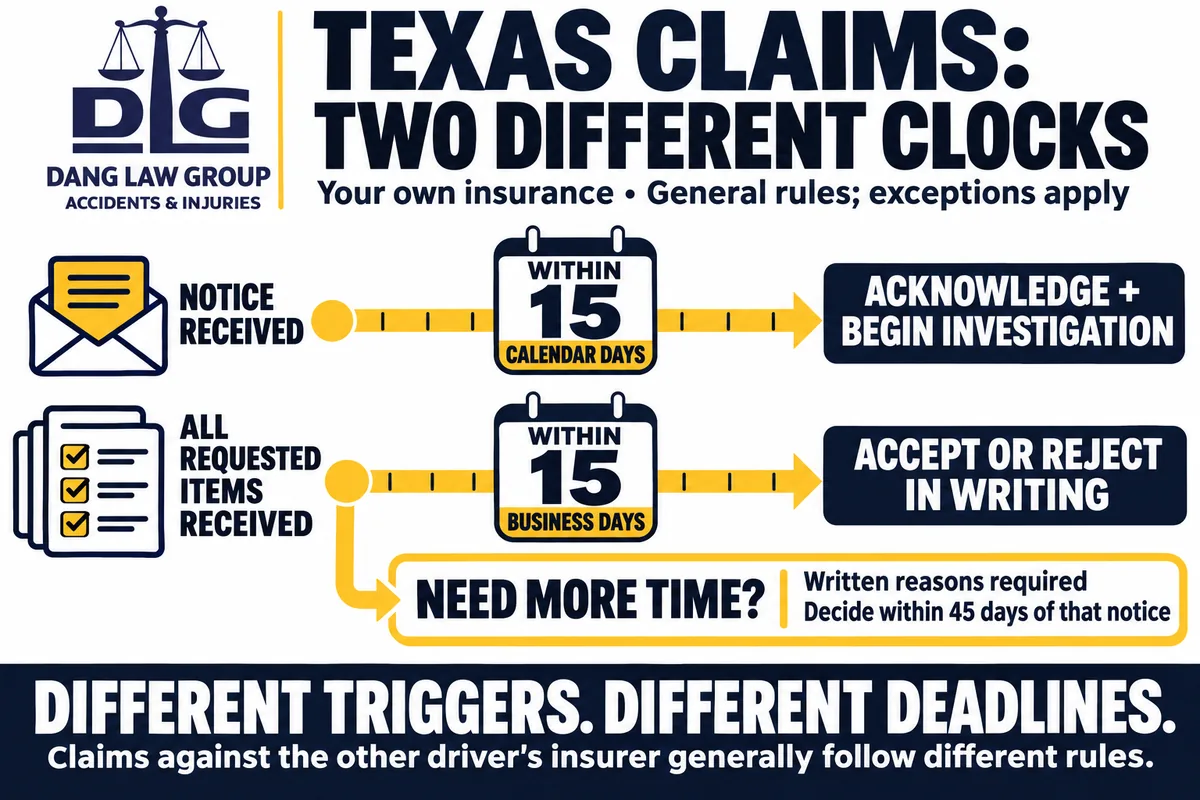
Under Texas Insurance Code Chapter 542, an insurer generally must acknowledge a first-party claim and start investigating within 15 days of notice. It then has 15 business days after receiving every document it requested to accept or reject, or up to 45 days if it explains the delay. Claims against the other driver’s insurer follow different rules.
These deadlines come from Subchapter B of Texas Insurance Code Chapter 542. Each one runs from a specific trigger point, not from the date of the crash. Here is how they generally line up:
| What the insurer must do | Deadline |
|---|---|
| Acknowledge the claim, begin investigating, and request needed documents | Within 15 days of receiving notice of the claim |
| Accept or reject the claim in writing | Within 15 business days of receiving all requested items |
| Decide the claim after notifying you it needs more time and why | Within 45 days of that notice |
| Pay a claim it has agreed to pay | Within 5 business days of notifying you |
| Pay when payment depends on something you must do | Within 5 business days of completing that step |
Notice the difference between days and business days. The acknowledgment window counts every calendar day. The decision and payment windows count only business days, so they usually run longer on the calendar.
What Is the Texas Prompt Payment of Claims Act?
The Texas Prompt Payment of Claims Act is the common name for Subchapter B of Texas Insurance Code Chapter 542, often shortened to Texas Insurance Code 542. It sets deadlines for how quickly insurers must handle a claim. The statute defines a claim as a first-party claim, meaning one you make under your own policy that the insurer pays directly to you.
The insurance claim investigation process usually moves through these stages:
- Acknowledgment: The insurer confirms it received your claim and assigns an adjuster, the person who evaluates the loss.
- Document requests: The adjuster asks for items such as the crash report, photos, repair estimates, and medical records.
- Statements: The adjuster may ask for a recorded statement. Your own policy usually requires reasonable cooperation, so it helps to understand when you can decline a recorded statement to an insurer before you agree.
- Coverage and damage review: The insurer inspects the vehicle, reviews bills, and checks whether the policy covers the loss.
- Decision: The insurer accepts or rejects the claim in writing. If it rejects the claim, Chapter 542 generally requires it to state the reasons.
Does Chapter 542 Apply to the Other Driver’s Insurance Company?
This is the point most people get wrong. Chapter 542 generally does not apply when you claim against the at-fault driver’s liability insurer. That is called a third-party claim, because you are not a party to the other driver’s policy. The insurer’s contract duties run to its own policyholder, not to you.
| Question | Your own insurer (first-party) | Other driver’s insurer (third-party) |
|---|---|---|
| Common examples | PIP, collision, uninsured or underinsured motorist coverage | Bodily injury and property damage liability |
| Chapter 542 deadlines | Generally apply | Generally do not apply |
| Who the insurer owes duties to | You, under your policy | Its own policyholder |
| Main leverage if delayed | Statutory deadlines, possible interest and fees, a state complaint | A documented demand, a state complaint, a lawsuit before the deadline |
Many people have both kinds of claims at once. You might use your own collision coverage to fix your car quickly while your injury claim against the other driver’s insurer moves at its own pace. For that injury claim, the deadline that matters most is yours. Under Texas Civil Practice and Remedies Code §16.003, you generally have two years from the date of injury to file a lawsuit, and an ongoing investigation does not pause that clock.
When Is an Insurance Delay Normal and When Is It a Warning Sign?
Not every slow claim means an insurance company is delaying a claim unfairly. Some delays are part of a careful review:
- Ongoing treatment: An injury claim is hard to value until your doctors know the full extent of your injuries.
- Disputed fault: Conflicting witness accounts or a missing police report can require more investigation.
- Several parties: Crashes involving multiple vehicles or insurers often take longer to sort out.
Other patterns may suggest the insurer is stalling. Watch for these signs:

If you have suffered injuries, call Attorney Dang to give the insurance companies a Bang!

- Repeat requests: The adjuster asks again for documents you already sent, or keeps adding requests without explaining why.
- Silence: Calls and emails go unanswered for weeks, or your file moves between adjusters with no progress.
- Missed deadlines: On a first-party claim, a Chapter 542 deadline passes with no decision and no written explanation.
- Pressure tactics: A low offer arrives with a short window to accept.
If the review ends in a denial, learn what your options are after a car accident claim denial in Texas, because a denial is not always the final word.
What Can You Do If the Insurance Company Is Slow to Respond?
If your claim has gone quiet, these steps may help you move it forward and protect your position:
- Put everything in writingFollow each phone call with a short email confirming what was said, what you sent, and the date.
- Keep a claim logRecord every contact, each adjuster’s name, and the date each document was received.
- Ask what is missingRequest a written list of items the insurer still needs. On a first-party claim, the decision clock generally runs from receipt of the last requested item.
- Ask for reasons in writingIf the insurer says it needs more time, ask it to explain why in writing.
- Escalate inside the companyAsk to speak with the adjuster’s supervisor if the claim has stalled.
- File a complaint with the Texas Department of InsuranceThe state agency that regulates insurers accepts consumer complaints about claim handling. It does not decide your claim, but insurers generally must respond.
- Get legal advice before the two-year deadlineAn attorney can review which rules apply and what remedies may be available.
This is often where experienced counsel makes a difference. At Dang Law Group, attorney Loc Dang and his team help injured Texans, in English and Spanish, track insurer deadlines and document delays. If your claim stems from an Austin crash and you are unsure which deadlines or insurer duties apply, an Austin car accident lawyer can help you review the claim and understand what to do next. On a first-party claim, an insurer that misses Chapter 542 deadlines may owe interest and reasonable attorney’s fees on top of the claim, depending on the circumstances. A slow third-party insurer may need to be pressed with a well-documented demand or, when appropriate, a lawsuit.
How Soon Do You Get Paid, and Should You Sign a Release First?
On a first-party claim, Chapter 542 generally requires payment within five business days after the insurer tells you it will pay. Third-party settlements have no matching statutory deadline. The liability insurer typically sends a release first and issues payment after you sign it. A release is a document in which you give up all further claims about the crash in exchange for the settlement money.
Key point
Once you sign a release, you generally cannot reopen the claim, even if your injuries turn out worse than you expected.
Signing before payment is common in third-party claims, so what matters is what you sign and when. Before you sign, check these points:
- The amount: Confirm the release states the exact figure you agreed to.
- The scope: Read whether it releases only the other driver or other people and companies too.
- Your treatment: Settling before maximum medical improvement, the point where doctors expect no further recovery, can leave future costs uncovered.
- Liens: A hospital may hold a lien under Texas Property Code Chapter 55, which is a legal claim against your settlement for unpaid care. Liens generally need to be resolved before funds are distributed.
When Texas Claim Deadlines May Not Protect You
Chapter 542 is useful, but it has real limits. The deadlines may not help you, or may run longer than you expect, in situations like these:
- Third-party claims: Claims against the other driver’s insurer generally fall outside Chapter 542.
- Incomplete paperwork: The decision clock generally starts only once the insurer has every item it reasonably requested, and the statute allows additional requests when the investigation needs them.
- Surplus lines insurers: Insurers that cover risks standard Texas insurers may not accept generally get longer deadlines.
- Declared disasters: Deadlines may be extended after a weather-related catastrophe or major natural disaster.
- UM/UIM claims: Uninsured and underinsured motorist coverage pays when the at-fault driver has no insurance or too little. Insurers may argue they owe nothing until fault and damages are established.
- Delays on your side: Late responses or missing records can slow progress and weaken a delay complaint.
Chapter 542 governs the insurer’s process, not the outcome. Meeting the deadlines does not mean the insurer must pay, and a missed deadline does not automatically mean you win. Texas Insurance Code Chapter 541 separately prohibits unfair claim settlement practices, such as refusing to pay without a reasonable investigation. Whether it applies depends on your circumstances.
Key takeaways
- Under Texas Insurance Code Chapter 542, an insurer generally must acknowledge a first-party claim and begin investigating within 15 days of receiving notice.
- After receiving all requested documents, a Texas insurer generally has 15 business days to accept or reject a first-party claim, or up to 45 days after explaining why it needs more time.
- Once a Texas insurer agrees to pay a first-party claim, it generally must pay within five business days.
- The Texas Prompt Payment of Claims Act generally does not apply to third-party claims against the at-fault driver’s liability insurer.
- An insurer’s ongoing investigation does not pause the two-year deadline to file a personal injury lawsuit under Texas Civil Practice and Remedies Code §16.003.
Legal sources
- Texas Insurance Code, Chapter 542 (Processing and Settlement of Claims).
- Texas Insurance Code, Chapter 541 (Unfair Methods of Competition and Unfair or Deceptive Acts or Practices).
- Texas Civil Practice and Remedies Code, Chapter 16 (Limitations).
- Texas Property Code, Chapter 55 (Hospital or Emergency Medical Services Lien).
Insurance Claim Stuck in Review? Get Help From an Austin Injury Lawyer
A stalled claim can leave you covering repairs and medical bills while the insurer takes its time. Knowing which deadlines apply, and which do not, is the first step toward getting your claim moving. Dang Law Group helps injured Texans in English and Spanish from offices in North and South Austin. Reach out today to talk through where your claim stands and what your options may be.
Information verified by lawyer Loc Dang
Loc Dang is a founder and member of our legal team. In this blog, Attorney Dang shares his expertise to guide accident victims.
CONTACT US
Where are we?
North Austin: 11442 N Interstate Hwy 35, Austin, TX 78753.South Austin: 2512 South IH 35, Suite 250, Austin TX 78704
You can contact us 24 hours a day if you have been in an accident and need legal help to fight for the maximum compensation you are legally entitled to. If you fill out this form , someone from our team will contact you.
 9 to 5pm
512-973-8997
